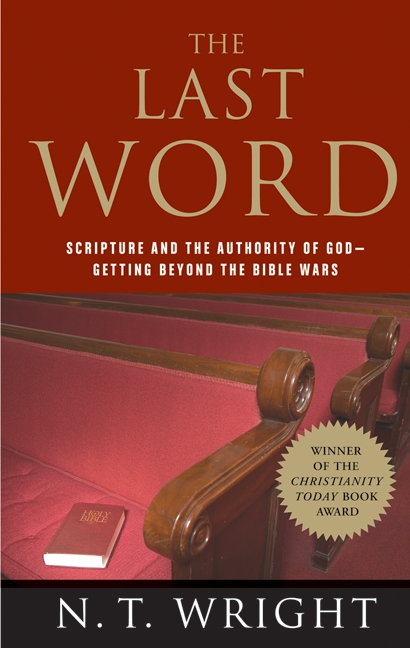
My year long study of the Doctrine of Revelation is progressing nicely and I am learning a lot. I have been steadily working my way through Carl F. Henry’s 6 volume magnum opus God, Revelation, and Authority and it has proven informative, to say the least. In conjunction with that I have been reading select other works on the doctrine to expand my knowledge and gain different perspectives. That’s where N.T. Wright’s fresh little book The Last Word: Beyond the Bible Wars to a New Understanding of the Authority of Scripture (2005) comes in. Wright is convinced that what we need to get the church beyond these so-called “Bible Wars” is a fresh look at exactly what it means to speak of the Scriptures as authoritative. He offers many helpful concepts, correctives, and insights in this book, but ultimately it is what he does not offer that proves to be a gaping whole in his project.
From Wright’s perspective both liberal and conservative theologians have misunderstood what it means to speak of Scripture as “authoritative,” and this has led to the vitriolic division that we have in the church today. The book is not as academic and certainly not as lengthy as his other works; it seems to be written primarily for church leaders. Three questions predetermine the course of the work: (1) “In what sense is the Bible authoritative in the first place?” (2) “How can the Bible be appropriately understood and interpreted?” (3) “How can its authority, assuming such appropriate interpretation, be brought to bear on the church itself, let alone the world” (18)? And so Wright proposes to us that a new definition of Scriptural authority is in order, and not so much a new one as an old one which we have forgotten. The “central claim of this book” is as follows: that the phrase “authority of scripture” can make Christian sense only if it is a shorthand for “the authority of the triune God, exercised somehow through Scripture” (23). More pointedly, Wright argues that the authority of Scripture is found in terms of “God at work powerfully through Scripture to bring about the Kingdom, by calling and shaping a new covenant people and equipping its leaders to be teachers and preachers” (64). So at the heart of our definition is the Kingdom of God, the metanarrative of Scripture, and the transformative power of the Spirit of God through Scripture. This is a different take, then, on the subject and Wright intends it to be so. He points clearly to the failure of the reductionist views of others who “reduce Scripture to a set of ‘timeless truths’ on the one hand, or to mere fuel for devotion on the other” (122). For Wright, then, the authority of Scripture lies in our understanding it as a story of God’s Kingdom-Project, and as the means by which that project is being enacted in our world. “It is enormously important,” he says, “that we see the role of Scripture not simply as being to provide true information about, or even an accurate running commentary upon, the work of God in salvation and new creation, but as taking an active part within that ongoing purpose” (30).
All of this I can agree to with a hearty amen! Wright’s contribution to the discussion of the story-line of Scripture, the progressive revelation of God’s redemptive/creative plan is unparalleled in modern scholarship (this short book doesn’t even do justice to all the contributions he has made in this area). I can affirm his definition of Scripture’s authority as God’s authority exercised through Scripture, and I can affirm his emphasis on that authority being bound up with God’s Kingdom plan. As the book continues to unfold, however, I note that there is something extremely important lacking from his book. The fact is that Wright never clarifies for us whether or not God’s Word is true. The issues of inerrancy remain at the heart of the debate between liberals and conservatives and while Wright wants to move us “beyond” these Bible wars, the fact is that by not addressing the truthfulness issue we cannot. It is, of course, somewhat intentional that he does not address this point, for he finds that the debate is bound up around this issue and believes, furthermore, that it is not the question we should be asking. He writes:
There is a great gulf fixed between those who want to prove the historicity of everything reported in the Bible in order to demonstrate that the Bible is “true” after all and those who, committed to living under the authority of scripture, remain open to what scripture itself actually teaches and emphasizes (94-5).
It is indeed true that there can be a gulf, but it is a false dichotomy to suggest (or perhaps only infer) that this gulf is necessarily present between proving the Scripture’s truthfulness and living in submission to its content. It seems that Wright’s intent is good, but his conclusion adds nothing substantial to the resolution of the “Bible Wars.”
I’ve found much to praise in the work, of course, including his attacks on the superiority and neutrality of Enlightenment rationalism, his dealing with interpretative issues (especially see his discussions on literal and non-literal interpretation), and his emphasis on the importance of the metanarrative to our understanding of and application of the Scriptures (here is where Wright excels in the book). There is no doubt that this Kingdom discussion will make its way into my own understanding and formulation of the doctrine of revelation; it is indeed, as Wright points out repeatedly, a central aspect to the Christian understanding of Scripture’s authority. Nonetheless it is the questions and the subject which Wright does not address that prove to make this book insufficient. Despite the title of the work, it is hardly the “last word” on the subject.
 Sparrow & Heart Soul Care
1 Comment