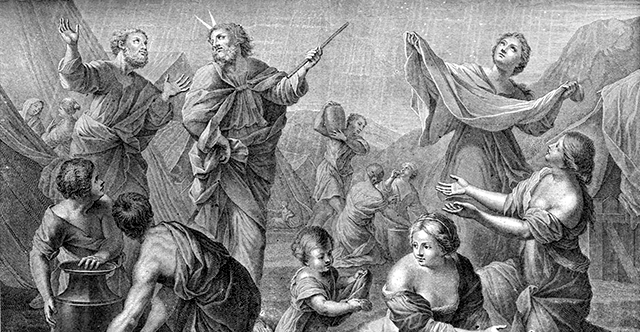
Life has a way of creating distance between faith and experience. As Christians we know that God can do all things, we know that He is trustworthy. But in the midst of trials we often wonder if He can provide what we need. In such seasons of doubt the story of Israel in the wilderness serves as an encouragement to keep trusting God. When it looks impossible, God routinely provides miracles of provision for His children.
We can be sympathetic to Israel’s anxiousness. Here they are, wandering in the wilderness with thousands of mouths to feed and no signs of food anywhere. Exodus 16 recounts the circumstances, noting that the “entire Israelite community” has left the land of Egypt. Yet, for all the reasonableness of their concern, God doesn’t interpret it as mere anxiousness about food. He hears their “complaints about him” (v. 7). After all that Yahweh had just done to free them from Egypt their lack of trust in Him is appalling. Yet, still in this setting the Lord gives them grace by means of miraculous provision.
God causes bread to rain down from heaven, which in and of itself is miraculous. But the still more remarkable provision is that each person will gather exactly what they need, no more and no less.
So the Israelites did this. Some gathered a lot, some a little. When they measured it by quarts, the person who gathered a lot had no surplus, and the person who gathered a little had no shortage. Each gathered as much as he needed to eat. (Ex. 16:17-18)
God miraculously provides. He does it again in verse 24. The people are told to gather enough on Friday so that they can eat for two days, since Saturday was the Sabbath and they were not to work that day. And, “they set it aside until morning as Moses commanded, and it didn’t stink or have maggots in it.” God’s miraculous provisions came again. And the point of this whole episode is to invite Israel to trust God.
In fact, in verses 19-20, they are expressly told not to try and save some of their bread for the future days (except on the Sabbath), but to trust that God would provide each day for their needs. The miraculous provisions were pointing them, and us, to the character of Yahweh: He is trustworthy. In fact, verse 4 expressly states that this is a test. The miracle was not merely the manna. The miracle was God’s patient commitment to teach His people how to trust Him one day at a time. The goal of these miraculous provisions is actually to increase their dependence upon God. That’s what all miraculous provisions are intended to do.
Consider your own life. While God does not always provide through supernatural signs as He did in the wilderness, He continually provides through His providential rule over every detail of our lives. Consider your own life. How many circumstances once seemed impossible that now bear the fingerprints of God’s care? Perhaps He used an earlier trial to prepare you for a present challenge. Perhaps He supplied a need through an unexpected person or opportunity. Perhaps He sustained you through a season that should have overwhelmed you. Often God’s provisions are only recognized in retrospect. What felt ordinary at the time later reveals itself as evidence of His faithful care. Whatever the circumstances, the goal is always to invite deeper trust of Him, which is what we need in the moments when, once again, we sense that only a miracle will do.
Life is full of God’s provisions and our waiting on His provisions. Sometimes that waiting can feel like an eternity, sometimes we wonder if it will ever come. In such moments Exodus 16 reminds us that God can be trusted and that we can look on His care from the past to preserve our faith in the present. God is the God of miraculous provisions. Perhaps the greatest miraculous provision is the gift of His Son.
The Cross reminds us again and again that we can trust God. Paul says plainly:
He did not even spare his own Son but gave him up for us all. How will he not also with him grant us everything? (Rom. 8:32)
This miraculous provision for sinners is the guarantee that we can trust Him with all our needs. How are you at waiting on the Lord? How are you at depending on Him? How are you at trusting that He will provide what you most need?
This of course, does not mean that God will always do what we want or relieve our struggles in the ways and times that we would like. He uses even hardships, as the Exodus itself reveals, to helps us grow. But we can count on Him to provide something when we are struggling and when we are in need. Exodus 16 encourages you to trust in Yahweh. The Cross reassures you that He is trustworthy. The wilderness is not evidence that God has abandoned His people. Often it is the very place where He teaches them that He alone is enough.

