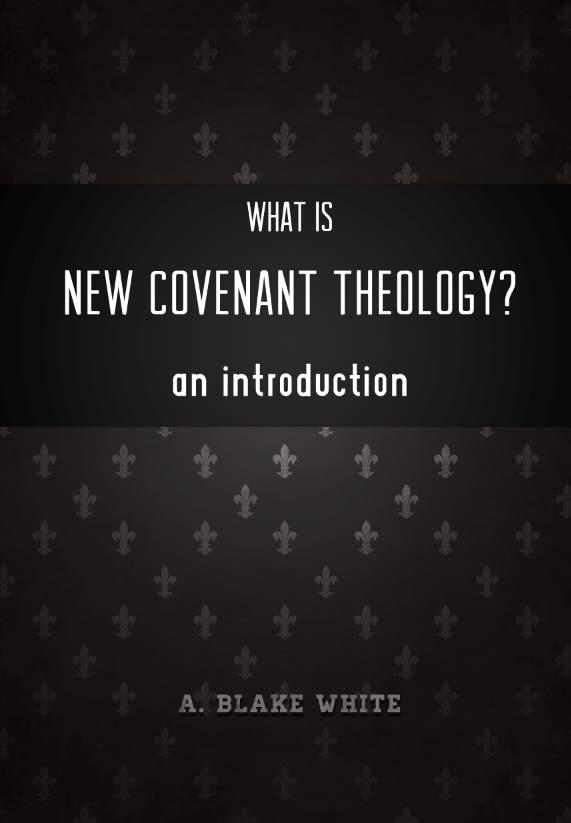
 I have a rebellious streak in me. It runs fairly deep and often works against any type of conformity. So when many of my friends began to share that they were adopting the position of New Covenant Theology I was not merely reluctant, I was opposed to it. I had accepted Covenant Theology as a young man and had determined not to study any contrary position, mostly out of spite. But I could never fully embrace Covenant Theology, there were aspects of it that, overtime, I had modified to fit better how I read the Bible and how I thought of Baptism. As it turns out, much of what I was doing was already being done and fit better in the NCT. So, when I read a book on the subject I discovered that much of what was called New Covenant Theology is what I already believed. A. Blake White’s small book What is New Covenant Theology?: An Introduction is a simple and therefore helpful clarification on the subject.
The problem with so many books on the subject of the covenants is that they wind up being very dense. For those somewhat unfamiliar with the territory the size of the book, the density of the content, and the style of the prose can be intimidating. This is the kind of subject where a helpful, concise, introduction to the major distinction and major developments of the system can be extremely helpful. As I had already bought into CT I wanted to know what the distinct differences and contributions of NCT were. A. Blake White does an astounding job of clarifying those differences without losing anything important in the development of the system. That makes this a rare book indeed.
The author was unknown to me. In fact the lack of familiarity would have likely caused me to pass right over this little booklet, but the endorsements on the back are quite astounding. Blake’s writing garnered support from the likes of Gary Long, Tom Schreiner, Stephen and Kirk Wellum, Tom Wells, John Reisinger, Jim Elliff, and Jason Myer. In each endorsement we read the same sentiment: White has written a very accessible primer on a very important subject.
The book covers seven different aspects of NCT. White explains in the introduction that he will not unpack all of the thorny issues related to this system; after all it is only an introduction. But he will cover the major differences between NCT, CT, and Dispensationalism. He also aims to highlight the major contributions of NCT to Biblical Theology.
Much of the discussion around these three systems has to do with how each of them views the continuity and discontinuity between the two testaments. White begins with the familiar distinction between systems. He states:
Generally speaking Covenant Theology emphasizes the unity between the covenants to the expense of the discontinuity…Dispensationalism, on the other hand, tends to emphasize discontinuity between the covenants at the expense of continuity…New Covenant theology accommodates both continuity and discontinuity. It holds that the new covenant is connected to what went beforehand, but it is new. (1-2)
In this sense, then, NCT acts as a via media between Dispensationalism and Covenant Theology. It offers a middle road to consider more carefully the totality of the Biblical data. None of this will be particularly new to students of the covenants. And, in fact, White’s introduction read with a bit of pretension as he proclaims NCT is “a system of theology that seeks to let the Bible inform our theology” (1). After all, don’t all systems seek to do this? The more one continues to read, however, the more one will see that in fact this is indeed a real distinct feature of NCT.
In chapters 1-7 White covers, then, the various major issues related to the continuity and discontinuity between the testaments. He starts by declaring that there has been only ever one plan of God to redeem the world, and this plan was Jesus. But this one plan, he states, beginning in the Old Testament is fulfilled in the New Testament in Jesus. So, chapter 2 turns our attention to reading the OT through the “Jesus-lens,” as I call it. Chapters 3, 4, and 5 help us then understand the role of the Old Covenant, and particularly the law, in relation to the person and work of Christ. Christians are not under the Law of Moses, the Old Covenant was temporary, and now in Christ there is, in fact, a NEW covenant. “The New Covenant really is new,” writes Blake (19). In a breathtaking use of Scripture he shows how the authors of the New Testament saw this newness. This was, in particular, where I began to see my own frustrations with CT crystalized. It does seem to me now that CT flattens the covenants, whereas NCT follows the language of the Scriptures more carefully and closely. This is what I have always believed and here it was spelled out in a helpful systematic way within NCT. Chapters 6 and 7 focus on the New Covenant community, particularly the giving of the Holy Spirit and the nature of the church as the Eschatological Israel. Here I found helpful support for positions I had already affirmed. It seems to me, after reading this little book, that I am actually closer akin to this system than I ever was to CT.
It’s not that I am fully convinced of all that NCT says. All systems have flaws and weaknesses. I have always been reluctant to go by any label, and yet most of us fall, more or less, within the boundaries of some system. It appears that I fall more within the boundaries of NCT and less within the boundaries of CT. This simple book – 50 pages – gives an incredible concise and yet theologically robust explanation and defense of New Covenant Theology. It is well worth your time as you wrestle with how best to read the unity and discontinuity between the testaments.
 Sparrow & Heart Soul Care
Dave, when does this new study begin?
Bill and Phyllis Dengler
I have a Biblical Theology class starting on Tuesday nights next week, if that’s what you’re referring to.