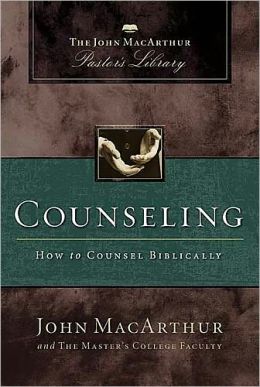
 Every discipline has its masters: Motzart and DaVinci; Jordan and Pele; Trump and Welch. When it comes to the discipline of Biblical Counseling two names that stand out for sure are John MacArthur and Wayne Mack. These men, along with others no doubt, have been on the front end of Biblical Counseling for years. In their volume on the subject they evidence both their years of experience. Counseling stands as a foundational book on the subject of Biblical Counseling.
The volume is edited by MacArthur and Mack, but its chapters are written by the various faculty of The Master’s Seminary. Each author adding an important contribution to give us a full picture of what Biblical Counseling is and isn’t. The book is broken down into four parts that cover the history, theological foundations, practice, and ministry of Biblical Counseling. In this regard the book is a thorough, formative work for those getting started in Biblical counseling, and a great refresher for those who have been in it.
The authors don’t have much sympathy for psychology. MacArthur himself begins the book with a look to the long history of tension between pastoral care and clinical psychology. He notes:
Before Freud, the study of the soul was thought of as a spiritual discipline. In other words, it was inherently associated with religion. Freud’s chief contribution was to define the human soul and the study of human behavior in wholly secular terms. He utterly divorced anthropology (the study of human beings) from the spiritual realm and thus made way for atheistic, humanistic, and rationalistic theories about human behavior. (7)
He is, perhaps, even more pointed than that when he writes:
The word psychology literally means “the study of the soul.” True soul-study cannot be done by unbelievers. After all, only Christians have the resources of comprehending the nature of the human soul and understanding how it can be transformed. The secular discipline of psychology is based on godless assumptions and evolutionary foundations and is capable of dealing with people only superficially and only on the temporal level.
John Street states that the “historical distrust and innate hostility between psychology and theology exist because each calls into question the legitimacy of other’s [worldview]” (31-32). The worldview of modern psychology, they tell us, includes features like the innate goodness and morality of man, the solution to our problems lies within ourselves, and deep-seated personal problem can really only be handled by trained experts. The Bible disagrees with each of those notions rather vociferously. The Bible calls all men sinners, calls all men to look to Christ and to His Spirit for the needed help to change, and calls all the church to counsel one another from the Scriptures. Modern psychology, they say, says that the Bible, if it is helpful at all, is completely insufficient in itself to provide man with what he needs to care for his soul. Modern psychology, MacArthur says, “Has diminished the church’s confidence in Scripture, prayer, fellowship, and preaching as means through which the Spirit of God works to change lives” (4).
The authors of course recognize that some value can be found in different studies, evidence of God’s common grace. And that people are complex creatures whose physical, spiritual, emotional, social, and mental well-being are all interrelated. Meaning that, sometimes a physical malady may be the cause of an emotional problem. Other times, however, they note that it may be a spiritual problem. At the heart of the book is an assumption that in fact most of our problems are in fact theological problems.
The book is, then, a defense of and articulation of this view of counseling. Part 2 addresses four major points that make up the foundation of Biblical counseling: the sovereignty of God, the sinfulness of man, the work of the Spirit, and the nature of the spiritual disciplines. Here the authors compose a theology of Biblical counseling that recognizes God’s control over all things, man’s greatest need and inability to fix himself, and the dual roles of the Spirit’s work in believers, and their own faithfulness to attend to the disciplines God has outlined for their growth. This is a great place to start in thinking through the specifics of why Biblical counseling is important and what marks it out as unique.
Part three is solely written by Wayne Mack. Mack is an experienced practitioner and professor of Biblical counseling. He devotes himself in part three to addressing the nuts and bolts of doing this kind of work. The practicality of this part of the book cannot be overstated. It would serve many Biblical counselors well both in starting out and in years to come as a reminder. Mack addresses everything from developing healthy relationships with counselees to interpreting the information you gather in a counseling session. He discusses giving hope, collecting data, interpreting that data, giving instruction, and leading people to change. He deals in these chapters both with pedagogy and compassion. In fact, I would go so far as to say that these seven chapters are worth the price of the book.
Finally part four connects Biblical Counseling to the local church. Counseling, they argue, is discipleship and the church is the primary means of that discipleship in a believer’s life. So William Goode writes:
Counseling must never be thought of as a weekly hour of magic, or an independent ministry conducted aside from the church. Preaching, teaching, evangelism, discipleship, and counseling are all integral parts that make up effective, biblical ministry. The local church is the instrument Christ ordained to help believers grow into His likeness. It is the only organization – or better, organism – He promised to build, sustain, and use. Counseling is an essential part of the local church’s ministry as it disciples and helps believers mature in Christ’s image. (223)
Goode does an excellent job of making this case, and the authors strongly urge every pastor and every church to take up the practice of Biblical counseling.
I recall having a wonderful conversation with a local pastor from our former town in Ohio. I asked him how he got involved in Biblical counseling and he said more often than not I saw our people struggling with life, with sin, and with hurt and going outside the church to find hope and help. I knew that something was wrong with that. Counseling provides us with the foundational tools to rediscover what the church should have been doing all along.
A Special note to friends: I recognize that some of what is said here, and some of what this book discusses, will be contentious for some of my dear friends. Those who are trained clinical psychologists, those training to become psychologists, and those who are working in counseling ministries outside of the church may be offended by some of this content. Please know that I love and respect each of you, and while we may disagree on this subject I am more than willing to have an honest conversation with you. I promise not to assume the worst of you and trust that you will do the same.
 Sparrow & Heart Soul Care
We read this when I went through my biblical counseling course a few years ago, I can’t overstate how helpful I found the book to be.
Thanks for this very helpful article. By the way, in case you might be editing the article at some point, in the first sentence, the composer you mentioned, Mozart, does not have a “t” in his name. I didn’t really want this posted, just sent to you directly. Thanks.