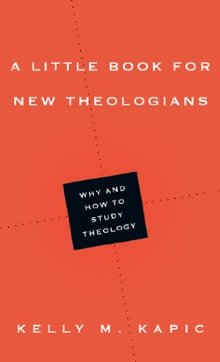
 The fact that “theology” gets such a bad wrap within the church may be owing more to the theologian than the subject itself. You see doing theology well depends on being a certain kind of theologian, and the failure to be that kind of theologian is what leads to dry, useless, and oppressive theology. As a profess of theology at Covenant College, Kelly Kapic knows this. A Little Book for New Theologians looks at some of these often overlooked principels for “doing theology.” It is the perfect tool for introducing new theologians to the discipline itself.
Kapic believes in the importance of being good theologians. He writes, “I have seen God use good theology to liberate lives. But I have also seen people misuse theology, resulting in abuse, hard hearts and pain” (9). Part of the problem, as Kapic sees it, is that we have cultivated “theological detachment” far too often. There is a disconnect between what “theology” and “life.” This little book is meant to be a shield against that development in the life of a young, budding theologian. “My prayer,” he writes, “is that this book might, in some small way, help new theologians avoid the strong dichotomies of theological detachment” (10). The book aims to guide the church into healthier theology by focusing on the theologian himself, in particular.
The short book is divided into two parts: Why Study Theology? and Characteristics of Faithful Theology and Theologians.He begins with a word about “theology” itself, pointing out that we are all theologians, and if we are Christians we can’t avoid it. “Theological reflection is a way of examining our praise, prayers, words and worship with the goal of making sure they conform to God alone” (18). All Christians are called to be theologians, and there’s no expectation that we all have PhDs in philosophy. Rather, Kapic says, “Theology is about life” (20).
He walks us through proper motivations to do theology in this first part. He points us to consider not only that theology is about living life in conformity to God’s will, but it is also about enjoying God. We do theology to know and enjoy the God who reveals himself to us. He writes: “Knowledge” in Scripture is not merely cognitive but also personal with elements of connection and commitment (24). But in a surprising, and refreshing, chapter Kapic warns us that we must think of theology as “mastering divinity.”
Theology is “always limited by at least two key realities: our finitude and our sin” (30). We are bound by these realities. And while we can understand true things about God, we can never exhaustively know God. Our knowledge is always limited and incomplete. For Kapic, this makes theology a pilgrimage. We are always on the adventure of discovering God. We are never done with the task of theology.
Part two directs us to consider more carefully the person who does theology and the proper approach he/she should take to the discipline. Each of the seven chapters in this section can be summarized by two key ideas: life and humility. Kapic is very serious about avoiding the disconnect that views theology merely as some academic discipline. Instead he wants his readers to see that “true theology is inevitably lived theology” (42). The two are very much intertwined. Bad living can affect theology, and bad theology will affect living. Readers can see this connecting clearly when they read chapter 8.
In chapter 8 in particular Kapic draws out the connections between life and theology in some profound ways. He argues that the way we care for others, particularly those in need, is evidence of just how faithful or false our theology is. He writes:
Since it speaks about God, faithful theology leads the theologian outward to consider God as he is revealed in his words and actions. Thus, theology must reflect God’s compassion and care for us and for our neighbors. If we are to pursue theology faithfully, we must contemplate the value God places on those who are most vulnerable and i need. We must be, in a word, anthroposensitive. Knowing and loving God leads us to those he loves and to think and write theology accordingly. (82)
This is an unbelievably fresh perspective on theological studies. Faithful theology is about life, and particularly it considers the issues of suffering and justice. Faithful theology is done in the context of this fallen world, next door to our hurting neighbors, and in reflection on the poor and needy. “A theology that contemplates Jesus will always be mindful of the depth of our own needs, and that should prompt us to ‘remember the poor,’ not as an optional extra but as a central aspect of our theological knowledge” (92).
In many ways this whole book is refreshing. It touches on matters of humility, repentance, prayer, reason, faith, tradition, community, and love of Scripture. It addresses issues that are far too often assumed in theological study, but rarely if ever outlined in this detail. Kapic believes that these overlooked principles are the difference in approaching theology for the health of the church and doing theology to harm of the church. I cannot recommend this volume enough. I am certain that had I read it as a young man – had it existed – I would have done far less damage to relationships, and encouraged far more people to study theology serious. A Little Book for New Theologians gives new theologians a healthy starting place and serves the church in untold, numerous ways.
 Sparrow & Heart Soul Care