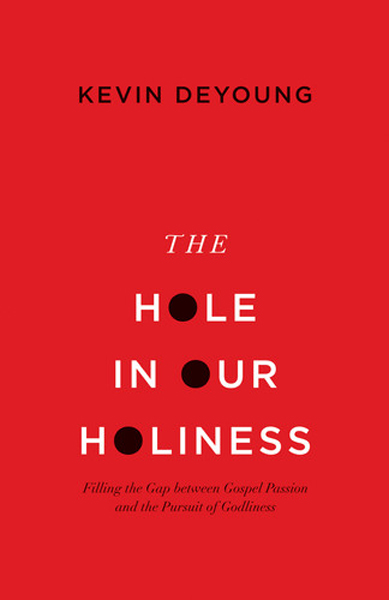
 Reading is for losers! After all, what good really comes from sticking your nose inside a book? Books just make you think critically and ruin perfectly unbalanced lives. Books make you re-think, re-consider, and repent. And who wants any of that? Not me. It’s best just to use books for things like propping up televisions, holding down papers, and making others think you’re super enlightened. I’ve decided all of this after reading Kevin DeYoung’s newest book The Hole in Our Holiness. This book struck me hard; but not because DeYoung beats his readers over the head with their unholiness, but rather because it cast sanctification in a fresh light. As a pastor and particularly as a counselor I thought this was an area in which I had generally nailed-down my theology. DeYoung challenges me not so much to rethink that theology, but definitely to rethink my articulation of that theology in some significantly profound ways.
DeYoung believes we have a holiness problem in the contemporary church. The proper focus on grace, he argues, is often unaccompanied by a proper reminder of holiness. “My fear is that as we rightly celebrate, and in some quarters rediscover, all that Christ has saved us from, we are giving little thought and making little effort concerning all that Christ has saved us to” (11). I think DeYoung is right on this point. I don’t think I had noticed it until just recently, but there is a tendency to assume that if we are going to be gospel-focused we cannot talk about obedience. As if we become anti-gospel when we call each other in the church to obey Jesus’ commands. “There is a gap between our love for the gospel and our love for godliness” (21). DeYoung wants to take aim at this “hole” and fill it with the Biblical support to back our calls to and pursuits of holiness.
He begins with placing us on firm ground for the call to holiness, saying that this is partly why God saved us. DeYoung’s writings are always packed with Scriptural references and expositions. The Hole In Our Holiness is no different in that regard. He highlights verse after verse that states that man was saved for “good works,” called to “a holy calling,” chosen “that we should be holy and blameless.” He never suggests that this is a gospel of works. But he won’t let the fear of legalism keep him from arguing for what the Bible teaches. He writes:
In all this it bears repeating that God is the one working in us, giving us the desire and ability to obey. We earn nothing. We are promised everything. But don’t be so scared of works-righteousness that you make pale what the Bible writes in bold colors. We are saved by grace through faith (Eph. 2:8). And we were created in Christ Jesus for good works (v. 10). Any gospel which purports to save people without also transforming them is inviting easy-believism. (30)
I have often feared the accusation of legalism, and feared that I would inappropriately pressure my people to their own despair. But DeYoung challenged me here to rethink my articulation of the gospel with a clear call to transformed living too. The gospel of grace leads to a pursuit of godliness.
But DeYoung doesn’t leave us just thinking in abstract theological terms either. He gives us a real practical guide for understanding what “holiness” looks like in our lives. The danger here, of course, is that we will turn holiness into a list of activities to avoid and activities to perform. He writes:
It’s all too easy to turn the fight of faith into sanctification by-checklist. Take care of a few bad habits, develop a couple good ones, and you’re set. But a moral checklist doesn’t take into consideration the idols of the hearts. It may not even have the gospel as part of the equation. (34)
Holiness is bigger than our bad habits. He also clarifies that holiness cannot be reduced to imitating the Christians of some “golden age.” You can’t just talk like the Puritans, argue like the Reformers, or dress like you’re from the 1950s and claim to be holy. Neither can we suggest that holiness is some generic brand of spirituality. There are real Biblical guides to holiness and we want to conform to those. So DeYoung outlines for us a picture of holiness rooted in the Scriptures. Holiness is renewing the image of God in us, representing Christ, obeying God’s commands, living a life marked by Biblical virtue (and he gives us the Scriptural lists to check ourselves by).
Of course one can anticipate the kind of reaction this book will get. It will be accused of the very thing that DeYoung both wants to avoid, and yet refuses to be scared by: legalism. Early in the book he acknowledges this reality for all of us.
Related to this first reason is the fear that a passion for holiness makes you some kind of weird hold over from a bygone era. As soon as you share your concern about swearing or about avoiding certain movies or about modesty or sexual purity or self-control or just plain godliness, people look at you like you have a moralistic dab of cream cheese on your face from the 1950s. Believers get nervous that their friends will call them legalistic, prudish, narrow-minded, old fashioned, holier-than-thou – or worst of all, a fundamentalist. (18)
But he is clear to root all our salvation in the gospel. And beyond that he finds a myriad of motivations for our obedience, and these are not about legalism but about freedom and joy.
DeYoung argues, and then demonstrates, that Jesus gives us a number of different reasons to obey the law of God. Certainly duty is one of the reasons, as is a fear of God. But other reasons to obey include: assurance of salvation, to win our neighbors, for the sake of our prayers, because the world is not our home, the communion of the saints, in gratitude for grace, to avoid the devil’s snares, and because we love Jesus. The list is extensive, with verses for each impetus.
Perhaps the most helpful chapter in the book, however, is chapter five. Here DeYoung makes a strong case for the possibility of godliness. In many ways the “hole” in our holiness is owing to our strong theological convictions that we are sinners, that perfection does not happen in this life, and that the gospel of grace is beautiful. But, DeYoung is right when he says:
With all the best intentions, we tend to flatten the biblical view on holiness until we squeeze out the dynamic nature of life with God. In an effort to own up to our own abiding sinfulness and highlight the gospel of free grace, we remove any notion that we can obey God or that he can delight in our good works. (64)
We confuse, he says, perfection with pleasing God. But in this beautiful chapter, and with ample Biblical support, he argues that we can attain godliness in this life. Not perfection, of course, but we can overcome sin and please God now. It’s a freeing chapter in so many ways. It’s a chapter that was a great encouragement to me and I believe will be equally helpful to my people.
DeYoung is right, “Legalism is a problem in the church.” The church I serve at knows this and fights it tooth and nail. But while legalism is a problem, “so is antinomianism” (54). Lawlessness is a problem too, and my church doesn’t fight this nearly as well. It’s not that we pat sin on the back, domesticate it, “okay” it. But where other churches might give only law, we can sometimes be guilty of giving only grace. Obedience is expected and required of God’s people, and godliness is possible. I want to work in my own life and in my own counsel to offer the Biblical balance.
I don’t really hate reading. I love it. And in this case I love that it has given me not just more work, but more hope too. The Hole in Our Holiness is just the book that the church needs today. But be forewarned, it will make you think hard about your church, your ministry, and your life.
 Sparrow & Heart Soul Care
Very good review Dave. I know I will not read all the books I want and your reviews are very helpful. Sounds like this is really good material for picking up some exercise toward godliness.