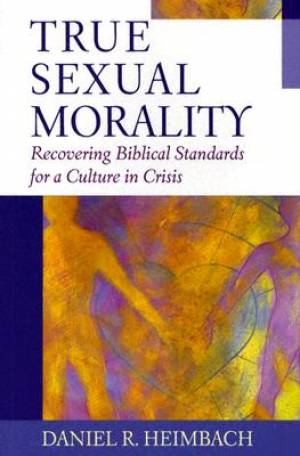
 Sex sells – even among Christians. Every year there are myriads of Christian books that come out on the topic of sex. But, like most of the culture around us, they don’t often reflect the Biblical standards for sex. Some attempt to do that, but they do it in a way that mimics the tone and character of our culture. So Mark Driscoll’s book, which is a decent book on the subject, was hyped as non-traditional book on sex. Real Marriage, was supposedly intended to be a book about sex that would shock Christians. But you will never hear such things uttered about Daniel Heimbach’s True Sexual Morality. The book is refreshing precisely because it takes a very strict and traditional view on Biblical morality as it relates to sex, and it neither mimics the world nor compromises with it. For that reason True Sexual Morality should be a standard work among Evangelicals for building a theology of sex.
Heimbach is professor of Christian Ethics at Southeastern Baptist Theological Seminary. He was a missionary child, a career Navy man, and a member on the White House domestic policy staff. He has been around the world. Has seen and experienced first-hand the societal changes and discussions revolved around sexuality in American culture. As a result he is convinced that at the heart of America’s moral decline is the issue of sex. He writes:
In just one generation, we have witnessed a total revolution in the way most people think of sex, and this in turn is creating a demand for monumental revisions affecting every social institution at almost every level. (30)
In lieu of these massive shifts, then, Heimbach thinks the church and the Christian community is in desperate need of a full-scale response. The problem, of course, is that many Christians have either not believed in the reality of the threat or we have given inferior responses.
The challenge we confront today calls for more than repeating (one more time, with new illustrations) the same old litany of biblical requirements. It demands instead a far deeper examination of : (1) what goes into God’s approach to sexual morality; (2) what makes God’s approach so wonderful and good; (3) what ideas are deceiving friends and neighbors into thinking biblical standards are bad; (4) what is wrong with the ideas that are destroying respect for traditional-biblical standards; and (5) what is at stake in all of this for the future of our culture and of the church. (23)
With that in mind Heimbach has written a thorough, the most thorough I’ve read, treatment of Biblical standards for sex.
The work is broken down into three parts. Part one is a bit of a sociological investigation of the cultural milieu in which the church finds itself today. Heimbach traces the historical roots of the sexual paganism so popular today. He highlights how the Christian community had been warned of the coming wave of paganism. Quoting from Abraham Kuyper, Francis Schaeffer, C.S. Lewis and Carl F. Henry he argues that the church has already lost ground in this cultural battle. So in chapter three he writes about the “Paganizing of ‘Christian’ Sexual Morality.” “Sexual paganism is flooding into church life in America through teachers who are supposed to provide instruction in Christian sexual morality” (71). The church, then, finds itself in a rather dire position. But there is hope.
As the culture drifts farther and farther from God’s view of sex, and as mainline denominations writhe from the poison of sexual pagan revisionism, it is time that evangelicals renew their faith in what God reveals in the Bible about sex, and firmly resist accommodating morally to the culture in any way at all. (130).
Part two gives us the tools to avoid cultural accommodation.
The Biblical view of sexual morality is about a great deal more than a list of “don’ts”. Part two breaks down into four major topics: definition, principles, prohibitions, and promises. Heimbach begins with a foundational definition of sexual morality rooted in the holiness of God. He writes, “True sexual morality is a matter of keeping one’s behavior consistent with the moral character of God” (133). God gets to determine what is right and acceptable sex since he is the creator of sex. Heimbach argues that good sex is not about what pleases us and about what feels natural to us, it is about what is acceptable and honoring to God. Ultimately he roots his arguments in the core of the gospel. The boundaries God sets up for sex are meant to point us to not simply sexual fidelity, but spiritual fidelity. Having given us a solid foundation to start with, Heimbach then directs us to the guiding principles for Biblical sexual morality: sex is relational, unique, profound, productive, sacrificial, multidimensional, and unites corresponding differences. He spends time unpacking each principle and demonstrating how vital it is to healthy, enjoyable, and moral sex. Chapters 8-10 unpack all the Biblical prohibitions as they relate to sex. He discusses the inflexible prohibitions and those with some exceptions to the norm. Here Heimbach doesn’t give thorough treatments of subjects like homosexuality or lust, but rather lets the text of Scripture speak for itself. The discussions are concise. Finally, part two concludes with a look at the special promises of God for those who dedicate themselves to pursuing true sexual morality. Part of his hope is that readers will not simply see the prohibitions involved in true sexual morality, but will see that the alternative to sexual paganism is far more enjoyable. It’s worth pursuing.
Parts three and four wrap up the book with a discussion of the ways in which “counterfeit views of sexual morality” have distracted and misled our culture, and a general assessment of our sexual culture. Part four feels more like a lengthy summary of the book and some will be less interested in its content. Part three, however, is particularly helpful in that it discusses the specific ways in which sexual paganism manipulates the truth and lies to us. It is absolutely worth reading if we are going to understand the specific nature of the conflict in which we find ourselves.
The book is long, over 460 pages including appendices. But it is worth the effort to read through it. At times Heimbach seems a bit dramatic. He does believe that sex is at the heart of our cultural shift away from God. I am not quite as convinced as he is that this is the driving force, but I find great value in this book. The fact that it comes to some pretty strict traditional views on sexuality is actually rather refreshing. The fact that the author takes the Bible so seriously that he uses it constantly to inform and support his guidelines and prohibitions for sex is refreshing. The fact that he comes to traditional conclusions without pretending like he is somehow not is refreshing. There’s no attempt to be “cool” or “shocking” in True Sexual Morality. In fact this is more or less a textbook for ethics classes, though it is incredibly accessible for those of us beyond the classroom. It is straightforward and simple in its discussion, but best of all it’s thoroughly Biblical.
For the Christian reader, whether you are a pastor or a parent, a young man struggling with lust or a youth group leader, this book is an important one to read. Sex is still a major topic of discussion within the church and within the culture at large. It isn’t going to go away and to better engage in the discussion it is important for Christians to develop a thorough theology of sex. Daniel Heimbach has given us an absolutely powerful tool in the process of developing that theology. I highly recommend True Sexual Morality.
 Sparrow & Heart Soul Care
1 Comment