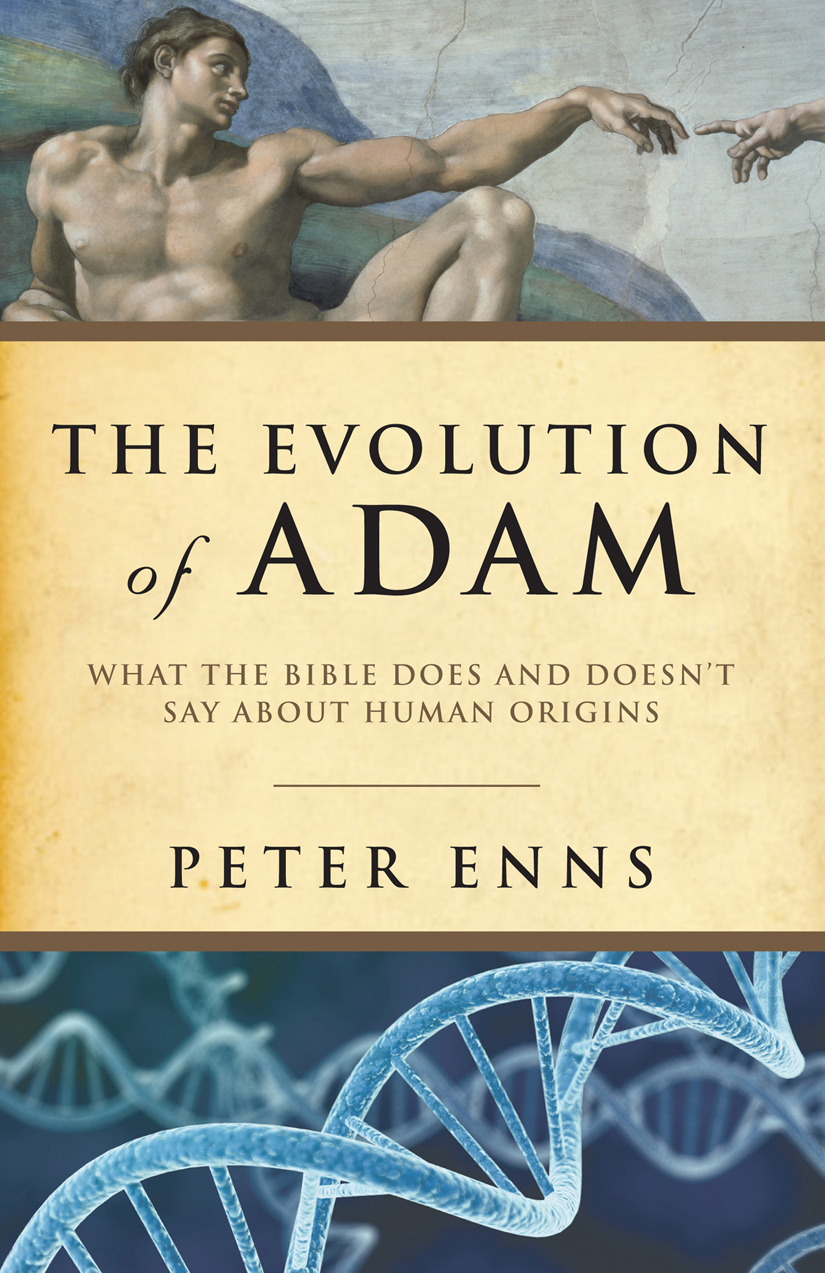
 If you’ve read Peter Enns’ first book Inspiration and Incarnation then it will come as no surprise to you that in his new book on the historicity of Adam the author does not start with the Bible as his ultimate authority. Afterall Enns may use the word “inspired” but he means something quite different from what most Evangelicals mean. For him the Bible has errors and mistakes and cannot always be taken to mean exactly what it says. This is especially true for him in regards to issues related to “creation,” “the Pentateuch,” and “Adam.” Most interesting for me, however, was the fact that in many ways I agree with Enns’ general conclusion, but I disagree greatly with the means he takes to reach that conclusion.
The book is broken down in to two sections. The first section deals directly with the Pentateuch and specifically the creation accounts in Genesis. The second division focuses on Paul’s use of “Adam.” In each case Enns is attempting offer readers a perspective on how these ancient documents, read in their ancient contexts, do not prove that Adam was an actual historical figure; rather he is a literary figure used to help establish Israel’s national identity. Taking his cues from Ancient Near Eastern documents and from standard liberal arguments Enns suggests that Scripture is not concerned with the modern scientific question of origins, which people so often impose or anachronistically read into it.
Genesis is an ancient text designed to address ancient issues within the scope of ancient ways of understanding origins. However one might label the genre of the opening chapters of Genesis (myth, legend, susprahistorical narrative, story, metaphor, symbolism, archetypal, etc.) is not the point here. The point is that Genesis and the modern scientific investigation of human origins do not overlap. To think that they do is an error in genre discernment. (36)
Of course, in many ways, Enns is right. Genesis was not concerned with the very same questions that the modern scientific mind is concerned. This is the part of his book I do agree with, though I think John Walton has done a much better job of articulating it. But this is not a new position, it has been a standard understanding for centuries.
Theologians and scholars have long appreciated and utilized the grammatical-historical method of interpretation. In fact, one of my chief frustrations with this book, as with Enns’ previous one, is that he regularly discusses old theories as if they are new discoveries that are changing the face of modern-day Biblical scholarship. Not a single issue that Enns raises in this book is “new,” in fact Old Testament scholars long ago addressed and offered intelligent answers to the dilemmas that Enns points out in his book. But Enns does not interact with a single one of them. There is no discussion in The Evolution of Adam regarding the work of Edwards J. Young or R.K. Harrison on these same issues (or see Duane Guarret’s Rethinking Genesis). Of course the fundamental reason that I personally still hold to Moses’ authorship of the Pentateuch and of a real historical Adam is because the Bible itself supports such conclusions.
When you start with the presupposition that Scripture is not the infallible Word of God, a conceptions that I think is itself untenable from reading what Scripture says about itself, then you can dismiss the references to Mosaic authorship in the Old and New Testament. The Pentateuch itself claims Mosaic authorship, the Prophets assumed Mosaic authorship, and Jesus affirms Mosaic authorship. But Enns assures us we can dismiss such things as nothing more than cultural accommodation to the traditions of the time period of their various authors/editors. Which is what he says of Paul’s use of Adam, as well. But if I am forced to choose between Enns’ interpretation and the Bible’s own confession I think it’s an easy choice for me.
The point to which the whole book is driving, of course, is that evolution is a plausible theory for faithful Christians because the Bible does not deny this as a possibility. The truth is that I have no problem with this position. It is not my prefered position, but I certainly think you can be an Evangelical and believe in evolution. I appreciate too that Enns affirms the gospel; I won’t call him heretic like so many others have. But while I may readily support his conclusion that Genesis isn’t interested in the modern origins debate, the means by which he arrives at that conclusion leaves much to be desired.
Update: If this is an issue you struggle with you might check out Kevin DeYoung’s short post as a starting place: 10 Reasons to Believe in a Historical Adam
 Sparrow & Heart Soul Care
Very interesting. Thanks for the review, bro.
Have you ever heard of The Story of Adam and Eve? It’s a writing (not sure how old) which supposedly tells the story of Adam and Eve after they left the garden, I’ve been reading it lately. Neat stuff.
Sorry bro. I am afraid I am unfamiliar with it. You are always reading such interesting and obscure things.