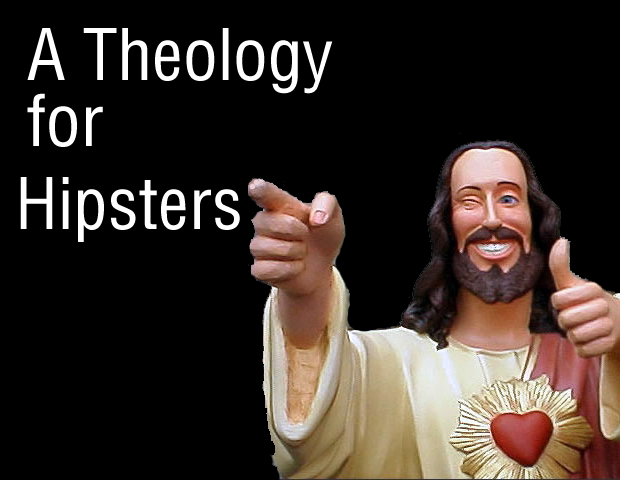
 Inclusivism
Calling fundamentalists strict might sound as obvious as saying that the Pope wears a funny hat, but it’s a point that has specific bearing on this issue of inclusivism. In the fundamentalist circles that many young hipsters grew up in there were strict rules about who one could and could not associate with. Of course top of the list were sinners, but even beyond them there were all sorts of guidelines as to which Christians were okay to commune with and which weren’t. In most cases it came down to simple comparisons, “Are they just like us…then you can associate.” For many hipsters the realization that there are other Christians out there who are both wonderful to know and yet aren’t like your church proposes a whole host of other questions. Some of these questions include things like: is it possible to be a Christian and not believe in the rapture? Is it possible to be a Christian and vote Democrat, smoke, drink, dance, and listen to rap? But some of these questions are much more serious in nature, like: is it possible to not be a Christian and still go to heaven? Are all religious pursuits valid if they are pursued with genuineness? Is the real Christian experience more about the journey than the destination? While we have already responded to the last question it is intimately related to this point of inclusivism, to which we must turn our attention.
Ours is a world of religious pluralism. Ecumenism and coexistence are the terms of the day that dictate the relation one should have with the varieties of religions. All are equally valid and all are owed a place at the table of “truth” (if we can even still use that term). In this milieu many a young hipster begins to question the exclusivism of the Christian faith. They have been taught not simply that Jesus is The way, The truth, and The life and that there is no other name under heaven given among men by which they must be saved, but they have been taught that conformity on all things is necessary for calling heaven home. As they mature and come in conflict with the latter part of that equation some come to assume the former part is equally as faulty. Thus, exclusivism becomes the way of fundamentalism. The more “enlightened” hipster embraces religious pluralism, the inclusivism of all faiths into the future eternal paradise. Within Christian theology this term and its associated ideas have become increasingly popular, especially among young hipster-favorite-authors.
The term applied in Christian theology gives mental ascent to the exclusivity of Christ’s death. It is only through Jesus’ death that people can be saved; yet proponents of inclusivism hold out that knowledge and belief in this Christ and His work are not necessary for salvation. So Brian McClaren writes, “It bothers me to use exclusive and Jesus in the same sentence. Everything about Jesus’ life and message seemed to be about inclusion, not exclusion.”[1] He adds, “Maybe God’s plan is an opt-out plan, not an opt-in one. If you want to stay out of the party, you can. But it’s hard for me to imagine somebody being more stubbornly ornery than God is gracious.”[2] Spencer Burke speaks even more candidly.
I actually think you can become a Christian and never even know who Jesus is…Many of my friends are now out in Muslim countries. We invite people to follow Jesus. They are not even asking them to leave their Muslim faith, they are asking them to simply follow Jesus.[3]
You see in inclusivism the heart of the gospel is ripped from the faith. There is no sin, no repentance, no real atonement, there is only “follow Jesus.” Only this does not mean give up your other gods and other religions, but simply tack Jesus onto it somewhere. Meanwhile the God of Scripture speaks of His own divine exclusivity saying that we are to have no other gods (Exodus 20:3), and that Jesus is the only way that someone may come to the Father (John 14:6). Whether we like it or not the gospel is by its very nature exclusive.
While I applaud the softening of the heart among hipsters, and the desire to embrace both humility and diversity, there is a place for it and there is a line at which it stops. God’s love and ours should extend to anyone, yet for those who continue to reject the gospel God’s love has an end date.
This open hand – closed hand distinction is extremely important if Christian hipsters are to maintain the fundamentals without the legalism. If we fall prey to any of this perversion, distortions, or diversions we will inevitably become less Christian, no matter how “hip” we remain. But along with these doctrinal and philosophical building blocks we must be aware of a few more dangers; these subjects fall more into the realm of style. While style is largely an open-hand issue that does not mean that all things are equal and that all things can and should be indulged to the full extent. So following McCracken’s lead it is necessary to make a warning about subjects like cool, rebellion, individuality, and progressiveness. But don’t worry, after all this warning I will be sure to put the “fun” back in its proper place in fundamentalism.
[1] Brian D. McLaren. The Last Word and the Word After That: A Tale of Faith, Doubt, and a New Kind of Christianity. Hoboken: Jossey-Bass, 2008. 35.
[2] Ibid. 138.
[3] Quoted in Gary L. Johnson and Ronald Gleason (eds.). Reforming or Conforming?: Post-Conservative Evangelicals and the Emerging Church. Wheaton: Crossway, 2008. 284.
 Sparrow & Heart Soul Care
Ok, interesting post. I should have read this before i commented on the “insurrection” post. I would have had a better idea of your perspective. I’m curious why you call yourself “postmodern” in your Bio page, and yet you still cling to such concepts as “the God of Scripture” and “maintain the fundamentals”. Um, hello? you are not postmodern, dude. not even close! I’d say that you are just a plain old Baptist with a trendy label on your church. But that’s ok. I’m not judging you. I can see from you Bio page that you have two small children, (ages 5 and 7?) and for that age group legalistic “because I say so” is exactly the right approach. But when you get to have teenagers (like I do) I think you will change your dogma (like I did). Believing in Jesus is not the only way to heaven. Doh. Have you not heard of King David, who was Jewish? Or Job who was primitive tribal? Or Nineveh? the bible is full of “non-Christians” who get it. Ever heard of Bill Gates or Warren Buffett? I can just see it now, at the great judgment seat “sorry Warren, you aren’t good enough… but Pastor Dave c’mon down”…. remember Jesus parable about the father who had two sons, and he asked the both to go work in the field? what do you think that parable means?
Well thanks for you comment John. Obviously you and I just won’t agree. Postmodernism, as you know, doesn’t actually have a concrete definition (in fact to give it a definition would be very un-postmodern). The term is used here to mean a change philosophically in our methods of ministry. But to avoid any confusion it might be best if I drop that label, so thanks for that. I def. don’t conform to a postmodern epistemology. I believe that the Bible is authoritative for life and faith, and actually the age of my kids has nothing to do with any of that.
Thanks for you comments, friend.