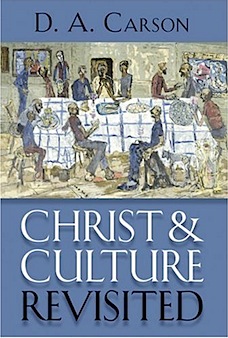
 Some subjects are easy to address, like who was the best Power Ranger (the Red one, of course). Some are simply inane, like which 80s metal band was greatest (nobody cares, and Pastor Matt should accept this!). Some are important, however, and incredibly difficult to address, like what is the relationship between Christians and the culture around them. There is a level of complexity that goes into this equation that is not always easy to answer. In previous generations Richard H. Niebuhr had addressed the problem in an almost formulaic manner, and his work Christ & Culture became the standard by which all other discussions on the subject were judged. But in recent years many have begun to question Niebuhr’s taxonomy and to reevaluate the simplistic approach he took to the subject. Chief among these reconsiderations has to be D.A. Carson’s 2008 Christ & Culture Revisited. Carson does not simply reevaluate Niebuhr and point out his errors, but he offers us a better model of determining the Christ and culture relationship, one that carefully takes into consideration the whole Biblical picture.
Carson has a number of issues with Niebuhr’s model. There are a number of cultural changes that necessitate a reevaluation and reformulation of the Christ & culture relationship. Carson points out that Niebuhr’s model made sense when Christianity was the dominant force in a relatively univocal culture. But much of that has changed. Ours is a massively multi-cultural experience and Christianity has been on the decline in the West for some time. We are no longer talking about “the culture” but “the cultures” and we are no longer seeing Christianity as the dominant religious and cultural influence it once was under the reign of Christendom in ages past. This alone requires rethinking the dynamics of what it means to be a Christian in this context. Beyond the cultural changes and shifts over the years since Niebuhr first wrote Christ & Culture, there are some issues more contained to the original writing. Carson points out that the author was often both too broad and too reductionist.
Niebuhr included in his perspective of “Christianity” branches that are clearly outside the pale of orthodoxy, particularly Gnostics and theological liberals. It’s one thing to try and create a system of understanding the subject that accommodates Roman Catholics, Protestants, and Greek Orthodox churches. But to include, as well, those who deny the very elementary components of the Christian faith seems more than just an accommodation. It is to make a system so broad that it actually loses much of its effectiveness. Add to this the reality that in composing a system so broadly accommodating Niebuhr is forced to reduce the five models to very simple approaches that lack nuance and awareness at times…especially for effectiveness in our day. But the heart of Carson’s criticism is Niebuhr’s handling of Scripture.
As Carson sees it Niebuhr tries to ground his five models of the Christ and culture relationship in Scripture but at the heart of his attempt is a misunderstanding of the canon. Carson explains the difference:
Niebuhr’s view, a view that is still quite common in some academic circles, is that the Bible in general, and the New Testament in particular provides us with a number of discrete paradigms. We are being faithful to Scripture so long as we align our choices with any one of these paradigms, or perhaps even with some combination of them. (41)
So we are not reflecting, here, on the totality of the message of Scripture, for no such message exists, only the plurality of various messages. In contrast to this view Carson states:
Christians recognize the diversity of the Bible in general, and of the New Testament in particular, but insist that the Bible as a whole constitutes the canon – and this canon’s “rule” lies in the totality of the canon’s instruction, not in providing a boundary to possible options. (41)
It is from this latter perspective that Carson attempts, then, to construct a more full and yet nuanced understanding of the Christ & Culture relationship.
The truth for Carson is that it is a much more dynamic and difficult task to construct an understanding of this relationship. Perhaps this is why some have been disappointed or frustrated with this work. We all want short, sweet, and simple answers. But few things in life work that way. Carson is a far better student of both academia and life than to assert otherwise. Carson believes that the heart of Niebuhr’s failure is that he did not take into consideration the whole of the Scriptural teaching. He writes:
We should not think of each pattern in Niebuhr’s fivefold scheme as warranted by individual documents in the New Testament, such that we have the option to pick and choose which pattern we prefer, assured that all are equally encompassed by the canon that warrants them individually. Rather, we should be attempting a holistic grasp of the relations between Christ and culture, fully aware, as we make our attempt, that peculiar circumstances may call us to emphasize some elements in one situation, and other elements in another situation.(43)
It is through the lens of Biblical theology, then, that Carson builds his model. He follows the pattern set forth in Scripture: Creation, Fall, Israel, Law, Christ, and New Covenant. These headings, then, serve to shape how we think about the subject at hand.
The storyline of Scripture helps us to see the various key pieces that make up the uniformed understanding of this relationship. Creation reminds us that all things have been made by God. “Christians cannot long think about Christ and culture without reflecting on the fact that this is God’s world…”(49).The Fall reminds us that this world which God has made has fallen into the trap of sin and been stained with all its consequences. “This side of the fall this world is simultaneously resplendent with glory and awash in shame, and that every expression of human culture simultaneously discloses that we were made in God’s image and shows itself to be mis-shaped and corroded by human rebellion against God”( 49).The discussion of Israel and the law may seem like a strange one, but as Carson explains it the point has real bearing on our relationship to culture. But the story of Israel is part of the story of Creation, Fall, Redemption that we are all involved in. Therefore we must look to what role they play in that story. Particularly, Carson writes, “We are constrained to reflect on the way these realities speak to how we should configure the relations between Christ and culture. Is this warrant for a theocracy? Why or why not” (52). Certainly Israel’s relationship to culture, as the people of God in the Old Testament, has some bearing on how we relate to culture. But we must evaluate if everything is transferable. The last section on Christ and the New Covenant spells out more clearly the solution to the dilemma that Christians have as they try to relate to culture. Carson, acknowledging that he could talk endlessly about this point’s application, limits himself to six observations which lead us to the reality that the Kingdom of God is both being manifest in this world and yet still to come. It is this storyline, these points taken all together (not the random selection of one or two) which must inform our model. But the model itself still needs to be applied to specifics and here is where Carson’s nuance is needed.
In the remaining part of the book he carefully unpacks the real difficulty in applying this model to our various contexts. Carson points to the technical difficulties of defining culture, the problems that postmodernism has delivered to this task, the struggle between church and state relations, and the real uniqueness of the various “worlds” that Christians live in. The principles we emphasize, here in the west, when it comes to church and state relations is not the same for Christians in oppressive, closed countries. We must make sure that as we define this relationship we are balanced, and nuanced. As Carson says early in the book we want to be flexible enough that this model can be used by anyone anywhere, and yet we want to be strict to the storyline of Scripture. Speaking of the final importance of reading Scripture fully and richly for the formulating of this model Carson adds the following:
To a generation that scrambles for the top and then looks around and asks, “Is this all there is?” a biblical vision that focuses on Christ and his cross, on the links between this world and the next, on bold Christian living and faithful witness, and on a large-scale vision that makes the world our parish while loving the neighbor next door, raises our eyes above ourselves, and delights in the glory of God. When churches so taught thrust their members into engagement with the wider world, their members are far less likely to be snookered by the world to which they are to bear witness and in which they are to do good. (228)
It is only through a full picture of what Scripture teaches that we can honestly and with nuance engage the culture around us as genuine Christians.
This is a hugely important book. With all the rage around Christian cultural engagement these days, and more churches existing “for their city,” this is a subject that must be discussed more frequently and studied more thoroughly. Carson’s is the single most important book on the subject today, because he approaches carefully the subject of methodology. And with everyone hollering about what Christians are and aren’t doing to the culture, we need to pause and give careful consideration about how, Biblically speaking, we are to do it!

