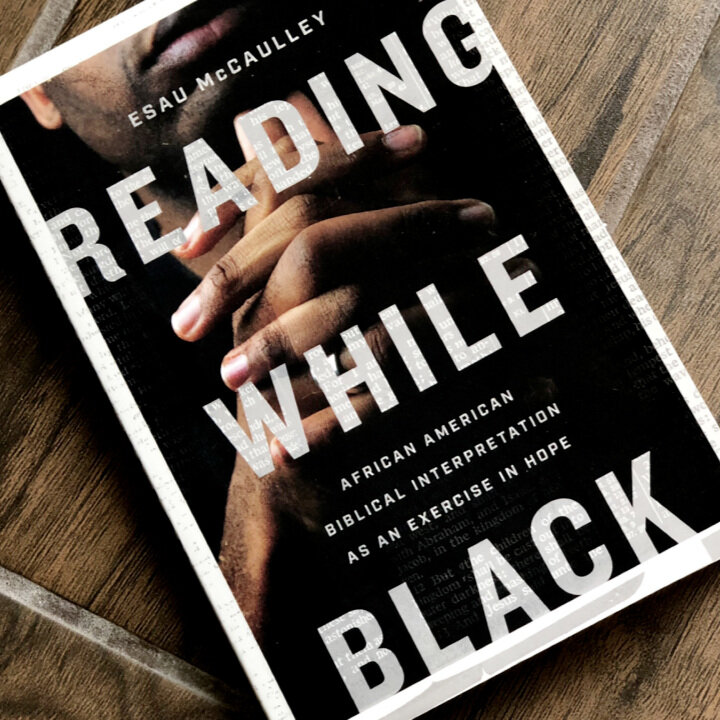
 Does our cultural context shape how we read and understand Scripture? Absolutely. This can, of course, be bad because it means that we allow our perceptions, biases, and perspectives to color the meaning of the text. We can, then, miss what God’s Word is saying because of our bias. But, our culture can also help us to see things in the text more clearly. In Reading While Black Esau McCaulley provides readers with a Black interpretation of Scripture. In so doing, he provides not only help to his African American brothers and sisters, but insight for the rest of us.
I really wasn’t sure what to expect when I picked up this book. I am clearly not the target audience. McCaulley writes as a Black theologian for Black Christians. “I want to make a case,” he writes, “that this…unapologetically Black and orthodox reading of the Bible can speak a relevant word to Black Christians today” (6). He aims to demonstrate that being both Black and Christian does not require one to deny either suffering or hope. African Americans in this country have faced serious oppression at the hands of White people, even particularly white Christians. For some this has led to an outright rejection of the faith. For others, holding onto your faith means being accused of living in denial of racial suffering. Esau McCaulley very powerfully demonstrates that you don’t have deny either suffering or hope.
The book’s seven chapters pick up on dominant themes from within African American culture and explore them through the lens of Scripture. McCaulley shows in some cases how they are consistent with the teaching of the Scriptures and in some cases how they are modified by the Scriptures. He does so, however, with a keen eye on the text and the Black theological tradition. Some of the themes he touches on include policing, political witness, justice, Black anger, and hope. He gives readers insights into the “Black Ecclesial Interpretation” and demonstrates how some of our readings of various passages are too influenced by White culture (an example of culture wrongly influencing our interpretation). He shows us in other cases how a Black interpretation better exposes what’s in the text. This was eye-opening to me. I was particularly struck by his discussion of “political witness” and the place of Romans 13 within the flow of Paul’s work and the whole of New Testament theology.
I am not the target audience of this book and yet I found it so illuminating. I saw things from the perspective of my African American brothers and sisters that I have missed and was challenged by. I also learned to read the text of Scripture with fresh eyes and see somethings that in my exegesis I have overlooked. I was also encouraged by the emphasis on the gospel throughout the book and McCaulley’s application of the Scriptures to real-life contexts. Finally, I am hopeful that this will be a book that serves my African American brothers and sisters well by giving them a reason to hope in the gospel despite what they have experienced. Many should read this book, both Black and White, and benefit from it.
 Sparrow & Heart Soul Care
Thank you for this review. This sounds like a must read to bridge many of the gaps between this divergent culture.