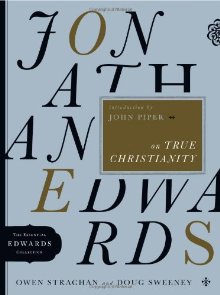
 Self-deception about salvation is one of the greatest lies of Satan. At least that’s how the Puritans felt, and Jonathan Edwards, having struggled with his own conversion, certainly affirmed that belief. Nominal Christianity (or Christianity in name only) was a serious issue for the theologian throughout his Northampton ministry. In Jonathan Edwards on True Christianity authors Owen Strachan and Doug Sweeney draw from his writings to assist us in our battle of this same danger today. Their work shows us how serious the threat is and how applicable Jonathan’s writings are for battling it.
The book’s size should not be misconstrued as evidence that it is a simple work. The five chapters are packed both with historical information and practical theology. The chapters move from our contemporary setting, through Edwards’s context and teachings, back to application in our own day. The authors are not merely historians, though they are that. Sweeney, in particular, has evidenced his expertise as an American church historian, and an Edwards scholar. But their primary concern is much more pastoral in nature, showing that Edwards is a great resource for contemporary pastors to draw from. They provide a great resource themselves in this book.
They set us up to receive wisdom from Edwards by reminding us of the reality of nominal Christianity in our day. The statistics are depressing, if not surprising. 33% of professing Christians are pro-choice, 26% believe in astrology, 20% believe in reincarnation. Less than half attend worship weekly, tithe, and share the gospel regularly. Only 33% read their Bible daily. The lack of spiritual growth is staggering when we look at the statistics on pornography: 37% of pastors struggle with porn addiction. The authors provide some historical context for this spiritual malaise, suggesting it started with the Enlightenment’s dismantling of the theological foundations of belief. As that skepticism gave way to church pragmatism it eventually led to an anti-intellectual Evangelicalism. I am not sure I buy this overly simplistic explanation for the problem, but it does provide some launching off points for investigation into the history of the modern church. The author’s, however, don’t stop with a mere diagnosing of the problem, their goal is to find an aid to fixing it. In Edwards they find such an aid.
As they have set a context for our own problem, so they move on to setting a context for Edwards. Nominal Christianity is not a new threat to the health of the church; it has itself a long history. In Edwards own day we can appreciate how often people would claim to be Christians merely because that was the expected belief of the populace. In his own day nominalism revealed itself as pride in the knowledge of doctrine, adherence to the trappings of religion, and a quiet and respectable life. Edwards, through his preaching and his writing, sought to expose this behavior and “uncover the specious beliefs of worldly church members.” He “labored to strip away pretense of belief with careful arguments and biblical reasoning” (61). Edwards saw this as a serious threat to the health of the church. Many are convinced they are saved, when in reality they are far from God. As Strachan and Sweeney write:
Sanctioned by Satan, the nominal Christian possessed all too many resources to deceive themselves about their true spiritual state, whether biblical knowledge, fear of judgment, religiously minded happiness, or other things. It is likely that these are the kinds of attributes many of the nominal Christians in our churches possess. They fear the Lord, and go to church, and do religious things, believing on some level that their involvement procures forgiveness and salvation. (69)
It is in light of this serious threat that they authors direct us to consider Edwards critique and counter to nominalism in his own day.
For Edwards, the counter begins with a proper and biblical understanding of conversion. “The starting point,” write Strachan and Sweeney, “for a discussion of Edwards’s view of conversion has to be this: he believed in it” (75). In an age, much like our own, when the spiritual work of God on the heart was thought to be a farce, Edwards defended Biblical conversion with reason and passion. He wrote:
There is no kind of love in the world that has such great, visible effects in men as love to Christ has had, though he be an unseen object, which is an evidence of a divine work in the hearts of men, infusing that love into them. (75)
Here the authors unpack Edwards’s theology of conversion. They wrestle with his convictions about the mind and the will, the influence of the Holy Spirit, and the evidences of a true conversion. They list, from Edwards’s own writings, five “Marks of True Conversion”. The marks include love for Christ, hatred of sin, love for the word, love for truth and the things of God, and love for believers.
In chapter four we are given two models of true converts in the lives of David Brainerd and the young Abigail Hutchinson. Edwards recorded details of both of their lives, and though their stories are different they have this in common: they were true believers. Here we are encouraged to “marvel” at the grace of God and the heart of a believer.
Chapter five concludes with the narrative of Edwards’s dismissal from the pastorate at Northampton. We are challenged to hold to the convictions that Edwards did regarding conversion, even if it means losing much. Though I am convinced there is much about this controversy that was Edwards’s own fault, there is no denying that he was challenging this congregation’s nominalism, and it cost him dearly. The authors call us to a “theocentric approach to life, ministry, and the gospel” (134). Such an approach may lead us to the places Edwards went, standing alone for truth. But it is the right place. Again we see how Edwards’s example is good for us today.
This volume has been my personal favorite from the whole Essential Edwards Collection. The authors have compiled great selections from the writings and sermons of Edwards and applied them wonderfully to our own context. They have avoided some of the frustrations of other volumes (like redundantly summarizing the quotations from Edwards). Particularly fascinating was the discussion of how Edwards’s ecclesiology was applied to assurance of salvation. That is worthy of a whole separate book, one I hope someone writes.
Though there are plenty of ways in which the time of Edwards is very different from our own, Strachan and Sweeney remind us that the nominal Christianity is still a real issue today. And they remind us, through the brilliant work of Edwards, that a clear understanding and application of the gospel is the answer to this threat. This is a book worth reading, especially if you are in ministry. Jonathan Edwards still has much to teach us.
 Sparrow & Heart Soul Care