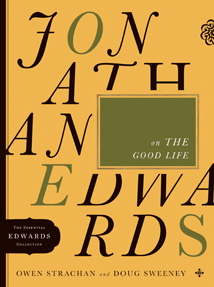
 The pictures suggest that Jonathan Edwards was a dour and stiff person. They suggest that his idea of fun was making sure no one else was having any. But the truth is that Jonathan Edwards deeply concerned with pursuit of the good life. In their book Jonathan Edwards on the Good Life Owen Strachan and Doug Sweeney aim to present the truth about Edwards.
It is important to qualify what we mean when we say “the good life.” For many in modern America the good life is synonymous with the American Dream. It includes a nice bank account, a 401k, a nice home with a two car garage, etc. But that is not at all what Edwards has in mind, nor is it what the authors present positively for us. Instead the good life, they write, is different:
It involves sacrifice, and hardship, and hard work. It requires self-denial, self-abasement, and an others-centered mindset. It is radically God-centered and deeply rooted in Scripture. This, and no other path, leads to lasting happiness for the souls of human beings. (20)
This is the good life that Edwards pursues and which Strachan and Sweeney promote in their book.
The book is broken down into five chapters each exploring a dimension of this good life. The authors steer us towards God’s design for the good life, explore the effects of sin on the good life, and the value of the Christian life in directing us to this life. Through exploring dozens of sermons and theological writings of Edwards the authors expose us to a view of the good life that is contrary to the weak view of our modern American way of life. For Edwards it is all rooted in God’s original plan and Christ’s redeeming work.
God’s original plan was for his creation to be very happy. Strachan and Sweeney write that Jonathan “discovered a simple but vitalizing truth: God had not made mankind to be miserable” (25). Despite misconceptions, Christianity does not intend for men and women to be grumpy and joyless. In his work The End for Which God Created the World Edwards argues that God delights in man’s happiness, specifically when that happiness is found in what truly will make us happy: God. “The foundation of the good life is God,” write the authors (26). In Edwards own words, it right and good that God’s glory be our delight. He writes:
‘Tis a thing infinitely good in itself that God’s glory should be known by a glorious society of created beings. And that there should be in them an increasing knowledge of God to all eternity is an existence, a reality infinitely worthy to be, and worthy to be valued and regarded by him, to whom it belongs in order that it be, which, of all things possible, is fittest and best. (27)
John Piper’s often quoted motto is a modified and condensed understanding of Edward’s main premise in The End For Which God Created the World: God is most glorified in us when we are most satisfied in Him. Ultimately, the idea is that as we come to know God more and more we find ever-increasing happiness. Happiness is found in knowing and loving God.
This important distinction shifts our focus away from our own selfish pursuits to the true pursuit of happiness. As the authors write:
The happiest Christians are not those who manage to accomplish all of their personal goals. Rather, the happiest Christians are those who embrace what God wants for their lives. (35).
Obedience is joy, the tell us. “Edwards shows us that the happiest people on earth are not those who do whatever they naturally, sinfully want to do, but those who do what God desires” (43). This shift is important and yet Edwards does not suggest that we can reach out and attain the “good life” simply by working hard.
The Fall has damaged all of human existence, including our pursuit and attainment of the good life. In discussing the Fall Edwards has a creative and interesting take on its relation to the good life. We are unhappy, he writes, because in the Fall mankind lost that “superior principle” which made our affections “spiritual, holy, and divine.” Mankind, Edwards argued, was made with two guiding principles. One inferior, a “spiritually neutral principle that includes man’s natural appetites and passions” (55), and the superior. At the Fall man’s inferior principle was all that was left intact and it came to dominate the throne of man’s heart. The good life cannot be reached by man’s own working because man is no longer capable of pursuing God on his own. The good life will always be out of reach. Strachan and Sweeney summarize Edwards, saying:
In this awful condition, [man] could glimpse that a higher, better, way of life existed than that which he chose, but he could never lay hold of it, and he often did not want to, preferring the filth of his natural, sin-driven lifestyle. He could see, fleetingly, that true happiness existed, but could not capture it. (61)
The good life was out of reach. Jesus work, and the work of God’s Holy Spirit in the heart of man, however, could bring us again to the pursuit of true happiness.
For Edwards, the central issue was developing a taste for the good life. It was not enough, according to the pastor, to hate sin, we must also love God. We are closer to the good life when we come to see and love the excellence of God. The Spirit of God awakens men at conversion to the real beauty of God himself, not just to the awfulness of sin. We read:
The Holy Spirit shone a “spiritual light” in the human heart in conversion, which Edwards defined as “a true sense of the divine excellency of the things revealed in the Word of God, and a conviction of the truth and reality of them, thence arising.” (77)
Again it is reinforced that the good life is in knowing and loving God. And this good life is attainable only as we come in contact with God’s Spirit through conversion, only as He gives us spiritual eyes to see.
Jonathan Edwards on the Good Life has much to commend itself. It provides ample quotations from Edwards own writing. It shifts us away from worldly thinking about happiness. It offers a much-needed distinction to the often shallow popular theology of modern Evangelicalism. But ultimately what makes this a good book is that it directs us to find our happiness in God himself.
This small book is tremendously devotional in nature. Though it is written with an eye towards the historical theology of one particularly important Puritan theologian, it is really a book for all of us who seek to follow Jesus. The good life is not found in fame, wealth, sex, and stuff it is found in knowing and loving God. Even as our circumstances changes we can still be happy. Jonathan Edwards knew this and we can learn from him as we dig into this wonderful volume.
 Sparrow & Heart Soul Care
1 Comment