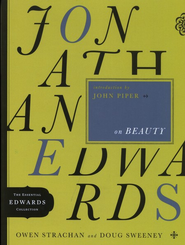
 Books sometimes turn out to be not what you were expecting. That doesn’t make them bad books, but it does make evaluations of them somewhat difficult. When I picked up Jonathan Edwards on Beauty I had imagined that the volume would be an examination of Edwards’ aesthetic philosophy. Instead it is more about what Edwards finds beautiful, not so much about “beauty” itself. I liked much about this book, but was disappointed by the overall approach.
Chapter one sets a good start to understanding his philosophy of beauty, but the book turns in chapters 2 and 3. It shifts from a focus on Edwards philosophy of beauty to things that Edwards finds beautiful. The book is broken down into five parts, addressing the beauty of (1) God, (2) Creation, (3) Christ, (4) the Church, and (5) the Trinitarian Afterlife. Part one is the most significant and certainly foundational. The first chapter establishes God as the center and fountainhead of all beauty. By examining seven attributes of God Edwards demonstrates the depth and inherent beauty of God. But he does more than just that, as Strachan and Sweeney write:
Edwards’s treatment of the traits of God offers a framework by which to comprehend and approach the Lord. God alone is self-sufficient and worthy of worship. Writing three hundred years ago, Edwards illuminated this fundamental reality of Scripture and showed that God, possessing beauty beyond human comprehension, is the only being deserving of worship. (40-41)
For Edwards God “formed the first link in a cycle of beauty that begins with creation and runs its course to heaven” (24). I love how the authors put it when they state plainly that in “Edwards’s theology, one cannot logically identify a scene of beauty and leave it disconnected from the character of its designer” (56). Here Edwards establishes a foundation for understanding all other beauty. Things are beautiful in so far as they are related to and reflect back the glory of God.
It’s not entirely clear what it means to reflect the glory of God, and a more thorough engagement of Edwards’ philosophy of beauty would have sured that up. But the little book progresses on to creation, Christ, and the church. In each chapter we see a specific example of reflecting God’s glory and therefore specific things that Edwards finds beautiful. Each chapter contains numerous quotations from Edwards writings. New readers will get a good introduction o Edwards style and logic from these selections. Often the commentary provided by Strachan and Sweeney on the passages felt unnecessary, even redundant. And here in these chapters the book shifts from the concept of beauty itself to the specific expressions of beauty found in creation, Christ, the church, and the afterlife. We learn less, then, about how Edwards developed his aesthetic philosophy and more about what makes the gospel beautiful.
The gospel is beautiful, there is no doubt about it. And the selections chosen by the authors from the plethora of Edwards’s writings put it on full display. At times it’s more implied than stated, as the authors note when writing about the persecuted church:
Though Edwards did not include the word “beauty” in the passage, it is clear that he viewed the persecuted but persevering church as an emblem of God’s glory and beauty. (112)
Many of the chosen selections seem to follow this trend. They say less about beauty directly than I had hoped. We do catch some wonderful glimpses of Edwards’s own love of creation through his writings.
He often compares spiritual realities to natural ones. Calling God the “sun” and Jesus the emanating rays of light pouring from that sun, making God visible to man. His typology did not stop at the pages of Scripture, for, the author’s tell us, Edwards saw in nature “types” of spiritual realities. So waves point to the wrath of God and roses growing among thorns point to the joy that comes after the trials. In this we get a good picture of Edward’s view of beauty, and yet it still doesn’t feel like a formal introduction to Edward’s philosophy of beauty.
Again, I don’t think this was a bad book it just didn’t answer the questions I was asking. It is intended to be an introduction to Edwards thought, and it is only 143 pages. Certainly I could be asking too much of this little volume. There are ample selections from Edwards writings and it does introduce us to the various ways in which the great theologian wrote about and preached on beauty. But overall I was not as pleased with this volume as I was the first in the Essential Edwards Collection. The author’s commentary was less clarifying, and it lacked the formal articulation of Edward’s aesthetic philosophy that I wanted. But I think that many will nonetheless find this an enjoyable book because of its simple introduction to the beauty of the gospel. It is easy to forget just how beautiful the gospel is. Edwards surely knew this tendency among sinful human hearts and so he preached on the beauty of the gospel unfolding throughout the redemptive narrative of Creation, Christ, Church, and afterlife. For that reason many will, I believe, enjoy this book.
 Sparrow & Heart Soul Care