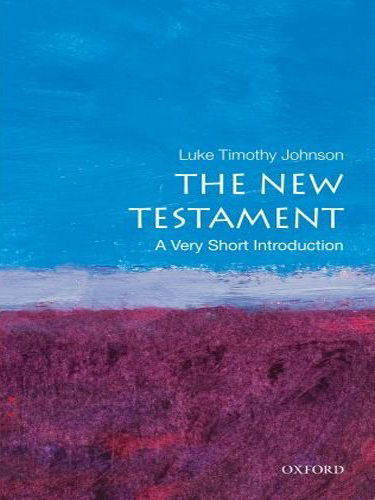
 Belief in the Bible is academic suicide these days. I guess that makes me dead in the water. I am teaching my first ever New Testament Survey Course for our local college and as part of my job I was asked to select an appropriate textbook. Finding a quality book was not easy. After all a good “survey” is hard to find. They either end up being too involved or too reductionist to be a decent survey. The other problem I had, however, was finding a textbook that didn’t treat the authors of the New Testament with such bias and disdain. It was hard to find a book that didn’t start out with the assumption that the authors of the New Testament were complete idiots, or that the content of the New Testament is pure fabrication for the purpose of maintaining power. Somewhere along the process of researching books, however, I came across this simple, small volume from Oxford UP by Luke Timothy Johnson. It’s not the best, but I appreciate that Johnson is largely willing to maintain a conservative bent towards the content of the New Testament. I am afraid such is a rarity in academia.
As part of a larger series on “very short introductions” to a host of religious texts, this little volume is precisely what it claims to be. At 160 pages Johnson does not cover all the books of the Bible, but rather gives us a big picture look at its content. For example, he doesn’t walk us through all of the Pauline literature, but rather focuses on how 1 Corinthians and Romans give us a taste for the whole of Paul’s writing. One might wonder why a volume that does not actually cover all the books of the New Testament would be desirable. But what Johnson lacks in detail he makes up for in other areas. As an introduction to the New Testament, Johnson doesn’t want us just to see what it says, but he wants to set the New Testament in its proper context, and that I can appreciate.
His work focuses on four specific dimensions of the New Testament: (1) Anthropological, (2) Historical, (3) Literary, and (4) Religious. What’s significant about this is not that Johnson is including those things, for any good survey would at least broach them. Rather it is the manner in which he broaches these dimensions. For example, while he focuses on the anthropological aspect of the narratives/letters he does not assume the worst about the intentions and knowledge base of these authors. He does not approach the text with complete skepticism. When touching on the historical dimension he allows for a much more conservative dating to the books than most scholars these days. He does not argue much for the pseudo-history of the “historical Jesus” movement, but focuses primarily on what we can know based on the text of the New Testament itself. That is a rare find these days. Likewise when he turns to consider the literary dimension he recognizes that these are works with specific agendas. I am confused by how so many conservative scholars are unwilling to admit this. And yet, again, Johnson does not assume the worst of those agendas, or pretend that some sort of objectivity would have been possible or should be prefered. He is honest about it, but not dismissive of it. Finally, when he addresses the religious aspect of the New Testament he takes it at face value. When speaking of the resurrection he states it matter-of-factly. Readers may or may not believe in the resurrection of Christ, but it is the fundamental key to understanding this thing called “Christianity.” Johnson will not pretend that the authors of the New Testament were speaking in merely psychological terms, or in symbols. He takes that they mean what they say, and believe what they write, regardless of how we might feel about it. He does not call us to believe the gospel or any such thing, but he certainly allows that the authors of the New Testament believed it. He writes:
So pivotal and provocative is this claim that care must be taken to state it clearly. The texts do not deny that Jesus died; rather, the reality of his death is emphasized. Nor do they identify Jesus’ “afterlife” with the memory of his deeds, or words, or ideals within communities. Such forms of memory persist, to be sure, but they do not constitute the claim of resurrection. The earliest writings do not speak of the resurrection as a resuscitation …
As a conservative scholar I appreciate these sentiments greatly, especially since they are increasingly hard to find.
But that does not meant that this is an altogether conservative volume. Johnson buys into many of the more liberal arguments regarding authorship of the New Testament. He does not allow that all the letters attributed to Paul are in fact written by Paul (which is part of the reason he only focuses on 1 Corinthians and Romans). Though he does readily admit (and perhaps he is revealing his true cards here) that it is “possible to hold that all the letters ascribed to Paul were actually written during his lifetime and under his authorization.” He also does not approach the text of Scripture as a continuous piece with one theology. So Jesus’ ministry does not connect with the mission of the church post-resurrection. And Matthew offers to correct some of Mark’s misstatements in his Gospel account. And the work of Luke in Acts is at best a rhetorical constructions, not actual events and speeches, etc. But in spite of all these weaknesses I have chosen to use this volume just the same.
I believe Johnson offers us a good introduction to both the nature and the content of the New Testament, if, albeit, from a less than thoroughly conservative perspective. In the world of academia, however, beggars can’t be choosers and so I appreciate this tiny volume as at least more conservative than the others. It wouldn’t be first choice, but it will have to do.
 Sparrow & Heart Soul Care
Thank you for your review. It gives me the information that I was seeking, which is Matthew’s theological bent. For years I’ve been listening to books (and lectures) on various topics, and my latest interest is a Great Courses lecture series “The History of Christianity: from the Disciples to the Dawn of the Reformation.” Matthew is teaching the course. I was a little reluctant to embark on this without having confidence in his religious and historic fidelity, and your blog post showed up in my search.
Thank you very much for what you wrote because now I feel like I can have more confidence that I’m not going to be dealing with one of the “usual sorts,” which would eventually have me realizing I was wasting my time and cause me to return it unfinished. I try to avoid that, as my time is valuable, so I am pretty forthright about doing background checks of my authors.