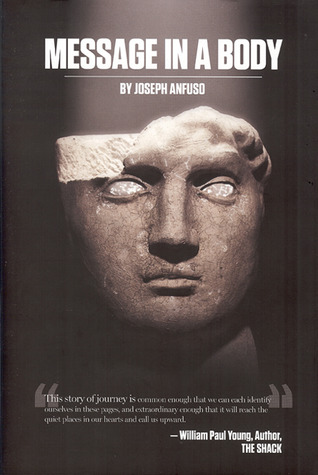
 When I first heard about Message In A Body it was billed as a story of a former hippie who found Jesus and pursued a calling to care for the least around the world. I thought to myself, what’s not to love about this book! It’s got Hippies, Jesus, and social justice in it. I love all three of those things. So I agreed to review the book, but immediately I found out that this is a story so much bigger than just some former Hippie coming to Christ. That in and of itself would have been compelling enough, but the story itself has more to it than that. It’s essentially the story of one man’s search for God and acceptance, and as he finds it I believer readers can find themselves in his story too.
Joseph Anfuso was born into a very prominent and very wealthy family in New Jersey. Joe’s father had been a Congressman and a Justice of the New York State Supreme Court. As a boy, then, the young Joe had spent his days running around with some of the most notable people in American politics. His father’s den was lined with the photographs of various political, religious, and Hollywood stars, all of whom had some personal connection to the distinguished Victor Anfuso. But growing up in his shadow was daunting. Add to that the pressure of having a twin brother who was taller and better with the ladies and you begin to get a picture of a young Joseph who was both aware of himself and uncomfortable with himself. Such discomfort, though, would send Joe on one of the greatest journeys of his life.
The author describes for us his college years in London, where he got sucked into the Hippie movement. Instead of going to class he spent his days doing drugs and listening to the Beatles. He finally came to accept that his parens’ values were not his values and he abandoned all pursuits to follow in his, then deceased, father’s footsteps. And as he began to dissociate himself with all the pressure and all the values of his family he saw them connected too with the stringent Catholicism of his boarding schools and of Christianity in general. While sitting in the ostentatious and towering Notre Dame he thought:
It suddenly seemed that everything I had yearned to flee from in my life – the demands of my father, the rules and regulations of boarding school, the dead, bankrupt values of a world gone made – were embodied in Notre Dame. I was seated, inside a stunning but lifeless mausoleum. (73).
And yet, for all that new-found enlightenment, Joes still felt trapped and uncomfortable with himself.
The journey of his life really begins as he sets off to find his own path to spiritual truth. When his twin brother becomes a devout Christian the pressure mounts once again to not simply find a religion better than his brother’s, but to prove him wrong. Surely, he thought, Jesus can’t really be the only way. And the search for that answer takes him all over the world. He searched for gurus in India and monastery training in the Himalayas, and for spiritual enlightenment atop the dizzying heights of Mount Everest. But in every case Joe found himself utterly disappointed. After the amazing accomplishment of climbing Everest he sits and wonders:
Now, amid the icy vacuum of the glacier, I wondered, as I hast at Kopan, if the eastern view of enlightenment was all that appealing. Was “oneness with the void” a fate worth pursuing? And was I, after all my years of wandering, even one step closer to the freedom I craved? Suddenly, the lifeless world of the glacier seemed to mirror the secret, empty landscape of my heart. (140)
It wasn’t until he returned home that his life finally found meaning.
Upon his return Joe came to find his entire family had embraced Christ and were all praying for his own conversion. He resisted, of course. After all there would be nothing unique about his becoming a Christian, and there was the pressure to do so, which he hated. But worst of all was the arrogant presumption of Christianity that Jesus was the only way. Joe just couldn’t accept that. But as the story of his conversion slowly unfolds we see that the acceptance that Joe has longed for all along is found there in the love of God.
What makes this story so compelling is that in many ways the longings of Joe’s heart are the longings of all our hearts. We may not have the means or desire, or sheer will, to search for it by trekking across the globe or climbing Mount Everest, but all of us want acceptance. All of us want to know who we are and to have confidence in that knowledge. Joe had searched for it in Tibetan Monasteries, and in Easter Religion, but found nothing. It was only in Jesus, only in God’s love, only through Christ’s work for him could he finally be free from the pressure to be and do.
It wasn’t that he never felt depressed, disappointed, frustrated, or even that he never struggled again with comparing himself to his brother, or feeling confident in his personhood. His story continues past his conversion to those continuing realities. But coming to Christ was the first step in real change for Joe. He writes about a conversation he had with God early on in his Christian walk. In the conversation God impresses upon Joe that he is called to be a servant, and to always be a servant. In response to this realization he writes:
More powerful than my feelings of disappointment were my feelings of inexplicable peace. It was as if a tiny sponge, deep inside my soul, had been moistened for the very first time. I now knew – in a way I had never known or believed before – that the God of the Bible…the living, personal God of the universe…not only existed, but he loved me…LOVED me…loved ME! (178)
He had found acceptance and peace in the one place he had always refused to look.
This is a beautiful story, not just about one man’s conversion, but about a quest that so many of us have been on. It’s a story about Joesph Anfuso, but it’s also a story about all of us. A story about the burning desire in all our hearts. Each of us longs for acceptance, peace, meaning, purpose, etc. As Joe tells his story we are reminded that it can be found only in Jesus.
As an autobiography the book is sometimes a bit self-indulgent (as most autobiographies are). Some of the early childhood stories seem a bit peripheral to the development of the book as a whole, but it the prose is easy to read and engaging. The story itself is easily a compelling read. But it’s Joseph’s own voice that makes this book worth reading. Read it and be encouraged that just as God has LOVED Joseph Anfuso, so he loves YOU.
 Sparrow & Heart Soul Care
I just put a long comment on your Pornopoly article. I was in a sister ministry to the one Joseph was in with his twin brother…. I believe it was Francis. Their ministry was Morningstar in Smartsville, CA, and ours was Gospel Outreach in Eureka. Those were some days… lots of stories from those years in the JESUS Movement. We ended up going into Jeunesse en Mission (Quebec’s YWAM). When we came back to CA, I got my RN. Later I became a Wesleyan minister. Still working bivocationally. You may be interested in my catch-all website (pastordavidrn). A variety of stuff on their, but my main focus for the last seven years has been “the human body,” its value spiritually and its awesome destiny.