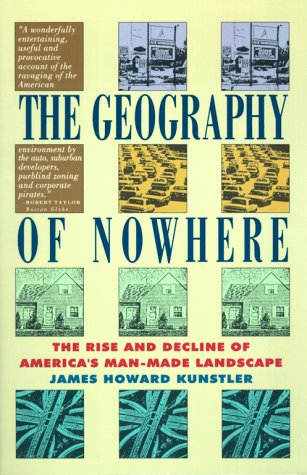
 “Eighty percent of everything built in America has been built in the last fifty years, and most of it is depressing, brutal, ugly, unhealthy, and spiritually degrading” (10). So writes James Howard Kunstler in his 1993 sociological study of suburban sprawls and decline in community life. Kunstler is a journalist/novelist, who has a pronounced disdain for the automobile, and after reading his book The Geography of Nowhere you could too…if you can get through it. The book has an incredibly important thesis but it is so bogged down in details, and in Kunstler’s widely cast net that it’s hard to find it. More often than not I found myself trudging through the chapters hoping he will get to his point instead of just unpacking illustrations of it and history behind it. The truth is The Geography of Nowhere spends so much time bogged down that it feels like your sitting the deplorable traffic that Kunstler writes against. The book’s message is for everyone, but the writing makes it palatable to only a select few.
Kunstler is convinced that the suburban sprawl that began in the late 1800s has seen he decline of community life, and has had a degrading effect on our nation’s common good. His book is about how and why that has happened. In chapter one he writes:
The process of destruction that is the subject of this book is so poorly understood that there are few words to even describe it. Suburbia. Sprawl. Overdevelopment. Conurbation (Mumford’s term). Megalopolis…Much of it occupies what was until recently rural land – destroying, incidentally, such age-old social arrangements as the distinction between city life and country life. To me, it is a landscape of scary places, the geography of nowhere, that has simply ceased to be a credible human habitat. This book is an attempt to discover how and why it happened, and what we might do about it. (15)
The book enumerates the consequences of this world we live in. Kunstler identifies economic, social, environmental, and even spiritual consequences to this development. Part of the problem with the book, however, is the amount of information which Kunstler tries to address. He spreads his net far too wide and what starts out as incredibly fascinating soon gets bogged down in details (some not always seemingly relevant). There is only so much of the history of architectural development that one can take if you’re not actually an architect. I found myself repeatedly glazed over reading page after page on the modernist movement of post-war architecture. There were times where I felt like I was sitting in traffic impatiently waiting to move forward, only to push an inch into more traffic.
It’s a shame too because I am certain that Kunstler’s points are good points. He is right to point out the damage that the automobile has done to American society, he is right to point to the ways in which it, along with the suburban dream, have isolated individuals from community. But most of us will never get that message because we can’t get past all the weight of the historical essay. I can’t think of a book lately that I wanted to like more than this one, but simply couldn’t. I don’t know of what the alternative to The Geography of Nowhere is, but when you find it let me know. Kunstler’s points were good and important, and I knew where he was going, but it just never felt like I was getting there. With this book it’s like I could see my exit, but I was constantly stuck in traffic.
 Sparrow & Heart Soul Care