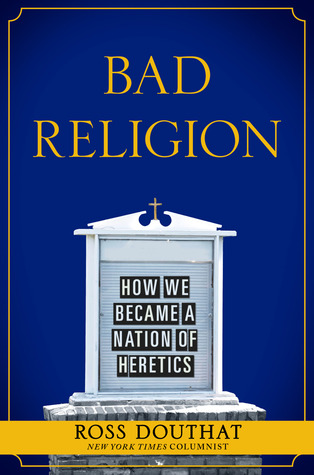
 America is not a healthy nation. Socially we have a host of ills that seem to be getting worse with each new election year. For some the blame lies at the feet of repressive religious groups who heave shame upon the victims of these social ills. For others the blame lies at the feet of the anti-religious and vocal minority who are fighting to steer the nation away from its historical roots as a “Christian Nation.” Ross Douthat doesn’t buy either of those arguments. The answer is far more complex. In his book Bad Religion How We Became A Nation of Heretics Douthat argues that America’s problem is not that it is too religious, nor that it is not religious enough, but rather that the type of religion it carries is a deadly Pseudo-Christianity. This sociological study is so comprehensive and so diligent in its arguments that readers can’t help but be convinced. We are not a Christian nation (if we ever were), we are a Pseudo-Christian nation, and it’s killing us.
Despite the best efforts of thinkers and authors like the late Christopher Hitchens, America is not an Atheist nation. We never could sell that worldview well in America. We have always been a religious nation and that is no different today than it was during its colonial founding. Douthat writes, “The United States remains a deeply religious country, and most Americans are still drawing some water from the Christian well” (4). The problem however is that it’s not genuine Christianity that has been flourishing in the last half century. Douthat adds:
But a growing number are inventing their own versions of what Christianity means, abandoning the nuances of traditional theology in favor of religions that stroke their egos and indulge or even celebrate their worst impulses. These faiths speak from many pulpits – conservative and liberal, political and pop-cultural, traditionally religious and fashionably “spiritual” – and many of their preachers call themselves Christian or claim a Christian warrant. But they are increasingly offering distortions of traditional Christianity, not the real thing. (4)
Pseudo-Christianity had displaced Christianity as the primary religion of our time, and therein lies the real culprit of our national woes.
Douthat breaks the book down into two parts. Part One deals with history. In an incredibly impressive way Douthat traces the sociological developments surrounding Christianities rise in the 40s and 50s to its declines in the 70s and beyond. The causes for both are many and varied and Douthat shows his skills in research and awareness as he looks at the key influences among both Catholics and Protestants and among predominately white churches and African-American churches. The second part of the book deals with the particular heresies that have manifested themselves in the popular culture of American society, and particularly those ones which have been passed off as Christian. The notable theologies included in this part of the book are Prosperity Gospel, God Within theology, and Nationalism. In each case he reveals how these theologies, with some modicum of truth in each, have boiled the faith down to one or two key doctrines and passed it off as the whole of the true Christian faith. Sometimes this has been done with the utmost good intention and sincere faith, at other times it has been done with dubious motivation and suspect education. Nonetheless, it has happened and our nation, while always making room for heresy, has never been so dominated by it. We are now paying the consequences for it.
The problems with each of these heresies are many, but Douthat’s overall concern is that in each case the heresies have neglected the balance that genuine Christianity as a whole gives us. Douthat writes:
In this America, the ancient Christian teaching that the Scriptures are simultaneously divinely inspired and open to multiple-interpretations has become an either/or choice instead. You’re either a rigid fundamentalist who believes that dinosaurs just missed hitching a ride on Noah’s Ark, or a self-consciously progressive believer for whom the Bible is a kind of refrigerator magnet poetry, awaiting rearrangement by more enlightened minds. As a result, the Jesus of the New Testament, whose paradoxical mix of qualities and commandments presents a challenge to every ideology and faction, has been replaced in the hearts and minds of many Americans with a more congenial figure – a “choose your own Jesus” who better fits their own preconceptions about what a savior should and shouldn’t be. (4-5)
The balance that the Scriptures gives us by means of its doctrinal and ethical tensions, mysteries, and paradoxes is lost by the narrowed focus of these various heresies. So, for example, Douthat points out the imbalance of the prosperity gospel heresy. He writes:
Like most heresies, [the prosperity gospel] resolves one of orthodoxy’s tensions by emphasizing one part of Christian doctrine – in this case, the idea that the things of this life are gifts from the Creator, rather than simply snares to be avoided, and that Christians are expected to participate in the world rather than withdraw from it. Then it effaces the harder teachings that traditionally balance it out. The result is a message that’s tailored less to the very rich than to the middle and working classes – to people who are hardworking but financially insecure, who feel that they have to think about money all the time because they’re trying to make more of it, and who want to be reassured that their striving is in accordance with God’s plan rather than a threat to their salvation. (190)
The heresy of the prosperity gospel has convinced religious Americans that it’s okay to be greedy, self-absorbed, and, despite Scripture’s insistence on the spiritual danger, driven by the love of money. The prosperity gospel tells us you can be both a faithful Christian and a money-hungry American pursuing the dream. The imbalance has been bad for our country even while individuals may feel more comfortable with it. “The result is a country where religion actively encourages the sort of recklessness that produced our current economic meltdown, rather than serving as a brake on materialism and a rebuke to avarice” (5).
Likewise the God Within theology has promoted a cultural therapeutic narcissism justified by religious language. Here the spirituality of Oprah and Deepak Chopra teaches us that you are god and the most important matter in the world is your own self-actualization and self-fulfillment. So the advocates of this heresy routinely encourage people to abandon their normal responsibilities in the pursuit of their own happiness, and justify that by calling it a divinely appointed journey. In this theology God is not a King to be obeyed and served, he is a “combination Divine Butler and Cosmic Therapist: he is always on call, takes care of any problem that arises, professionally helps his people to feel better about themselves” (233). In addition to this error the moralism of this so-called Moralistic Therapeutic Deism is incredibly weak. Pointing to Christian Smith’s research, Douthat quotes: The majority of those interviewed stated…that nobody has any natural or general responsibility or obligation to help other people (235).
The list of issues could go on ad nauseam. The heresies of the American religious scene reveal the real source of our national problems. We are not a Christian nation, nor are we an increasingly anti-religious nation. We are a Pseudo-Christian nation that lacks the proper balance of the Bible. Douthat is a New York Times columnist and an incredibly gifted writer. The book is a thoroughly enjoyable and engaging read. It reflects a breadth of research and knowledge that is rare, and reveals a knowledge of Christian theology, contemporary sociology, American history, and more that is impressive and helpful. Douthat has an impressive ability to bounce between issues of politics and theology, history and dogma. The book is thoroughly convincing, and while I won’t agree with all that Douthat says or believes (though his Catholicism doesn’t seem a far cry from my protestant theology) I highly recommend this book. As Tim Keller has so aptly said, “Everyone who is interested in why the church is faring as it is in the U.S. culture today needs to get this book.”
 Sparrow & Heart Soul Care
Hi Pastor Dave,
I agree with you that we’re a pseudo-Christian nation, but I’m not sure the Bible has the answers. Perhaps parts of it, but not in its entirety. I think people really want to believe, but as a nation of individuals, we’re increasingly projecting our own morality onto the Bible. It’s a culture shift that started decades ago and is slowly picking up speed. We’re seeing the ugliness of verse-mining fundamentalism with the Westboro Baptist Church, a regressive Catholic Church becoming increasingly vocal in a largely Protestant country, the fast growing Evangelical movement that preaches isolationism, and the shock value of Hitchens’ Atheism. To me, Christianity seems like it’s fast approaching its own Wall Street meltdown. It’s a mass of confusion and chaos bashing against each other. What happened to the unconditional love and open arms of the church? What happened to the meaning of being a good Christian? The entire message has been muddied by mixed messages.
The issue of living life the a balance of the Bible has led to the confusion. It raises the question of, “where do I find this balance?” which gave preachers poised to make a name for themselves the perfect time to layer their own messages into what people want, a fresh view of the Bible mixed with old standbys. It’s marketing tactics, the same ones employed by used car salesmen that are driving the divide. All it takes is a hook; something familiar mixed with something new then a whole generation of Christian Americans are lost.
Ross is of course a fully paid up member of the establishment in both its “religious” and secular forms – although it seems as though he likes to pretend otherwise, or that he is some kind of gad fly.
It seems to me that the kind of Christianity that Ross Douthat actually promotes is very much in the tradition as pictured and described in these references.
The blood-soaked applied politics of Constantines famous sword.
http://www.dartmouth.edu/~spanmod/mural/panel13.html
http://www.jesusneverexisted.com/cruelty.html
http://www.logosjournal.com/hammer_kellner
Note the unspeakably vile sado-masochistic snuff/splatter movie being reviewed in the third reference.
Also do a Google on Columbus & Other Cannibals by Jack Forbes.