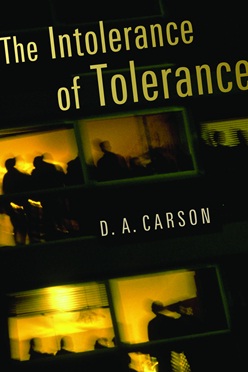
The notion of tolerance is changing, and with the new definitions the shape of tolerance itself has changed. Although a few things can be said in favor of the newer definition, the sad reality is that this new, contemporary tolerance is intrinsically intolerant. It is blind to its own shortcomings because it erroneously thinks it holds the moral high ground; it cannot be questioned because it has become part of the West’s plausibility structure. Worse, this new tolerance is socially dangerous and is certainly intellectually debilitating. (2)
D.A. Carson is research professor of New Testament at Trinity Evangelical Divinity school, this is not a book directly about the New Testament. But Carson believes the subject is so worthy of our attention that he is stepping beyond his bounds of expertise to address it. And make no mistake, this erudite volume reflects Carson’s qualifications as a legitimate Renaissance man. Though the volume is largely a sociological study of the changing face of American culture, Carson can handle the task well. The monograph is on more that just a shift in semantics too. It is a reflection on the changes to the current intellectual landscape and values system. For Carson the new understanding of “tolerance” is actually far more intolerant and insidious to our culture than its predecessor was .
The book aims to expose the hypocrisy of the “New Tolerance.” Carson argues first that though the new tolerance claims to be just that, it is actually far more intolerant that we are led to believe. Secondly, he argues that despite its intentions the new tolerance is actually far less conducive to a genuinely religiously diverse culture.
The New Tolerance is Actually Intolerant
Understanding the distinction is important. The old tolerance, Carson argues, allowed for people to hold differing views. It also allowed for people to argue for the supremacy of their view, even vociferously, in public. It agreed that there was such a thing as objective truth and that two mutually exclusive contradictory views could not both be right. Yet it maintained that people were welcome to hold their respective views with conviction. The new tolerance, however, holds that people have a right to never be offended. That two views, no matter how contradictory, can both be right and no one should ever be told they are wrong. This, I suppose, does sound more loving, more “tolerant.” But, as Carson repeatedly argues, all tolerance has limits. And the limits of the new tolerance are much more pronounced than its proponents are willing to admit.
Carson gives a plethora of examples, ranging from mild in nature to the utterly inane. He writes about the town of Dudley, Worcestershire in England, which banned any representation of pigs from its benefits department “on the grounds that Muslims coming in for benefits might be offended” (24). He writes also about Michael Houellebecq, a respected French writer. In a magazine interview he wrote that Islam was “the dumbest religion,” he was promptly taken to court for “inciting religious hatred” (26). Scott McConnell was dismissed from his graduate program for writing a term paper that argued for corporal punishment (28-29). Several universities in Britain banned Christian organizations from campus on the grounds that they required officers to hold their views on faith (31). Carson’s lists are long, sometimes almost overwhelming evidence is provided to prove his point. And that point is clear: in order to promote “tolerance” advocates of the new definition refuse to tolerate those who disagree with their views. There is discrimination happening against someone, someone is not permitted to promote their view, discuss their view, or simply practice it publicly. But it is discrimination all in the name of “tolerance.” Carson adds:
The new tolerance tends to avoid serious engagement over difficult moral issues, analyzing almost every issue on the one axis tolerant/intolerant, excluding all others from the pantheon of the virtuous who do not align with this axis. Perhaps the saddest blind spot of all in this stance is the failure to recognize just how culturally driven this particular defeater belief is. (15)
The new tolerance refuses to have discussions about moral issues, for after all that might offend someone. The result has been, argues Carson, that the new tolerance has dominated the “conversation.” The advocates of this view have “won,” so to speak. And this has led Carson to argue that the new tolerance is not simply inconsistent, but it is agenda-driven. He writes that the new tolerance appeals “to tolerance selectively in order to promote their own selective values. This is not merely accidental inconsistency; it is inconsistency with an agenda” (84).
The New Tolerance Does Not Favor Religious Pluralism
Advocates of the new tolerance certainly do think they promote religious pluralism. After all if you’re not allowed to say that Islam or Hinduism are wrong then that promotes religious diversity, right? But Carson suggests that the new tolerance is actually not favorable at all towards Christians, and actually undermines the convictions behind all religious belief.
I am not one to jump on the “victimized Christians” bandwagon. I recognize that all too often Christians receive the kind of criticism that they have earned. But Carson gives a litany of examples where the common denominator of those being discriminated against is their Evangelicalism. He points to countless examples within academia. He also mentions the Co-operative Bank, based in Manchester, which forced a Christian organization to close its account with them because of its stance on homosexuality. Carson comments on this example by stating, “Thus in the name of supporting diversity the Bank eliminates one of its diverse customers” (22). Because Christians hold a number of controversial positions, rooted in Scripture, and hold them with sincere conviction, and because they seek to act on those convictions it makes sense that they are often the target of discrimination. So while the new tolerance advocates for religious pluralism and unfettered diversity, it is selective on who reaps the benefits of this “tolerance.”
Furthermore, Carson argues, the new tolerance doesn’t have much support for religious belief at all. In the marketplace of ideas religious beliefs are to have no actual influence. Secularism, Carson argues, has won the dominate foothold on Western culture. And that means that while religious belief is acceptable in a person’s private life, it is not welcome in the public square. Carson spends a whole chapter developing this idea more thoroughly. The new tolerance trivializes genuine faith, he states, by suggesting that citizens simply put it on the shelf while they conduct themselves at work and in the voting booth. The facts about this new tolerance and its relation to religion are far more problematic for people of faith than they first appear. The new tolerance is, in fact, not so tolerant of religious conviction…especially Evangelical.
I am not a big participant in the whole “culture wars” discussion. Often it seems a lot like fear-mongering and teenage drama (he said/she said kind of stuff). But Carson’s writing here is impressive. It lacks neither in breadth of content nor insight. And he calls his Christian readers to take action. The book ends with ten suggestions for moving forward. He calls us to, at some level, emulate his response. “Expose the New Tolerance’s moral and epistemological bankruptcy” (161), expose its “condescending arrogance” (165), and “challenge Secularism’s ostensible neutrality and superiority” (169). But he also call us to grace-based living. “Practice and encourage civility” (172), evangelize (173), and “Delight in and trust God” (176). The final suggestion is, in my opinion, a key practice to remember after reading this book.
It’s important to know our context and be aware of the culture in which we live and move and have our being. But it can generate real fear for some; a bath of anxiety can engulf the church if we are not careful. We must remember who holds the world in His hands. I feel as perhaps I should be more engaged in this conversation than I have been; Carson has opened my eyes to more of my context than I previously saw. But at the end of the day I want to stay ultimately focused on the mission of God. I want to trust that he is controlling all things and I needn’t fear the future. Words may change, and cultures may change, but our God remains the same.
 Sparrow & Heart Soul Care
1 Comment