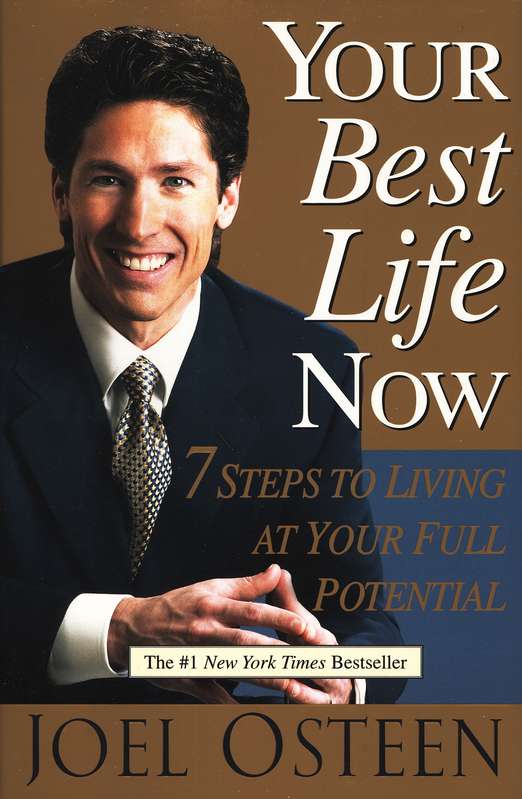
 Due to my wife having surgery last week I was unable to finish reading Grenz and Franke. The review will be ready next week, but in the meantime enjoy this reflection on Osteen’s controversial work.
It’s not uncommon for pastors and theologians to point out what’s wrong with Joel Osteen’s theology in his book Your Best Life Now and similar messages. Most of them cite the fact that the Bible guarantees suffering for believers, not success. In fact those closest to Jesus in the early church were martyred and the church faced many years of persecution under the Roman Empire prior to Constantine. It makes little sense to claim that God wants us to be healthy, wealthy, and wise when we read passages like Romans 5:3, 8:18, 2 Corinthians 1:5-7, Philippians 3:10, 2 Timothy 2:3, 4:5, James 5:10, 1 Peter 2:19, 4:13 and countless other passages. It is fair to point out that Scripture also invites us to pray for healing, for recovery, for victory etc. but this in no way binds God to our requests or obligates Him to meet our demands. We must be balanced and careful here in the kind of theology we build. Having prefaced with all of that talk, however, I think there is a related issue to Your Best Life Now that does not often get addressed, and it is the self-centeredness of this type of theology.
Scripture calls us not infrequently to pursue the interests of others above our own (Philippians 2:3-4), to be devoted to building up the saints (1 Thessalonians 5:11) and loving our brothers in such a way that we are willing to lay down our lives for them (1 John 3:16) and share our possessions with them (1 John 3:17). This is only a small sampling, too, of the full picture of Scripture which calls us routinely to self-sacrificing and self-denial (Matthew 16:24; see also Mark 8:34 and Luke 9:23). This, however, is not the message of Osteen’s book.
What are we to make of the Biblical call to self-denial and pursuit of the interest of others, and of the Osteen call to pursue your own gain and your own treasure. Furthermore, what are we to make of pursuing that treasure now, here on earth, instead of “storing up in heaven” our treasure and waiting for our best life then, when we are in the presence of Jesus? Listen to how Scripture speaks of our treasures, of our best life.
Jesus, in speaking to the rich young ruler (a man who had his treasure now), says this:
21 Jesus said to him, “If you would be perfect, go, sell what you possess and give to the poor, and you will have treasure in heaven; and come, follow me.” (Matthew 19:21)
What does Jesus call him to do? To give up earthly treasure with the knowledge that there is greater treasure in heaven. The lessons continue. As a point of application for the disciples who were fearing what they were going to eat Jesus says:
33 Sell your possessions, and give to the needy. Provide yourselves with moneybags that do not grow old, with a treasure in the heavens that does not fail, where no thief approaches and no moth destroys. (Luke 12:33)
Jesus draws, again, this contrast of care for those in need in this world and treasure stored up in heaven. It’s not, of course, that Jesus hates wealth or call us to a life of poverty. The fact that you may or may not have wealth is not really the issue, the issue is whether or not you pursue it as “best” for you, instead of pursuing God and instead of caring for His people.
There is a distinction then, it seems, between Osteen’s message and Jesus’ message. We are to focus on others and we are to store up treasure in heaven if we want to follow Jesus’ model and Jesus commands.

