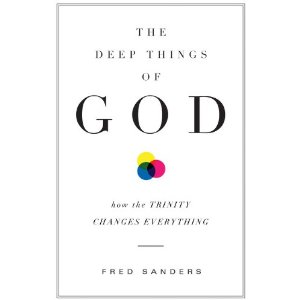
 Like discovering that Linkin Park doesn’t make good music, there are certain moments when we realize that it gets better! Fred Sanders wants us to see how much better it can get by pointing us to the Good News behind the Good News. For Sanders that good news is found in the very person and essence of God. That’s what he argues in his book The Deep Things of God: How The Trinity Changes Everything. The Trinity is the good news (9). He states, “The central argument of this book is that the doctrine of the Trinity inherently belongs to the gospel itself” (9). Sanders believes that without this connection between doctrines then we may actually have a diminished gospel. I think he’s right. This book does more than just give a freshness and practicality to the doctrine of the Trinity. This book renews our understanding of the gospel itself.
Sanders understands that the doctrine of the Trinity has become a valued belief in name only for many evangelicals. He understands that “To many evangelicals, the stakes of thinking about the Trinity seem too high and the payoff too low” (8). We believe in this doctrine, but we haven’t really the slightest idea what to do with it. But, according to Sanders, “No matter how much the doctrine may have become nonfunctional in the self-understanding of contemporary evangelicals, a robustly Trinitarian view of salvation has been the core…of the historic evangelical faith” (10). All of this shallowness is causing serious problems, particularly in the area of discipleship.
Sanders believes that our lack of understanding the doctrine of the Trinity has actually led to very poor, very imbalanced, view of the gospel itself. He writes:
Many evangelicals seem haunted by a sense of not being about anything except the moment of conversion. When they stop to ask themselves where they are taking their converts, they fear when they get there, there will be no there there. (12)
In fact we have boiled discipleship down to believing certain things. A reductionist evangelicalism has been taught that the whole of the Christian message is simply “Bible, cross, conversion, and heaven” (16), and this is all they know and all they teach. But they feel there must be something more.
Even more alarming, perhaps, than a reductionist evangelicalism is a reductionist gospel itself. Sanders whole book spends a great deal of time showing the relationship between the gospel and the Trinity. He strongly believes, and in no-uncertain-terms declares, that a diminished gospel, reduced gospel, partial gospel is NO GOSPEL. In one of the most powerful passages in the book Sanders writes:
A gospel which is only about the moment of conversion but does not extend to every moment of life in Christ is too small. A gospel that gets your sins forgiven but offers no power for transformation is too small. A gospel that isolates one of the benefits of union with Christ and ignores all the others is too small. A gospel that must be measured by your own moral conduct, social conscience, or religious experience is too small. A gospel that rearranges the components of your life but does not put you personally in the presence of God is too small. (106)
So what, then, is the solution? The answer to this reductionism is to look to the great reality beyond salvation. To move behind the good news, to the very person of God. This answer Sanders sees most clearly discussed in the classic Christian work of Henry Scougal. Speaking of Scougal he writes:
Here Scougal breaks through to the fact that the gospel can be accounted for only by reference to something above and beyond the imminent realities of head, hand, and heart. True religion is a divine life, and by definition divine life is something found in the living God. (116)
If we want to avoid reducing the message of salvation then we must look to the source of our salvation. The more we understand the person of God, three in one, the more we will see the totality of salvation and not merely the various elements and implications of it.
The book is brilliant in this deduction. And Sanders reveals himself to be a stellar systematic theologian as he works through this doctrine. He also reveals his skills in writing as he turns phrases after phrase of witty wry humor into meaningful statements. He is at once both provocative and respectful, humorous and responsible. The work will be regarded as a classic in years to come, I am certain of that. It is on the relationship between the good news and the Trinity that The Deep Things of God will make its lasting impression.
The sub-title of the book states that the Trinity changes everything, and Sanders takes time to show us the major things that understanding the Trinity reshapes and renews in the Christian life. He talks about the Christian life, reading Scripture, and praying and demonstrates how the doctrine of the Trinity is both inherent in these elements and yet overlooked. He discusses, then, how each is renewed by understanding the influence and placement of the doctrine of the Trinity. But by clearly connecting the gospel to the Trinity Sanders does us a great service.
Ours is a theological climate where everything about the gospel is being challenged and redefined. Sanders offers us a redefinition of sorts, but it is one back in line with Scripture. Some will see resonance of John Piper’s God is the Gospel here, but Sanders does the subject a much better treatment. By grasping the good news behind the good news the church will be healthier. Pick up and read The Deep Things of God and find that the Trinity does indeed change everything, not least of which may be you!
 Sparrow & Heart Soul Care
2 Comments