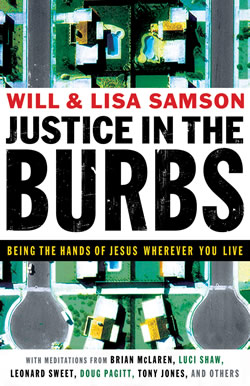
Will and Lisa Samson are the kind of couple I could definitely enjoy getting to know. I’d love to pick their brains over coffee or listen to their life stories over lunch. The couple lived in a Missional commune in Lexington, KY and have had their hands in a number of social justice projects and organizations. Together they are also the authors of Justice In The Burbs: Being The Hands of Jesus Wherever You Live. The title of the book alone captured my attention, for this is a subject on which it appears there is little written and yet much need. The book, however, is less a practical guide or method book and more of an inspirational call to participate in social justice. The book lacked in some areas for me (see below), and some of the “meditations” were not simply less than orthodox (see below) but were also so pretentious that they were actually unhelpful. Nonetheless, I believe the Samsons themselves have offered a solid motivation for average suburbanites to start a justice movement in their own homes, and perhaps their own communities.
The book is broken down into three parts: first, a fictional story gives readers a clear picture of what the principles of each chapter look like acted out in real life; second, a discourse that focuses on the specific concepts to be applied. Here the authors lay out specific ideas, support them, and offer scripturally and practically grounded motivations for just actions; thirdly, a meditation where some of their friends (largely from the Emergent Village) reflect on the concepts Will and Lisa outline. The book’s strength is largely in the narrative portion at the front of each chapter. Here Lisa Samson, who is also a novelist, offers charming characters who, like us readers, are trying to figure out how to live out their Christian faith in this messed up world. Throughout the discourses Will and Lisa reveal some surprising insightfulness and theological acumen. Largely their theological points have been made by others, such as N.T. Wright, Ron Sider, and Tony Campolo, but Will and Lisa do a good job of stating in concise language the major arguments for Christian concern for social justice.
The book largely follows the leading of the narrative. As the fictional story about Matt and Christine unfolds we find them going from typical suburbanites to fully invested justice workers. With that in mind the layout of the chapters has the same feel as the way the average mind works. Interlaced throughout the book is both motivation and argument, joy and worry, excitement and caution. So chapter one begins with a defense of the book’s objective. “In many ways,” the authors write, “the struggle for justice can be seen as one of the defining issues of humanity, one o important framework for understanding all of history” (29). Arguments continue in chapter two as the authors turn to consider what the Scriptures say about this issue of justice. They point out not simply that the Bible speaks to this issue of justice, but more pointedly in chapter two, they discuss much of the American churches shallow reading of Scripture. “Most of us engage in a very superficial and reductionist reading of the Bible that allows us to maintain misconceptions, preconceptions, and just plain erroneous ideas” (46)… “We need a new view of Scripture” (47). Chapter three reflects on the varying issues that prevent us from engaging in social justice. So the Samsons site our common fears, over safety. They cite our obsessions with business and comfort/ease as those who work hard, play hard, and live in the suburbs (note the inner city). In fact in very keen insightfulness they point out that most folks move the burbs precisely because they don’t want to be bothered by all the great needs of the inner city, even if that is not expressly stated. Finally they cite the theological and political issues which prevent some. There has long been a concern that social justice meant “liberal” and since the church has a now tight relationship to the political right this is an unacceptable fit. Throughout the book Will and Lisa do a good job of pointing out that the church has a long history of helping those in need and it has nothing to do with politics, rather it has everything to do with Jesus.
As chapter four begins the authors shift their focus, believing that at this point faithful readers will be convinced and ready to jump into the social justice pool. Their concerns now shift from foundational arguments to motivational ones. They want to encourage this desire. They speak from experience, it seems, when they acknowledge that the process can be overwhelming. You don’t need to initiate some massive project, but rather join up with those all ready working. “This change in thinking has requires us to move away from the category of ‘starter’” (77). Secondly, they point out that our work doesn’t always have to be in and through the church. There are plenty of good organizations doing this work that are unaffiliated with the church (78). But above all, they say, “do something.” “We would rather think more, study more, make sure we have the ‘right’ answer. That would be the wrong response. More than anything else we could emphasize, we want to be sure that you hear this message loud and clear: do something” (78-79).
Chapters 5, 6, and 7 attempt to keep the momentum going. The authors realize the temptation will be to throw in the towel when it gets tough. They are quick to point out that giving up has serious consequences for our world, our church, our future, and generally speaking, then, us. Chapter 7 specifically prepares us for the backlash that comes as we stop pursuing the American dream and pursue justice, which always comes with sacrifice and which always looks weird to the watching world. The story of Matt and Christine does a great job of exploring what it looks like when your friends and family don’t embrace the burden for justice. In sad pictures we see as Christine’s own mother and friends grow not just suspicious of her work and concern, but even hostile to it. Their advice is both sound and biblical, however, for the Christian facing this. They do not promote brow beating or dishing out guilt, rather they encourage mutual conversation and love. “Keep your relationships. Maintain your bonds. Live justly, but do so in a way that is winsome and calls others to join in” (122).
The latter half of the book, chapters 8 and on, come to find us fully embracing the call to live justly. So the focus of the chapters shifts again. This time Will and Lisa give us help in navigating this new world that we are passionate and excited to participate in. They warn us that as “outsiders” coming into the world of socially concerned movements and organizations it will be important to demonstrate our commitment. We are outsiders, they emphasize, but we don’t have to remain outsiders. Be willing to serve and work for the long haul (a popular phrase used in the latter half of the book). Chapter 9 builds upon our acceptance with a theology of place. Surely the Samson have seen and personally experienced the urge some have to leave suburbia and move to the inner city, where social needs are “real.” After all, they point out, there aren’t many poor and homeless in the burbs. But Will and Lisa believe that to move out of suburbia would be a mistake. “Wherever you are that is where the kingdom of God is at work. There is no neutral place…If you find yourself in the suburbs, welcome to your mission field” (151).
Chapter ten really could have served as the final chapter for me. The last two chapters, which deal with the blessing of being part of a long stream of social workers (chapter 11) and the warning that in this kind of ministry there is no quick fix (chapter 12) are helpful but really rather redundant. Chapter ten, however, is the most practical of all in the book. With very specific suggestions and recommendations Will and Lisa offer the readers an entrance into these “justicey” things. They urge us to start in our home. Living a life of justice through what we eat, buy, use, and consume is a necessity if we are really serious. The helpful tips and specific information in this chapter were gold for me. I now have specific ways in which my family and I can make changes to our living that will put us in the stream of just living. They then urge us to move beyond our home to look at our community. What needs exist right where we live. Latchkey kids? Lonely widowers, widows, divorcees? Finally they want us to think larger. Think about national organizations that you can participate with like Habitat for Humanity, Rescue Missions and Food Pantries. If the book contained more of these types of suggestions and recommendations I would have bought up dozens of copies and past them out at my church. But as it stand I probably won’t do that, and there are several reasons why.
Ultimately the book is really a good book, and yet I have some qualms about its content, particularly its meditations. At the end of each chapter the authors have invited some of their friends to reflect on the concepts in the chapter. Most of these are toss away reflections. They add almost nothing to the content. If that were the only issue I wouldn’t probably squabble about it. But on several occasions the content in these reflections was seriously misguided. Take for example Tony Jones’ reflection on living justly in the burbs. He connects with the cry of many of us that it is truly hard work. “My only hope,” he writes, “of living justly in the burbs is complete reliance upon God’s Holy Spirit.” I say, amen to that. But then he adds these words, “And honestly, I have enough confidence in the Spirit to believe SHE will guide me into living more justly, because SHE lives in the burbs with me” (64). Now here’s my question? Why is he referring to the Holy Spirit as a she? I can anticipate the response, a common Emergent one, that since God is spirit and therefore asexual God has no gender, therefore we can refer to him/her with which ever identifying label we choose. Okay the point is fair enough, except that God always uses male pronouns to identify himself in Scripture. Only a few occasions do we get God calling himself by female labels (a mother hen, etc.), but even these have specific contexts of analogy, not actual identification. Furthermore there is a theology built into God’s gender identification that is not simply contextually bound to patriarchal cultures. God identifies himself as male because he has set up an order with male headship in the home and the church.
I recognize that for some it will sound like I am taking issue over the theological minutia, but I don’t believe this a small matter. What is common among the Emergent types is the discounting of Scriptural teaching based on the assumption that so much of it is isolated to ancient contexts and only general principles can be applied to today. This underlying philosophy is, in my opinion, a disastrous hermeneutic for the church to adopt. We see it even in the discussions about our need for a “new view of Scripture.” I appreciate the discussion of that point about the reductionist reading that so many have of Scripture. But there is a subtle trend in the book, largely via the “meditations,” that the orthodox understanding of Scripture is not right. So Leonard Sweet paints a picture of the apostle Paul’s teaching as devoid, or nearly, of “propositions.” He writes, “Paul is not at all interested in quoting the propositions and ‘stands’ of Jesus. What absolutely mesmerized Paul, however, was the person of Jesus and what he did…”(96). Doug Pagitt writes similarly in his reflection. Speaking of how he his own changing faith may have influenced his daughter he writes:
Maybe a model of evolving faith is just what is needed to live in a world of great change. Maybe Michon has learned from our changing practice of faith not to lock into just one way of thinking and living. Maybe she will know deeply in her being that she ought to go easy on people with whom she disagrees because just like her dad, they may be perfectly confident in things now that they will question later (124).
Again, I love the sentiments of these kinds of comments, and yet I know where Doug Pagitt is theologically too, and it’s not orthodox. So his “changing faith” has gone far left of the Scriptures. So naturally I am suspicious of such comments, and of the general demeanor the book in its “reflections” of Scripture, the Christian life, and the gospel. I don’t know who all the other authors are, nor do I know where Will and Lisa fall on these issues (though they seem refreshingly orthodox for Emergent friends). I don’t mean to make judgments and speak ill, here, only to cite reasons for my concern. I really loved this book in many ways, but because of its associations and the comments made in light of them I am cautious at best.
Will and Lisa Samson have done a great job of inspiring Christians to care about social justice, and for that I commend them. And while I won’t be handing out copies at my church I will be utilizing the concepts of this book to inspire my church to care, like Jesus, for the lost AND the least. For the burbs need the presence and love of Jesus too!

