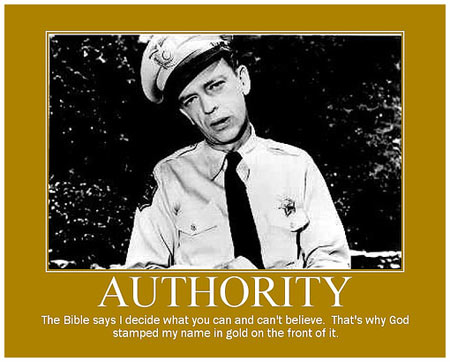
To speak of Scripture’s authority is to speak of its right to hold sway over our thinking and acting. The Bible, then, is the standard, the norm, the supreme source of truth to which we must submit. So Wayne Grudem writes that to speak of the authority of Scripture is to say, essentially, that to disobey Scripture is to disobey God himself (Systematic Theology, 73). We will look, in the coming posts, at the application of this doctrine to daily living, but I want to consider today the source of this authority. What makes Scripture authoritative? There are a couple of views on this point and it is worth considering if we are to build a right theology of scripture.
I remember a friend of mine from my undergraduate Greek courses. He was a sharp kid, far better at Greek than I was, and knowledgeable about a great many things. Over the course of the two years of Greek we took I routinely talked with him about Evangelicalism, about Jesus, the gospel, and Scripture. He ultimately found it interesting, but not any better than other world religions. For him, Scripture gained its authority only through the readers’ conferring authority upon it. Authority then really resides in the autonomous individual, who then determines to grant Scripture authority over them. It’s not legitimate authority, it’s Barney Fife authority. This is a fairly common approach, especially with our postmodern reader-response hermeneutic, which declares that all meaning is determined by the reader of the text, not by the text itself. The problems with this are numerous. For starter’s it’s really a charade. In this view we are not really granting Scripture authority, for ultimately we retain the right to determine when and if the Scriptures speak authoritatively. Secondly, and perhaps more importantly, this view ignores the very words of Scripture which declare that they are a Word from the Lord.
A second view is a bit more nuanced than the previous. Some have contended that based solely on the content of Scripture we may deduce the authority of Scripture. After all, if it is true that the Word testifies to its own authority, then it seems to indicate, clearly, that authority is derived from self. John Frame points out that this view has much to commend to us. Most of us, he points out, come first to believe the content (the gospel of Jesus in particular) and only after this come to affirm the authority of Scripture. Furthermore, he states, this view does acknowledge the self-attestation of Scripture. But, as Frame also points out, this view has two major defects: (1) It has led some to suggest that authority is really derived from our subjective affirmation of the content, leading us back to view one; and (2) It has led others to believe that because some parts of the Scriptures are, seemingly, not connected to this major theme of the gospel not all of Scripture is, therefore, authoritative (Doctrine of the Word of God, 164).
Okay, I feel your headache coming on. I know all of this talk sounds like crazy, useless, theologizing. The stuff of pastors, nerds, and people with no real jobs, but the final point will, I think, make this all clear.
The final view, and the one that we must ultimately accept, is that Scripture’s authority is derived from its author (i.e. God). Scripture is authoritative because God, the one who wrote it, is the authority. John Frame puts it this way:
Divine authorship is the ultimate reason why Scripture is authoritative. Its authority is absolute because God’s authority is absolute, and Scripture is his personal word to us (165).
There are several reasons to stress this point.
First, it is important to stress this because it makes a close association between God and His Word. Spirituality and interest in God is trendy today, obedience to God’s Word is almost never trendy. But one cannot rightly say that you serve God, obey God, honor God, respect God, etc. if one also insists on disobeying His Word. They are intimately intertwined. To disobey the Word is to disobey God!
Second, it is to distinguish between God and His Word. Bibliolatry is as much a sin as is the worship of other gods. We do not worship the Bible; it is not the same as God. God and His Word are not synonymous. The Word is authoritative, but it is such because it is from God, the real source of authority. We must not confuse the two, even while we hold to their intimate association.
The Word of God is the Christian’s final and ultimate source of authority. This, as we have seen, does not mean that we ignore the roles of reason, science, philosophy, etc. But it does mean that Scripture is supreme. In upcoming posts we will begin to see this doctrine in application. For the moment, however, reflect on this point that God’s Word is authoritative because it is GOD’s Word! Remember the authority of God almighty as you read and study your Bible this week. To disobey the Word, remember, is to disobey God…now read more carefully.
 Sparrow & Heart Soul Care