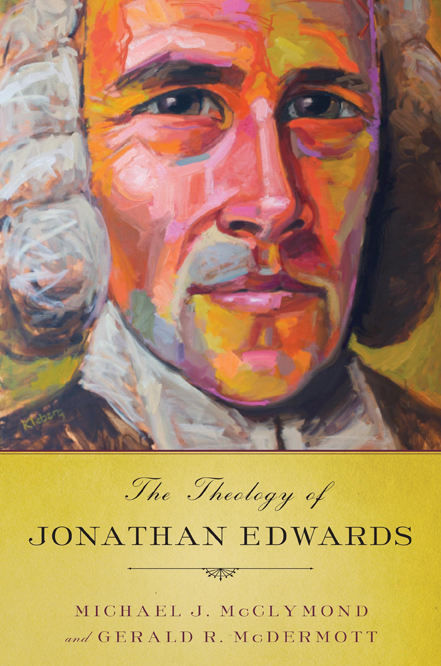
 You need at least 700 pages to even remotely unpack the theology of Jonathan Edwards. The man and his thought are so complex anything less than this couldn’t even approach comprehensiveness. Combine the page count with two established and recognized scholars in the field of Edwardsian study and you have what amounts to the most current comprehensive treatment of Jonathan Edwards’ theology. In particular the authors achieve a level of comprehensiveness due to their “symphonic” approach to Edwards’ theology. The Theology of Jonathan Edwards is insightful because of the authors’ abilities to hear all the various sounds coming from Edwards’ thought.
It cannot be easy to attempt a whole theology of Edwards. The man wrote so prolifically, on a wide array of subjects, and is often very dense. He broke new ground in some fields and yet saw himself within the main flow of the Reformed tradition he inherited. He has been hailed as everything from a traditional orthodox Calvinist to a pseudo pantheist. The perspectives on Edwards are wide and diverse. McClymond and McDermott seem to think this is a result of an overemphasis of one or more aspects of Edwards’ theology. The best approach will recognize the diversity of writing and will read each part in line with the whole. They compare it to hearing a symphony.
To construe Edwards’ theology as a whole, one might distinguish the imaginary orchestra into five parts – violins, the other strings (violas, cellos, and basses), woodwinds, brass, and percussion. To appreciate the music requires that one pay attention to all five constituents in the orchestra. (4)
The goal, they say, in trying to do a whole theology of Edwards is to understand the placement of each major emphasis in his writings as they relate to the whole. The reality of many interpretations of Edwards’ theology is that they only capture one sound in the whole symphony. McDermott and McClymond write:
A caveat regarding many existing interpretations of Edwards’s theology is that they capture one or another part of the symphony, yet fail to construe the sound and flow of the whole. Some listeners seem to be sitting so close to the woodwind section (i.e. the Calvinistic or theocentric aspect) that they cannot hear the violins and other strings (i.e., divine communication and creaturely participation), and so they miss out on some of the loveliest melodies and most refined harmonies of Edwards’s music. (8)
This symphonic approach, what I might call a “perspectival approach” allows them to capture and fairly treat all the various aspects of Edwards theology as a whole.
They evidence their abilities particularly well in their discussion of Edwards’ own methodologies. The Theology of Jonathan Edwards captures a myriad of methods and strategies that evidence themselves across the breadth of Edwards work. The book highlights themes like beauty and aesthetics (chapter 6), metaphysics (chapter 7), typology (chapter 8), and reason and revelation (chapter 9). The authors look at how Edwards does apologetics, exposition, and Biblical theology as well. In each case they are looking at the whole of his theology from a different angle, describing the variety of methods that inform his theological approach as a whole. Other authors have either emphasized one aspect to the exclusion of others – for example John Gerstner focuses so heavily on Edwards use of reason and revelation that he never even touches on aesthetics (see The Rational Biblical Theology of Jonathan Edwards, 3 vols.). Stephen Holmes, on the other hand, talks very little about Edwards’ methodology and views him rather as a traditional Calvinist (see, God of Grace & God of Glory). McClymond and McDermott offer a far better look at the overall approach of Edwards to developing his theology.
I thoroughly enjoyed this work. It is both comprehensive and academic, yet it is very easy to read. The authors have great skill in making the content of Edwards’ thought accessible to readers, breaking down his logical progressions in more manageable bits. They give readers not simply an introduction to Edwards, but a very thorough summary of his thought and the context in which it arose. In that regard The Theology of Jonathan Edwards stands alone among works of its kind.
 Sparrow & Heart Soul Care