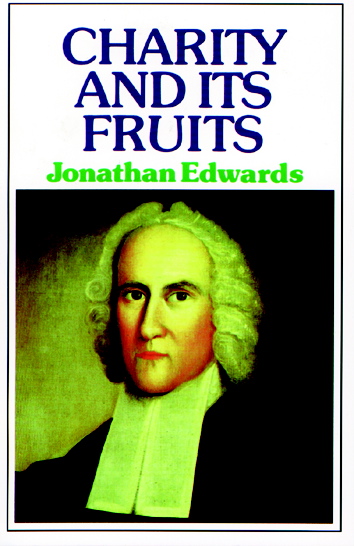
 What does it mean to be a Christian? There are lots of ways people tend to answer that question. Jonathan Edwards answered it by looking to love. “All that is distinguished and saving and true Christianity [can] be summarily comprehended in love.” In Charity and its Fruits Edwards gives us more than just ethics, he gives us true theology. A true theology of love understands it as a practice of grace.
This is one of the more interesting works of Edwards’ that I have read this year. Edwards is a deep thinker, that is no less true in Charity, and yet, this work is more directly practical than the other works of his I have read. This emphasis is drawn largely from the context in which Edwards wrote the series of sermons. He was highly concerned that the professed converts of his Northampton Congregation from days of The Great Awakening were not genuine. Their practice did not seem to match their profession, particularly in the area of love towards neighbor. So this series was intended to press upon them, as it must upon all readers, that a genuine work of the Spirit results in love. As an exposition of 1 Corinthians 13 the pastor sought to apply the text to his people as a test, to encourage them to evaluate the genuineness of their profession.
The motivation for this love stems from the believers interaction with the God of love. Throughout the various “lectures” Edwards reiterates this point, but it is encapsulated best in his final sermon in the series, “Heaven is a world of love.” Speaking of the relationship of Father, Son, and Holy Spirit he writes:
There in heaven this fountain of love, this eternal three in one, is set open without any obstacle to hinder access to it. There this glorious God is manifested and shines forth in full glory, in beams of love; there the fountain overflows in streams and rivers of love and delight, enough for all to drink at, and to swim in, yea, so as to overflow the world as it were with a deluge of love.
God is the fountain of love, and heaven a world where the love can overflow without any obstacle or impediment. The believer’s experience of this love compels him to love others and gives evidence of his experience of true saving faith. In fact coming into relationship with God is the ground for all love to men. Again, Edwards, writes:
Love to God is the foundation of gracious love to men; and men are loved, either because they are in some respect like God, in the possession of his nature and spiritual image, or because of the relation they stand in to him as his children or creatures – as those who are blessed of him, or to whom his mercy is offered, or in some other way from regard to him.
Edwards grounds his motivation properly in the supernatural experience of the Triune God. But this experience results in practice. That is really the strength of the book.
As Edwards unpacks in his usual logically exhaustive way the concept of love as the ultimate Christian virtue he argues that “all true Christian grace tends to practice.” Where modern Christians have all too often divorced belief and life Edwards wants to show their necessary connection. This is not a sentimental work on love. It is simple and direct. To love God means to love and hate respectively what God loves and hates. Where so many modern works on love may tend towards the dramatic or the theological anemic definitions, Edwards stands strong on redemptive work of Christ as the foundation of love. We love because he first loved us, and if we’ve experienced that grace it will compel us to show love to neighbor.
Though Edwards was writing a series of sermons for his very specific congregation, nonetheless we need to hear his message. We have recovered a great sense of love for neighbor in American Evangelicalism. Missional movements combined with charitable giving and passion for social justice have come to dominate the landscape of particularly young Evangelicalism. But without the solid theological foundations driving this practical work we will not have a proper perspective or motivation to love our neighbor long-term. Edwards combines solid theology and practical instruction in this work. It is a true theology of love, because it understands love is a practice of grace received from God.
 Sparrow & Heart Soul Care