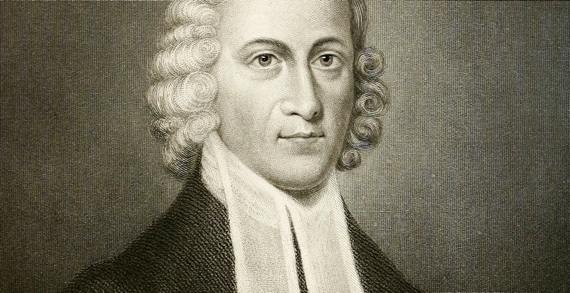
 The most important thing I’ve learned from spending this year studying Jonathan Edwards is that it is impossible to spend a year studying Jonathan Edwards. Edwards’ writings are both prolific and dense. To do justice to a single work requires readers to move slowly through them. Furthermore, Edwards wrote so many different works that to read them all, as well as to read the critical commentary on said works, requires more than a year. I have barely scratched the surface on Jonathan Edwards. Yet, in thus far this year I have learned a great deal both about the great Puritan preacher and about good theological methodology. As I head towards the end of the year I want to spend some time introducing my readers to, and formalizing my own thoughts on, Jonathan Edwards theology. To begin with, then, we will consider Edwards’ theological methodology. Edwards theological method can be summarized in a variety of ways.
The late John Gerstner described his approach as Biblically rational. In his magnum opus, The Rational Biblical Theology of Jonathan Edwards demonstrates that while he is thoroughly committed to the inerrancy, authority, and sufficiency of Scripture, Edwards was nonetheless engaged with the most progressive rational thought of his day. Gerstner shows the influence that both non-Reformed and even non-Christian writers had on him, and how Edwards reshaped and refashioned those influences to fit his Biblical theological framework. He was both thoroughly Biblical and thoroughly rational.
McClymond and McDermott call it a symphony. Edwards was a man consumed with discovering the harmony of all things. He drew together the various aspects of his theology and of his world to notice the ways in which they fit so neatly together. Even if at times he forced the fittings in unnatural ways, he was concerned to show that there was a harmony to all things. God was at the center of it all. McClymond and McDermott’s symphonic presentation also likens Edwards approach to that of a great tree. Though his thought is grounded in one spot, that of the Calvinist tradition, its branches reach far and wide.
John Piper, on the other hand, views Edwards’ theology as that of a “Christian Hedonist.” Edwards thought may be summarized as that of a “mind in love with God.” Those two elements combined to formulate the heart of his theology: mind and love. Edwards thought deep thoughts about God, grounded in Scripture and expressed in reason, and yet those deep thoughts compelled him to great love of God. Both must be understood as parts of Edwards theological method. He was not a cold distant academic, musing about abstract concepts. He was a hedonist, in pursuit of his greatest joy in the fountain of greatest joy, namely God himself.
All of these strike me as perfectly acceptable ways to discuss the theological method of Edwards. Over the next couple of weeks I want to explore in more detail how Edwards approached the task of doing theology. We will consider each of these perspectives in their own right and draw them together to better understand Edwards’ thought. Though I have concerns and disagreements with Edwards at times, I firmly believe his approach to theology is just what our current Evangelical climate needs. It may be impossible to plumb the depths of Edwards thought and theology in a single year, but what I have learned thus far this year has had a profound impact on me. I believe it can also have a profound impact on the church as a whole.
 Sparrow & Heart Soul Care
Thanks for this series Pastor Dave! I’m a big fan of Jonathan Edwards, but know so little about him and his works. However, I do want to emulate “a mind in love with God”!