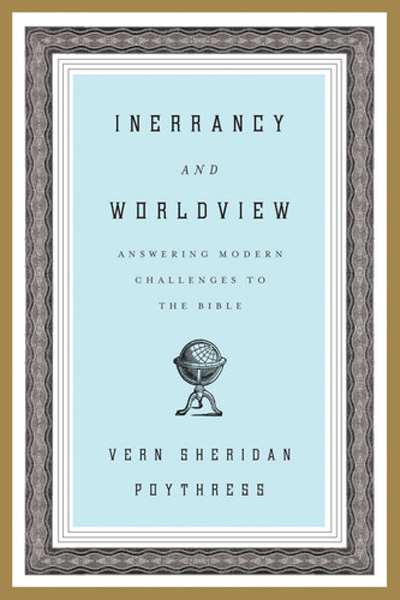
 God is who we make him to be. At least that’s how some would have us believe. After all, they say, our culture limits our ability to understand things. We can only understand that which exists in relation to other things in our culture. So, for us to understand the infinite God he must have relation to our finite culture, thus he becomes what we make him. This is not an altogether improper understanding of the principle of correlation within sociology, but it does hide some underlying assumptions. When utilized within a Biblical worldview the principle of correlation can help us affirm the doctrine of inerrancy.
We must concede that culture would be impossible to learn if we had to learn each piece of that culture independently, unconnected to the other elements of that culture. Vern Poythress notes that “Every culture has patterns for marriage, for eating, and for raising children” (Inerrancy and Worldview, 116). These patterns make sense within their culture and can be learned because of the relationships present within the patters, and the relation between patterns. Cultures depend upon these kinds of regularities, as we have seen, and these relationships help us learn cultures as a whole. But, again, where we begin is important or determining our outcome.
If we begin with an impersonalist worldview we will immediately conclude that the Bible cannot be the inspired Word of God. After all, there is nothing that relates to this reality in a strictly impersonal world. The finite cannot adequately represent the infinite. Again Poythress notes:
The meaning of a god, if it were to come into the system of culture, must correlate with the other finite meanings within culture. Hence it is itself finite, and therefore inadequate for representing an infinitude. Culture is the limit of our conceptual world. A god cannot really “be himself” in our thinking of him, but is only what we “make him” according to the constraints of our culture. (117)
The failure of this view, however, stems from an improper view of meaning.
We have touched on this already in a separate post in this series, but it is worth reiterating that meaning is reflective of God and is anchored in his own mind. Therefore we may speak of meaning both as stable and yet flexible. Reflecting on God’s own personhood we speak of God as a unity within a diversity. God is one and God is three. Meaning reflects its maker in being both stable and concrete, and yet diverse. So meaning, then, cannot be boiled down to simple textbook definitions. This mechanistic approach limits meaning and ultimately takes God out of the picture. But the Biblical worldview anchors meaning in the mind of God and identifies God as one intimately involved with his created world. When we presuppose the finiteness of meaning and when we presuppose an absentee God then principle of correlation can be used to disprove inerrancy. When, however, we operate within the Biblical worldview this principle doesn’t have to lead to such conclusions.
We have demonstrated over and again how God reveals himself in the created world. He communicates with us regularly and has the power and perspicuity to do so in ways that we can understand. He does in fact relate to the world and without losing his infinite nature. The prime example of this of course is Jesus. He was in direct relation to this world and revealed the Father to His disciples. He taught, lived, and moved among people to communicate truth to them, to relate to them. The diversity of meaning is exemplified in the Word made flesh and it continues to be true for those of us who study God’s word. How can we know God within our culture? We can know him because culture belongs to God and he has created it in such a way that he can relate to us in it. The infinite God relates to us without losing anything, and in so doing offers us everything.
 Sparrow & Heart Soul Care