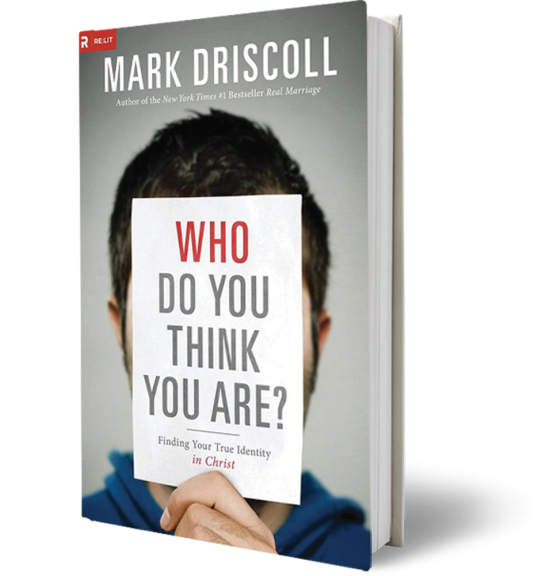
 Who you believe you are defines how you live. I am convinced that most of the struggles that Christians experience in their sanctification stem from a deficient knowledge of their identity in Christ. Finding quality studies on identity, however, has proven to be more difficult than I had imagined. When I heard that Mark Driscoll was going to be publishing a book on our identity in Christ I was determined to get it. If I sometimes have a love/hate relationship with Driscoll’s ministry I almost always appreciate his writing. He writes both with a clear dependence on strong exposition of Scripture and yet with a very intentional eye towards practical application. In many ways Who Do You Think You Are? does not disappoint. But while the content was good the development of his thesis was sometimes frustrating. Who Do You Think You Are? sometimes blurs the line between identity and experience.
In sixteen chapters Driscoll aims to unpack the believers identity in Christ as it is laid out in the text of Paul’s letter to the Ephesians. The theme of being identified as “in Christ” is central to the book of Ephesians. So in grounding us in the Scriptures themselves it seems natural for Driscoll to draw from the deep well that is this epistle. To truly grasp our identity we must grasp what it means, then, to be “in Christ.” Driscoll writes:
The two words “in Christ” changed the world and are the summary, essence, and totality of a believer’s identity. Simply put, either our identity is in Christ or in idolatry. (24)
The breakdown of his book, then, is attempting to establish what it means to be “in Christ.” So the chapters cover a host of ideas from the letter to the Ephesians, including: sainthood, blessing, salvation, reconciliation, affliction, forgiveness, adoption, and more. My difficulty with the book is that he sometimes confuses what we experience with who we are.
He starts out strong. In chapter one he is grounding our identity in the gospel. We were created to be “image bearers” of God almighty, there is both an inherent humility and dignity that is ours because of this reality. And yet, because of the fall we have all rejected our role as image bearers and instead become false worshippers, idolatrous. He draws out briefly the consequences of our idolatry for our identity: we become like what we worship. Driscoll writes, “To put it simply, underlying our sinful false worship is the fact that our identity has become rooted in our idolatry. Therefore, it’s vital that we learn to know our identity idolatry” (7). He utilizes IDOLs as an acrostic to highlight the various things we make idols: items, duties, others, longings, and sufferings. Sin has corrupted our identity through idolatry. But as we come to terms with who we are apart from Christ we can see more clearly who we ought to be.
He turns then to consider our Sainthood and calls us to revel in the new identity we have because of the gospel. He does a great job of stressing our new identity throughout the book, reminding us again and again that we are not what we have done or what has been done to us. We are new creations. Chapter eleven, in particular, discusses this “new man” that we have become in the gospel. This was one of my favorite chapters, as Driscoll unpacks for us the realities of justification, regeneration, and glorification. He says that justification is our being made externally new. God no longer looks at our sin but declares us righteous in his sight on account of Jesus’ imputed righteousness. This frees us to live differently, Driscoll says. He writes:
You don’t have to be perfect, because Jesus is. You don’t have to pay God back, because Jesus has. You don’t need to suffer for your sins, because Jesus did. You are free to stop working for your righteousness and start working from Jesus’ righteousness. (144).
We are also internally new, that’s regeneration. We have been made spiritually alive in Christ. He goes over the implications of regeneration stating that we have: a new birth, a new Lord, a new heart, a new mind, new desires, a new community, a new power, and a new freedom. Finally he moves to glorification saying that we will be made new eternally. “While we are genuinely new in Christ, we are not yet completely new in Christ” (152), that is yet to come.
The content of the book is solid. Driscoll grounds our new identity in the gospel and repeatedly reminds us that we are new creations in Christ Jesus. The failure comes, however, as he tries to format, in an effort to be consistent and catchy, actually loses the balanced distinction between identity and experience. Where he begins by stating that we are not what we have done or what has been done to us, but rather we are “in Christ,” he slowly moves away from that starting place. So each chapter begins with a claim of identity: I Am ___. This works great when he writes “I Am a Saint” (chapter three), and “I Am New” (chapter eleven). But it becomes confusing when he writes “I Am Afflicted” (chapter eight), or “I Am Heard” (chapter nine). These are experience, one admittedly a good one, and they may shape or influence my identity, but I cannot say “I Am Afflicted” in the same way that I can say “I Am in Christ” (chapter two). The two are fundamentally different.
I was particularly troubled by the equation of identity and experience in the chapter on affliction. One of the major premises of this book is that we are not what we experience. So Driscoll writes clearly in chapter one:
You aren’t what’s been done to you but what Jesus has done for you. You aren’t what you do but what Jesus has done. What you do doesn’t determine who you are. Rather, who you are in Christ determines what you do. These are fundamental truths that we’ll explore in depth throughout this book. (3)
But chapter eight spells out fourteen different kinds of affliction found in Scripture as though they were key identifiers for believers. Our experience, then, does dictate our identity. This not only seems a confusing message in light of the initial premise of the book but it strikes me as confirming what some many wrongly believe: who I am is what I do or what happens to me. To a lesser degree the same thing happens as Driscoll talks about blessing, appreciation, and reward. His content is solid but his format will inadvertently confuse readers, I believe.
Admittedly it can be easy to blur these lines. After all forgiveness and love are both things we experience from God that dramatically shape our identity. To say “I Am Loved” (chapter fourteen) seems a fitting testimony to my identity. But there is danger in not clearly distinguishing the difference between experience and identity. The danger is that we confirm for people what they already believe, that identity is rooted in what they do or what has been done to them. But our identity is “in Christ.”
While I really liked this book, and found so much valuable content, some of which I am already using in counseling, I question its long-term effectiveness. I guess I will keep looking for that good book on identity.
 Sparrow & Heart Soul Care