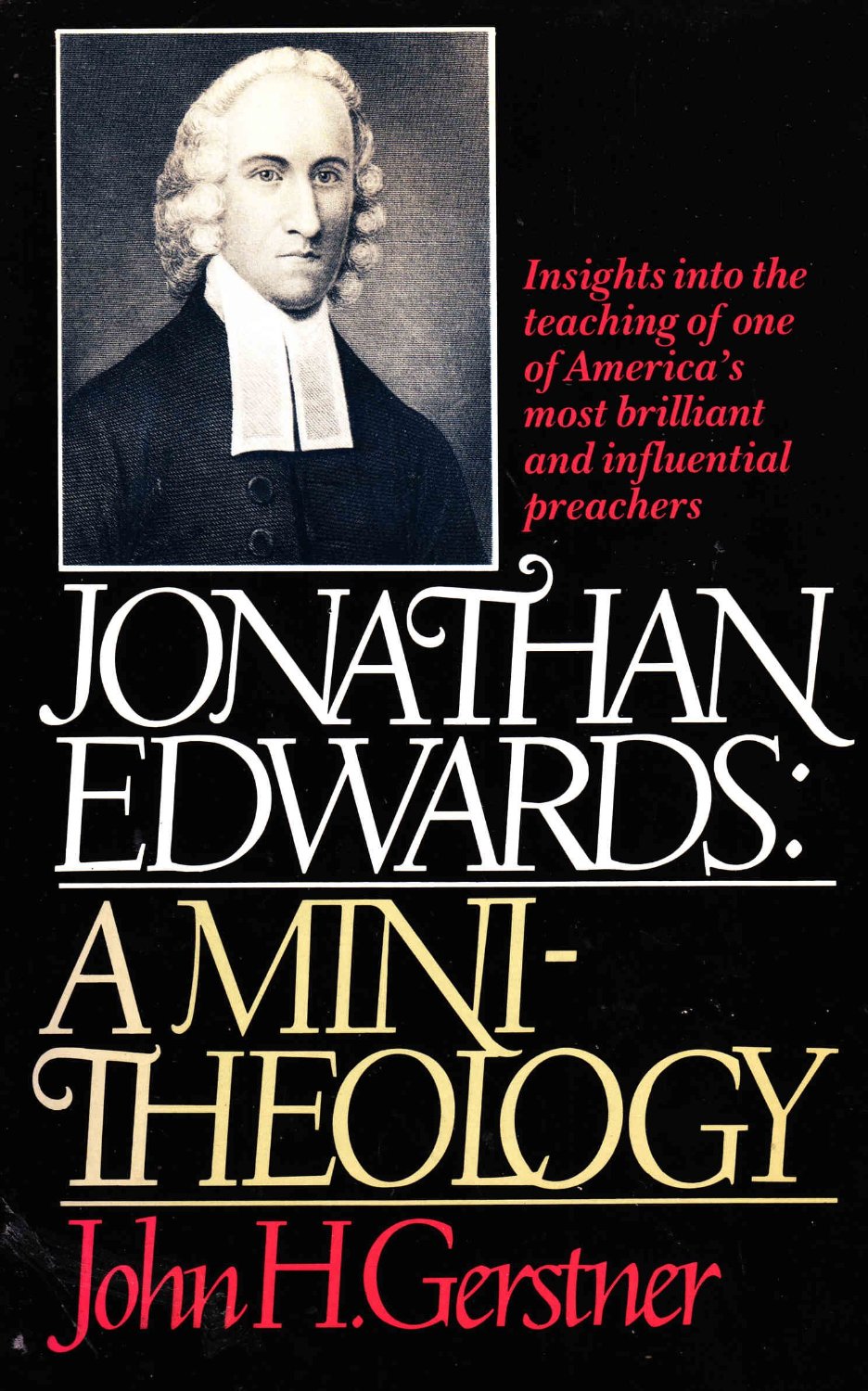
 Every year I pick a subject that I am going to study for the year. This year that subject is Jonathan Edwards. Thus far I have read a handful of sermons and biographies of the man and his thought, each contributing something to the overall study. They have not all been equally enjoyable, but I can say without a doubt that John Gerstner’s A Mini Theology has easily been my least favorite. The monograph is dense and often focused on elements that seem unnecessary in a “mini-theology.” Gerstner’s verbose tendency makes this volume so convoluted that it’s best to read other similar works.
The volume is a condensation of Gerstner’s masterful three-volume work on the Rational Biblical Theology of Jonathan Edwards. It was written before the latter volume, but its content overlaps and is clearly evidence of the project Gerstner was working on at the time. It’s clear that Gerstner knows his subject well, in fact that may be some of the reason this little volume is so dense at times. I have been working through the larger Rational Biblical Theology, but it is slow progress because Gerstner focuses on so much detail about the development of Edwards’s ideas. That frustration is even more pronounced in the smaller work. With only 120 pages it befuddles me as to why Gerstner spends so many pages comparing Edwards to Augustine and other theologians, or why he spends so much time dissecting the development of specific doctrines throughout the history of the church. The focus is certainly on Edwards, and an eye is always cast towards his contribution, but Gerstner takes sometimes a long time to get to that point in so few pages.
He does focus on Edwards, of course. The book highlights eleven specific doctrines that proved key to Edwards’s own theology. So Gerstner focuses on Edwards views of reason and revelation, the Trinity, man and the fall, sin, atonement, regeneration, justification, sanctification, eschatology, hell, and heaven. In each case he does not merely analyze what Edwards’s says, but tries to highlight the theologian’s specific contribution to the doctrine. That is a worthwhile study, to be sure. The major frustration I have with the volume, however, is Gerstner’s writing style.
It is disappointing that so many theologians are, in fact, such terrible writers. Gerstner is clearly a brilliant theologian and a student of history, but his writing leaves much to be desired. He is incredibly verbose, often creating long strains of thought whose main point gets muddled in loquaciousness. A friend of mine recently stated that he has so little interest in reading theologians and philosophers. Not because their ideas are difficult to comprehend, but because their writing is so terrible that it makes it difficult to enjoy. That certainly holds true of Gerstner’s little volume on Edwards. In light of these frustrations I think other works accomplish much more effectively the goal of this little volume.
Good introductions to the basic concepts and contributions of Edwards’s theology are easier to find these days. In contrast to Gernster’s book, The Essential Edwards collection provides a great introduction to his theology and with careful writing and practical application. I have reviewed each of those volumes this year, and found that Owen Strachan and Doug Sweeney have written a great introductory series. On a lesser note, but still insightful, is Stephen J. Nichols’s book Jonathan Edwards: A Guided Tour of His Life and Thought. Not merely a biography, Nichols’s monograph explores the inner workings of Edwards’s mind and the manner in which he arrived at some of the conclusions he did. On more specific topics of theology there are plenty of books to view, but these introductions work well to accomplish what Gerstner intended.
Jonathan Edwards: A Mini-Theology is not invaluable, but even the insight it provides is better gleaned from simpler approaches and more clean prose. I appreciate Gerstner’s intent and competency on the subject, but this book leaves much room for improvement in communication.
 Sparrow & Heart Soul Care
1 Comment