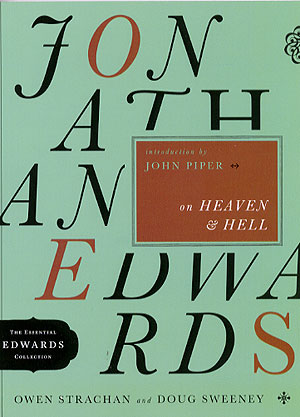
 Our modernist sensibilities have taught us to think little of the doctrines of heaven and hell. We are too enlightened for such beliefs, we say. We either diminish their importance or we reinterpret them for our comfort. But Jonathan Edwards, America’s greatest theologian, challenges us to think a fresh on such subjects. For those who believe the Bible to be the inspired Word of God, we cannot simply do what we want with these doctrines. In their book Jonathan Edwards on Heaven and Hell authors Owen Strachan and Douglas Sweeney draw out the great theologian’s teachings in order to challenge us to believe rightly. Edwards’s creative teaching on the afterlife is capable of reinvigorating our theology and potentially our lives.
This volume is part of a larger series known as The Essential Edwards Collection. These five volumes have each focused on different elements of Edwards’s theology, always aiming to communicate it with a pastoral bent. The authors are not simply historians, as though they were attempting merely to communicate facts about Edwards. Rather they are writing to provoke reflection and transformation in the lives of their readers. This is true too as it relates to this final volume in the collection. Here they are concerned to reboot belief in the doctrines of heaven and hell among believers.
It may seem a strange goal, but they do well to set its context in the opening chapter. They identify the trend among Christians today to either downplay or completely drop belief in the doctrine of hell. No mention is made of Rob Bell’s infamous monograph, but they indicate that his would only be one in a litany of examples of disbelief. Add to that the reality that even among the church an ignorance of the afterlife has become ubiquitous and you have a serious problem. We have trained ourselves to “think deeply and searching about things like heaven and hell when our more pressing concerns have ceased – which is a rare occurrence” (40). To assist in the recovery of these doctrines, then, the authors point us Jonathan Edwards. They write:
Though the task seems impossible, we have guides who have gone before us and who can help us to recover an eschatological perspective. One of them is the colonial pastor Jonathan Edwards, who devoted tremendous amounts of time and energy into thinking and teaching on heaven and hell. (40)
Looking at both Edwards context and his teachings we are to see just how reasonable and responsible it is to believe in the afterlife.
They begin with the obvious assertion that Edwards believed in a real heaven and a real hell. Thoughts of the afterlife dominated the minds of people in Colonial America. They looked death in the face often and could not escape that reality. And yet, it should not be presumed that all had a thoroughly developed theology of heaven and hell. Strachan and Sweeney point out that Edwards battled much of the same kind of indifference towards such realities that the church faces today. They quote Edwards, saying:
Now the greater part of men have not a lively sensible apprehension of the wrath of god and of eternal punishment; it never was set before their eyes and brought into clear view. (58)
It was in such a climate that Edwards preached with vivid and imaginative detail the horrors of hell and the beauties of heaven. And creative preaching and writing were certainly a hallmark of his deep thought.
Edwards preached in great detail, from the Scriptures, on the terror of hell. His goal was not to scare people into heaven, but to scare them back from the brink of hell. He aimed in his preaching, to unpack the reality of hell in all its terror so that men would give pause to their life and reflect upon their state before God. Edwards used the power of the imagination in his preaching. The authors encourage us to do the same in our own theological study. They write:
This last point is worth pondering. Though we need to steer clear of emotional speculation, it will do us great good to think about heaven by using our imaginations in according with the Bible. The Scripture is a visionary book, one that engages our minds, fires our thoughts, and rouses us to action…If we do not let the biblical testimony on heaven and hell play in our minds, it will surely rest lightly on our hearts, causing us to lose sight of the monumental vision the Lord gave us of the age to come. (53)
Edwards was possessed no morbid fascination with hell. It grieved him that people were on their way to destruction, and it was because of this that he preached with such passion, consistency, and creativity the reality of hell. But he did not focus solely on hell, he wrote extensively on heaven too, and in the same vein.
It has been argued that, though Edwards is known for his speaking on hell, he wrote more on the beauty of heaven. The authors draw from Edwards sermons to “reinvigorate us” with a picture of what heaven may be like. In his writings Edwards promotes a multidimensional view of heaven that sees our delight in it as ever-expanding. He grounds our love for heaven in the presence of God and the “world of love” we enter into there. The same playfulness and creativity engages his writings here. Such engagement of our imaginations, the authors argue, can transform the way we live.
Ultimately the goal of Edwards’s teaching, and the goal of the authors of this volume, is to see us become so heavenly minded that it changes the way we live on earth. To reinvigorate our theology on the afterlife is to reinvigorate our living in the present life. The authors write:
Edwards’s meditation produced not only deep preaching, but a radically different way of life. His insights, based on the Bible, can do the same for us. At our core, we can reconceive our existences, rooting them in heaven more than earth. What does this mean practically? It means that we study Scripture, saturate our minds with it, and learn to think in scriptural categories. We need to commit ourselves to putting the Scripture and its teaching on the afterlife constantly before us so that the Holy Spirit can transform our lives. As we read texts on heaven and hell, meditating deeply on them, we will naturally find that we think of heaven as our true home. (120)
Edwards teaching on heaven and hell, and the life he lived in light of such a belief, are a challenge to us today to be more heavenly minded.
This final volume in The Essential Edwards Collection is well written and engaging. The authors draw heavily from Edwards’s own writings showing the compelling nature of his teachings on the afterlife. They use ample quotations, with minimal necessary clarification or expansion of his thought. They guide us through his teachings with a soft hand. Strachan and Sweeney surely have a pastoral intent in their writing and the whole volume drives towards our application. I commend it to both those seeking to learn more about Edwards, and to those in need of an afterlife reminder.
 Sparrow & Heart Soul Care
1 Comment