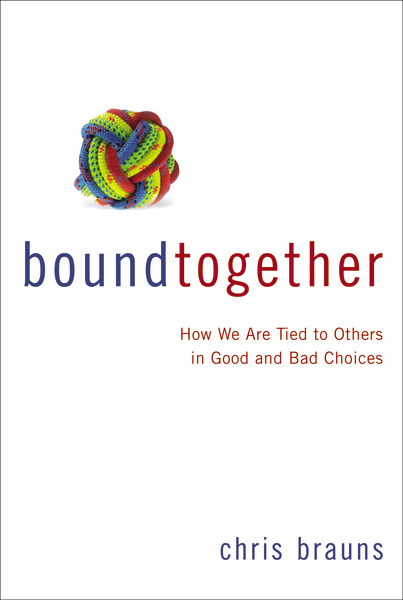
 Giving fresh communication to old theological concepts is no easy task. Some who do “fresh theology” end up going too far and falling prey to their own creativity. Heresy is only a “fresh communication” away. But in Bound Together Chris Brauns communicates the significance of our solidarity with Adam, Christ, and others in fresh and insightful ways.
It doesn’t take much to convince us that we are all connected to each other by the choices we make. An abusive family members make choices that certainly affect the rest of his family. A rebellious child makes decisions that affect his parents. A husband’s affair has consequences for his wife and his children, and many others. This is obvious to us. And yet, our individualism is so prominent that even if we know it, we don’t often meditate on such a reality. The point of this book is compel us to think carefully about our solidarity, Brauns writes:
Persuading you to carefully investigate the reality that we are deeply connected to one another is my goal in writing this book. I want to assure you that, if you do, you will discover truth is fundamental to all true joy, however dark it may seem in the beginning. Indeed, without the truth that we are bound together there is no joy. (15-16)
This solidarity with others is both the best and worst news you’ve ever heard, he writes.
Brauns calls this concept the “principle of the rope.” Simply put, this means “that our lives, choices, and actions are linked to the lives, choices, and actions of other people” (25). We are not isolated individuals, rather, we are “bound together”. The book unpacks this concept across two parts: (1)Understanding the Principle of the Rope, and (2) Applying the Principle of the Rope. Each spells out the darkness of the principle and the hope found in it.
The principle starts in the Garden of Eden, where our solidarity with Adam unites us with his sin. “The doctrine of original sin is the ultimate negative application of the principle of the rope” (49). Brauns’s articulation of this doctrine articulates the two common views of the transference of Adam’s sin to us, and help us to clearly see the implications of the doctrine. We must clearly grasp this solidarity if we are going to understand ourselves and our hope clearly. Brauns writes:
I want to suggest that if the principle of the rope is true, then the bad news is really as bad as you and I make it out to be. It means that despite our best efforts and good intentions, we can not change the reality of sin in this world or in our lives. Original sin is, indeed, bad news – the very worst sort of news, especially for those of us who have been taught that we can change ourselves, our future, and the world we live in. (50)
The principle of the rope leads us to some dark conclusions as Brauns demonstrates it both via Scripture and experience. But it is not the final word about our solidarity.
As much as we might hate the principle of the rope – and at some level surely I do – we must see that without this principle there is no hope for us. Though we are roped to Adam in the fall, we can also be roped to Christ in his offer of redemption. And, as Brauns says, the rope tying us to Christ is stronger! He writes:
The principle of the rope is what underlies the good news of the gospel, namely, that if we are roped to Christ, we are so bound to him that nothing – not even the rope that ties us to Adam – can ever separate us from his love. (59)
By looking at the various expressions of our union with Christ in Scripture, Brauns helps us see the implications of this solidarity. He stresses for us the truth that without the principle of the rope there is no hope for us.
In the application of this principle Brauns looks at how our solidarity provides hope for us in marriage, in hurting families, in the fear of facing death, and in society at large. He draws from Scripture to illustrate and support these points in some unique ways. Looking at the story of Rahab to find encouragement and application for hurting families was a seemingly strange move, but Brauns does this so well that I not only found it captivating, but encouraging too. In the final chapter he goes after the idealization of American individualism in full force. He makes it clear that individuality is still a reality and still important earlier in the book, but in chapter ten he warns us of individualism’s dangers. The Bible’s emphasis on community, he tells us, assures us that true joy is only grown within such a context. The principle of the rope is not only true, but it is good news.
This short book (192 pages) gives us a fresh and encouraging look at some common doctrines. Our unity with Adam, Christ, and with others may be something that Christians know in theory, but we continue to be plagued by individualism in the church too. We need this fresh look to help us see the significance of the principle of the rope, the implications of the principle of the rope, and the hope of the principle of the rope. We need this principle to be true if we are to find salvation, and if we are to grow in joy. Chris Brauns has not simply written a fine book, he has written a much-needed book.
 Sparrow & Heart Soul Care
3 Comments