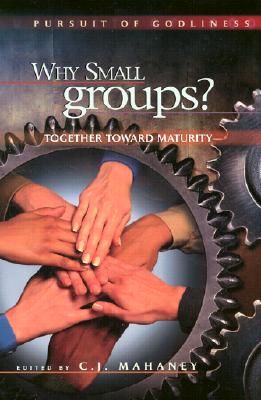
 Churches are trend hoppers. A great number of churches hop from one ministry craze to the next as if these things alone can bring about the Kingdom of God. We’ve seen fads come and go. In the 1970s small groups became all the rage and churches often adopted them without much theological consideration, many still insist on them today but give little thought to how to do small groups and why they should do them. C.J. Mahaney and the team at Sovereign Grace Ministries has given some intentional thought to it, however, and in their book on the subject they give us a foundation for small group ministry. Why Small Groups? is a useful tool for launching small group ministry and refreshing leaders on the goal of small group ministry.
The book itself is straightforward. The seven short chapters introduce readers to basic concepts of healthy small groups: fellowship, participation, leadership, care and correction, change, and relation to the church as a whole. The various authors add their own flavor to each chapter making for some simple and refreshing changes to the reading as you span the chapters. In many cases the chapters do more than just give us some information on the various related subjects, they actually correct faulty thinking in much of modern evangelicalism.
Mahaney starts the book of with a defense of the publication itself. “Some might be wondering, ‘Why another book on small groups?’” It’s a good question and yet Mahaney has a solid defense. He writes:
Actually, we would prefer that a book like this weren’t necessary, but it clearly is. Though there seems to be an endless supply of books written about and for small groups, we have found little that 1) contains sound doctrine, 2) is written by pastors, and 3) places a biblical emphasis on the local church. (v)
The book reorients readers and small group oversees to a more biblical foundation for the ministry itself. Take for example the chapter on fellowship.
We throw the word fellowship around as if every occasion of socializing is a “fellowship” activity. Watching the Super Bowl together? You just had fellowship. Sat in Sunday School class together? You just had fellowship. Bumped shoulders in the buffet line? You just had fellowship. But Biblically fellowship represents a specific kind of community. So, John Loftness corrects our misconceptions about the term and applies it more critically to certain ways of doing life together. He defines fellowship as: participating together in the life and truth made possible by the Holy Spirit through our union with Christ (19). He adds that “Fellowship is sharing something in common on the deepest possible level of human relationship – our experience of God himself.” He lists eight specific “means to fellowship”: Worshipping together, praying together, utilizing our spiritual gifts to help others grow, carrying one another’s burdens, sharing our spiritual experiences, confessing our sins to one another, correcting one another, and serving one another in practical ways. This redefines fellowship in Biblical terms and makes us considering more carefully what exactly is happening in our small groups.
Mahaney’s initial chapter lays a great theological foundation, wrestling with the distinction between justification and sanctification. He lays out a theological support for the activity that should happen within small groups. Each chapter, then, builds upon it. Those looking for a defense of the ministry should start here and work their way through the rest of the monograph.
There were times where the different voices seemed to impair the feeling of cogency. In one sense, any one of the chapters could be picked up and read apart from the rest of the book. That of course is a good thing since it allows easy access for small group leaders to refresh themselves on a singular aspect of the ministry. And yet it is clear that the authors have one vision as they write about small group ministry. They see the ministry primarily as an extension of the church’s role to assist believers in their personal sanctification. The authors consistently remind us of this point, and of what previous contributors have said in the volume. Over all, then, the individual voices don’t necessarily detract from the quality of the book.
As a pastor of discipleship, and as one coming into an existing small group ministry with the responsibility to oversee it, I have the particular task of making sure all our existing and future leaders are on the same page. Many have already read this volume and it will be easy for me, then, to highlight select chapters again. As you think about your own small group ministry I would highly recommend connecting your leaders to this book. It serves as a great resource for launching and refreshing a small group ministry on solid Biblical and theological foundations. Your small groups should be more than a fad, they should be a Biblical support to the mission of the church; this book can help you in making sure that is a reality.
 Sparrow & Heart Soul Care
1 Comment