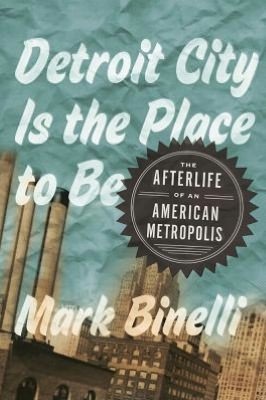
 After living in rural Southern Ohio for the last five years the idea of moving to a major metro had great appeal. After all, the city has actual coffee shops, not just the little Starbucks kiosk inside Kroger! But even I have to admit that Detroit isn’t exactly the metro that most people are dying to move to. It’s not exactly known for its coffee shops. But despite its bad press Mark Binelli still believes there’s value in Detroit. In his 2012 book Detroit City is the Place to Be Binelli tries to persuade us all. What makes Detroit valuable ultimately is Detroiters.
Binelli knows something about the city, he grew up here. As a young kid the author talks about working with his father down on Service Street as a delivery boy for a knife-sharpening company. He knows this city as home. But in Detroit City is the Place to Be he does not write as some doe-eyed idealist, blind to the faults of this once great metropolis. The book recounts the past and present problems of the city with both honesty and detail. But his book is not about the common finger-pointing done by others. Pick your narrative, he says, there’s plenty of blame to go around. Blame the racial tensions, the corrupt government leaders, the failed economy, the corporate capitalist greed, or suburban sprawl. Binelli is frank about these, and many other, plot lines. He writes about the truth in all of them, and yet his goal is not to provide another sensationalist history of Detroit’s decline. Rather, he writes with a rather unique goal. He writes:
But I wasn’t really interested in any of that. Detroit-as-whodunit has been done, ad nauseam. Rather than relegate the sins of the past, I hoped to discover something new about the city – specifically, what happens to a once-great place after it has been used up and discarded? Who sticks around and tries to make things work again? And what sort of newcomers are drawn to the place for similar reasons? These questions seemed particularly pertinent now that Detroit was no longer such a freakish outlier. (13)
Binelli’s goal was far more positive than other journalist’s exploration of the city. It’s the kind of goal that you really only expect from an insider, and yet Binelli’s return to the city was not unique.
His explorations lead him to me more and more people just like him, people who still loved Detroit. Not just the aspiring artists, entrepreneurs, and innovationists either. There were plenty of people coming to the city because it lacked the kind of definition that prohibited experimentation in other places. Detroit struck some as a city without law and without boundary, a blank slate, the new frontier! They could come and attempt what would cost billions in other cities, and no one would stop them because…well, they had tried everything else and failed. So young people began, once again, to flock into the city. “It had taken the worst economic crisis since the Great Depression to do the unthinkable: Detroit had suddenly become trendy” (14). Hipsters, artists, and free thinkers were buying up property, displaying outrageous artwork (like an entire abandoned building covered in stuffed animals) and planting their urban gardens (Detroit has more urban gardening going on than any other city in the U.S.). Binelli interacts with these people, interviews them, and listens to their stories. But it is the true Detroiters who fascinate him the most.
Detroit has become a city of DIY, he says. Failed government has thrust it upon them, but many Detroit natives have taken the initiative to fight for their city. “Detroit had become a DIY city unlike any other, the kind of place where regular civilians took it upon themselves to tauten the civic slack,” writes Binelli (53). He gives examples throughout the book: civilian dog-catchers (because the government could not afford enough man power and money to deal with all the strays), civilian neighborhood watch, even private vigilante groups (the Detroit 300), and urban agriculture. In many ways, says Binelli, this serves as a reminder of the spirit of Detroit. One man told him, “Detroit drew a different kind of people. It had a history of drawing a different kind of people. People were coming to work.” Detroit has always been a blue-collar metro. It was built on the backs of real-workers! It’s their city and Binelli writes their story with both beauty, hope, and yet honesty.
The author is not so love-struck with his hometown as to buy into a sort of blind optimism. The book vacillates between stories of hope and reminders of despair often. Binelli is a great writer, witty and compelling prose line the pages. But just when you think his narrative is bounding upward we read a detailed description of the decaying ruins of the old Packard plant. It’s haunting. But that seems fitting for a book on Detroit, a city where hope is dusted with ash. And yet Binelli, and the many like him, still cling to some kind of optimism. As the book ends he writes with frankness:
Of course, it would be easy to end this book on a different note. Any number of the city’s grisly headlines could be plucked and highlighted, and not unrepresentatively, either. But if I did that, it would only be to make sure you understand I’m not a soft touch. The truth is, my optimism was proving tenacious. I couldn’t say why. (298)
It must be hard for true Detroiters to say why they love this city. It surely hasn’t always rewarded their affection. And yet, it still exists, clinging on to life. Much like this city itself, it persists.
As a newcomer I hope to understand such love for the Detroit metro, I hope to see it grow in me. I am excited about living here, and like Binelli, much of that excitement stems from the people I’ve met. The real value of Detroit is the Detroiter.
 Sparrow & Heart Soul Care
2 Comments