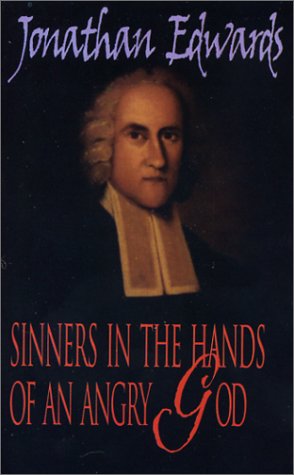
 Talking about famous sermons is kind of like talking about tallest midgets. After all, how famous can a sermon really be? As sermons go Jonathan Edwards’s “Sinners in the Hands of an Angry God” (1741) is surely the most famous one, and yet it is often the most misunderstood. It is read in high school and college classrooms all across the U.S. and because of the imagery, language, and overall content it is often hated and despised. Most, however, fail to appreciate this sermon because they fail to understand its perspective.
Maybe famous isn’t the right word. Maybe infamous is more fitting. I recall reading it as a young student in high school and being utterly disgusted with it. I was annoyed that this was the representation of Christianity that my English teacher had selected for our class. I was certain that I wanted nothing to do with this view of the faith. The sermon does use some very harsh imagery and the language sounds very condemning to our modern politically correct context.
Edwards builds the sermon off Deuteronomy 32:35, which reads, “Their foot shall slide in due time.” Edwards’s agenda is to call people to seek the means of grace, to seek Christ, while they still can. He puts before them all the horrors and dreads of standing before God apart from Christ. He warns them that they are prepared for destruction and doom if they do not seek Christ. To many it sounds much like fear mongering, like the Colonial preacher is trying to “scare people into heaven.” But when one considers carefully the perspective of its author we see how much bigger his desires for them are.
The sermon develops by first giving us a series of reflections on the initial text. Edwards notes in summation of the text: The observation from the words that I would now insist upon is this – There is nothing that keeps wicked men at any one moment out of hell, but the mere pleasure of God (Sinners in the Hands of an Angry God and Other Writings, 4). He wishes to drive home to his hearers that there is no hope for men apart from God’s own intervention. No one can secure a place for themselves in heaven. Edwards remarks that it is only God’s pleasure that keeps men out of hell, for “there is no want of power in God to cast wicked men into hell at any moment” (4). And men themselves “deserve to be cast into hell” (5) He assures them that “It is no security to wicked men for one moment, that there are no visible means of death at hand” (6). And from these and other conclusions he draws out, then, application for his hearers. He states his goal in preaching ultimately as follows: The use of this awful subject may be for the awakening unconverted persons in this congregation (9). His burden is for the people of his church. Here is where it is important to consider the perspective of the author.
For Jonathan Edwards the truth of all religion was found within the pages of Scripture. The Scriptures teach that God is the only God, that Christ is the only savior, and that apart from him there is no hope of securing a right relationship with God. These Scriptures teach that all men are born rebels and enemies of God, that all men deserve wrath and condemnation for their rebellion. And so his appeal here is not to scare people, not to seize control over them but to lovingly warn them of their state. His concern is that they would come to Christ before it is too late. He writes:
This that you have heard is the case of every one of your that are out of Christ. – That world of misery, that lake of burning brimstone, is extended abroad under you. There is the dreadful pit of the glowing flames of the wrath of God; there is hell’s wide gaping mouth open; and you have nothing to stand upon, nor any thing to take hold of; there is nothing between you and hell but the air; it is only the power and mere pleasure of God that holds you up. (9)
He warns them with all earnestness. And yet his goal is not just to scare them, but to draw them to Christ. He continues, saying:
And now you have an extraordinary opportunity, a day wherein Christ has thrown the door of mercy wide open, and stands in calling and crying with a loud voice to poor sinners; a day wherein many are flocking to him, and pressing into the kingdom of God. (16)
Though many will surely misunderstand Edwards’s intent and see him as nothing more than a power-hungry pastor, the Christian worldview defends him. The perspective from which he writes urges him to seriously warn men of the coming judgment and to call them to salvation.
Atheist Pen Jillette has said that from his perspective while he does not believe in Christianity he thinks it would be morally wrong for Christians not to evangelize! He is right. If, after all, Christians believe that all men outside of Christ will go to hell for eternity and yet the refuse to share the hope of salvation with them it would be a most wicked thing! Jonathan Edwards was a great theologian, and a great preacher, but he was nothing if not an evangelist. His concern for his church is that they would all know Christ and escape the judgment of God. In fact it is commonly noted among scholars that while Edwards is so frequently hated he spoke more about love and heaven than he did hell and judgment. So why does he often get such a bad wrap? The answer lies partly in our misconceptions and party in Edwards own success in preaching.
On the one hand our culture is so averse to any notion of judgment or hell. The idea that there is a God who has authority over my life is resisted at every turn in both the secular and religious corners of our present day. God is peaceful and loving, more like a grandfather than a divine judge. This God would never send people to hell. So many modern readers, then, hate Edwards because they believe him to be misrepresenting their god. They believe his message to be outdated, archaic, and molded by an angry religion. They, of course, seem to miss this picture so clearly presented in the Bible, but then again Edwards was a better student of the Bible than most Christians today. From Edwards perspective what he preaches and declares here is right and good. It is the right thing to do to warn men of the impending judgment and hold out the offer escape to them.
On the other hand, the fact that “Sinners in the Hands of an Angry God” is so hated reveals the success of its author. Edwards was a brilliant man, and in the sermon he uses compelling imagery, analogies, and descriptions to make his point. He says that man is like a disgusting spider hanging over the pit of hell by a slender thread. He depicts God as treading on man in the coming judgment like one treads on grapes in a wine-press, the blood, he says, of the men staining his robe. He shows how terrifying God’s judgment is by comparing it to the wrath of a great prince, and then shows how God’s wrath is even more to be feared than the most tyrannical of rulers. These are graphic, unsettling pictures. And for many they are simply too graphic, too unsettling to tolerate. The reason, perhaps, that this sermon has become so famous (or infamous) is because it is written so well. It reads well, engages the mind, and possesses a certain literary quality that makes it worth reading over and over. Edwards enrages us partly because he is so successful at depicting the God of Scripture, a God that clashes with our postmodern domesticated god.
“Sinners in the Hands of an Angry God” is a compelling sermon. There is no doubt that it is unsettling, but that is as it should be. Jonathan Edwards was a brilliant preacher, and compelling evangelist. His writings are worth your time, and this sermon in particular is important. God used this sermon to spark a revival in Edwards own town. The Great Awakening came about and continued partly because of God’s work through the preaching and writing of this faithful colonial pastor. Contemporary Christians would do well to read this sermon and remind themselves of who God really is, and to think carefully about their relationship to Him.
 Sparrow & Heart Soul Care