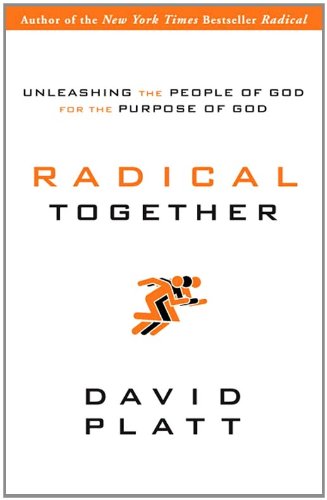
 David Platt is known for stirring the pot, but the truth is that the pot has needed stirred. In Radical Together David Platt wonders aloud if we are really building our churches on the Word of God. In Radical he stated plainly that individual Christians were not doing so with their own lives. Here he expands his horizon to consider the church as a whole. This is a great book, filled with lots to consider and challenge the American consumerist church culture of the 21st century. To unleash the people of God for the purposes of God we must build a ministry centered on the Word of God.
A myriad of books have targeted the failures of much of the modern Evangelical church. John MacArthur attacked the entertainment culture of the church years ago in his book Ashamed of the Gospel and Mark Dever’s tremendous resource 9 Marks of a Healthy Church has sought to point leaders in a new direction. Radical Together aims to combine both assault and direction. He does lament and attack the consumerist culture of the American church, but he also provides us with a better way. Six foundational ideas guide this book, each calling the church to reexamine its existence in light of God’s Word.
Platt asks tough questions throughout the book, but ultimately he is guided by one overarching question that every pastor/leader needs to ask: How can we in the church best unleash the people of God in the Spirit of God with the Word of God for the glory of God in the world (3). To answer that question may require us to go to some tough places, and do some “radical” things. For example, Platt argues that we need to give up good things in the church in order to pursue what’s best. He writes:
One of the worst enemies of Christians can be good things in the church…But too often we’re oblivious to the threat posed by the good things we’re doing. We’ve laid down our defenses against the way that good can hinder the best. In this sense, good things can subtly and effectively become one of our worst enemies. (8)
There’s nothing wrong, per se, he argues, with big buildings, big budgets, and loads of programs. But we have to ask if such things are distracting us from fulfilling the purposes of God in the world. “We must be willing,” he writes, “to sacrifice good things in the church in order to experience the great things of God” (9). It’s time we put everything on the table and ask God what should stay, and what should go.
And Platt does just this. In chapter two he calls us to consider our understanding of the gospel. Are we motivating our people by guilt and fear, or by the gospel that calls us to work as a response to God’s grace. In chapter three he asks us to consider our teaching. Are we really hearing from God, or just from the opinions of men. In chapter four he asks hard questions about buildings and programs. “Imagine your church had no building or facilities whatsoever,” he writes. “Could you still make disciples” (64)? That’s a tough question for some of us to answer.
It’s not that Platt is just picking on the church. He is calling us to reconsider the way we do church in order to help us do the most for God’s glory and God’s people. He writes:
There is only one thing God has promised to bless, and that is his plan. He has given us his plan in his Word, and if we want the blessing of God, then we don’t need to come up with something else. Instead, we need to align with the plan he has already promised to bless. (51)
Radical Together takes the concepts of Platt’s first book and now applies to them to the corporate life of the people of God. Like the first book, it’s not nearly as “radical” as it seems. It’s just Biblical.
This little book is simple, straightforward, direct, and engaging. Much like its author. There’s nothing new in it. And surely you can find older books that echo these themes. Platt is hardly the first person to call the church to a return to Scripture, I hope he won’t be the last. But what I loved about this book is its soft frankness. Platt is not writing as an expert pastor with all the answers for us. He is writing as a young pastor “working out the implications of the gospel in a local church” (3). He is humble throughout the book, but he is honest. Honest about the challenges he is asking his church to take up, and honest about the failures of much of American Christianity. Both those elements are commendable. While other books and other authors can sound haughty and can point the finger Platt doesn’t do that. And while other authors might gloss over or soften the failures of the American church, Platt doesn’t do that either. He is humble and honest, and that marks Radical Together.
More than anything, however, what marks this book is its Biblical foundation. Platt does not believe that the ministry of the church needs experts and complicated methodologies. It needs God’s Word. This is a great resource that many pastors will appreciate, and that all need to read.
 Sparrow & Heart Soul Care