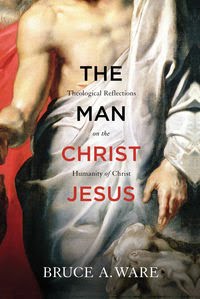
 Too many Evangelicals elevate the divinity of Jesus to the exclusion of His humanity. Jesus is the God-Man, but for much of modern Christianity that balance is not present. We see Jesus as more of the GOD-man, as if his humanity is only cursory to who He is. But in his clear and concise book The Man Christ Jesus Dr. Bruce Ware emphasizes the importance of Jesus’ humanity. Modern day Evangelicals need to recover a sense of the importance of Jesus’ humanity. For who Jesus was as a man has dramatic implications for us.
Ware unpacks Jesus’ humanity by examining evidence in Scripture from both the Old and New Testaments. Ware is easy to read, accessible, and yet not simple. He begins by discussing the Kenosis, particularly asking what it means that Jesus “emptied himself.” Ware wrestles with Philippians 2:5-8 here, ultimately concluding that while we rightly identify Jesus as fully God and fully man Jesus emptied himself of the rights and privileges he had as God in order to become man. So Ware writes:
Christ being fully God, possessing the very nature of God and being fully equal to God in every respect, did not thereby insist on holding onto all the privileges and benefits of his position of equality with God (the Father) and thereby refuse to accept coming as a man. (19)
As Ware articulates it, Jesus empties himself by adding to Himself. He pours out by taking on. The divine Son of God denies His rights by taking on humanity. Ware adds, “He must come fully as a man, and as a man he must live his life and give his life as one of us. In so doing, Christ pours himself out (all of who he is) as he takes on, in addition to his full divine nature, a full human nature” (20). This Kenosis shapes, then, the rest of our evaluation of Christ’s life.
Ware examines how Jesus was “empowered by the Spirit.” How He”grew in knowledge” and “grew in faith.” He examines how he “resisted temptation” and died in our place. And finally he considers how he rose and is now reigning as a the with the continued identity of “the man Christ Jesus.” In each chapter he looks at the evidence and argues that Christians are too quick to pull the trigger on Jesus’ divinity as an answer to important theological questions. So Ware sets up the question guiding chapter 2: How did Jesus live his life of obedience, resisting temptation and carrying out perfectly the will of his Father? The answer for many Evangelicals is found in looking at Jesus’ identity, but Ware states plainly that this can’t be the answer. He writes:
If Jesus was perfectly obedient because he was perfectly God, then how can we, his followers, be called to live like him, to “follow in his steps” (1 Peter 2:21), as Peter commands us to do? If he lived his life out of his intrinsic divine nature as God, yet we have no such divine nature and clearly are not God, is it legitimate for biblical writers to encourage – indeed, command – us to live as he did? (31)
And Ware identifies wholes in our theology like this all over the place. As we fail to consider the humanity of Jesus we actually fail to consider His relevance for us in a myriad of ways.
This little book is packed with some great weightiness. At a mere 147 pages Ware is not short on theological development. He gives us a great introduction to the importance of Jesus’ humanity and reminds Christians everywhere that Jesus’ humanity matters for how we understand Him, how we understand our relationship to Him, and how we understand emmulate Him. I highly recommend Ware’s book The Man Christ Jesus.
 Sparrow & Heart Soul Care