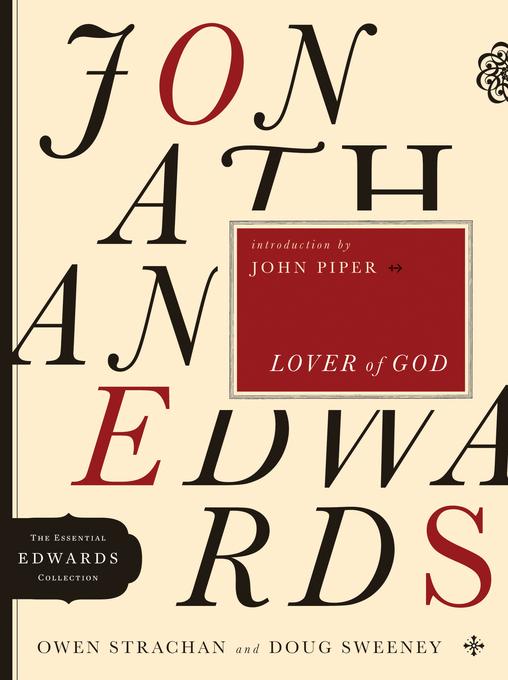
 It’s a dangerous thing to critique the Puritans. The minute you do you can be lambasted and accused of turning people off these great and godly theologians. But they were, after all, men. As men, as human beings, the Puritans, even Jonathan Edwards, were flawed. I loved this little book by Sweeney and Strachan not simply because it introduces readers to Edwards in an incredibly accessible fashion, but also because it acknowledges his humanity.
This little book is part of a series known as The Essential Edwards Collection. Drs. Owen Strachan and Douglas Sweeney have here compiled five volumes covering five major themes in Edwards’ writing in order to introduce the average Christian to “America’s Greatest Theologian.” “If we can succeed,” they write, then readers will “experience the joy of deepened theology and enlivened spirituality” (21). The book is short, 160 pages, but it’s not simplistic. In fact I was struck by the variety of things I read in it that I had never heard about Edwards before. We catch glimpses of him as a young man, of his home life with wife and children, we skim the tops of his most significant theological works, and read about his untimely death. But what most struck me about the book was the frankness about his humanity.
Strachan and Sweeney are clearly lovers of Edwards. But they are honest about his faults. They mention his blindness to the social evil of slavery. Strachan and Sweeney write:
The fact that Edwards had slaves testifies that he was a man of his day who shared at least one of the massive sins of his era. If his sin resulted from a cultural blind spot, it is no less terrible. (127)
Edwards owned slaves and any treatment of him today by faithful historians and faithful Christians must acknowledge this. In fact we must do more than acknowledge it we must hate it and wrestle with how to celebrate a man whose faults include such an offensive one. Strachan and Sweeney don’t deal with the subject in much depth but they do acknowledge it and call us to examine ourselves in light of Edwards’ blindness. They add:
This sobering example reminds us to examine carefully the culture in which we live. Many Christians can tick off the ways in which their behavior differs from that of the world. But on a deeper, more fundamental level, are there whole areas of our lives that conform to the wicked patterns of the world? (127)
Edwards’ humanity includes this disturbing reality and we must wrestle with it.
Strachan and Sweeney also include discussions of Edwards’ temperament. Another area of sin for the great theologian. He argued for three years with his congregation over the matter of a raise, and while he may have been justified, the authors say, in asking for the raise “Nonetheless, he showed an ill-tempered spirit at times and did not always make the process of negotiation an easy one” (105). They talk too about his lack of imbalance. His temperament was such that he felt a sense of urgency to constantly get work done. But this work ethic often led to complete exhaustion and recurring illness.
Throughout the spring of 1729, Jonathan stayed at home. He had again driven himself with such passion that he damaged his health. If the young pastor’s sense of urgency allowed him to accomplish much, it also drove him into the ground and hindered his ministry. If this would seem like the error of a young man, Jonathan repeated the mistake throughout his life. (60)
It seems that some level of workaholism was common even in the 18th century.
Ultimately the authors present us with a picture of Edwards the sinner. He did not merely preach about sin, he battled it in his own life. Edwards reflected often on his own struggles with sin. He was no “perfect Puritan,” he was a man. After a quote from Edwards own writings, reflecting on his own sinfulness, the authors comment:
Students of Edwards need to mark these words. We should not view him as a super-Christian. The Northampton pastor modeled a faithful Christian life of great depth and joy, but he was a man, and a sinner, just like the rest of the race. (68)
Edwards understood discipleship so well and grace so well, it would seem, because he understood his own sinfulness so well.
This picture of the humanity of Edwards should not lead us to the conclusion that he is not worth reading or studying. Rather it ought to make him more compelling. After all, if Edwards were a super-Christian there’s not much that most of us can relate to. We might appreciate him from a far, but we may feel less inclined to learn from him. Most of us never feel like super-Christians (and those who do probably aren’t even close). Edwards’ humanity is what makes him worth listening to. He was a sinner, and yet we are still able to label him a “lover of God.” As Strachan and Sweeney conclude:
Jonathan Edwards was a combination of many rare gifts. But all of these flowed out of one simple and essential reality: Jonathan Edwards was a Christian. He was a believer who followed Jesus Christ in repentant faith. He loved God, and he sought to live for Him. In this fundamental way, Jonathan Edwards was just like you and me. (20)
Jonathan Edwards was just like you and me! Lover of God and fallen human being. That is what makes him worth reading, and that is what makes this little book about the man worth reading too.
 Sparrow & Heart Soul Care