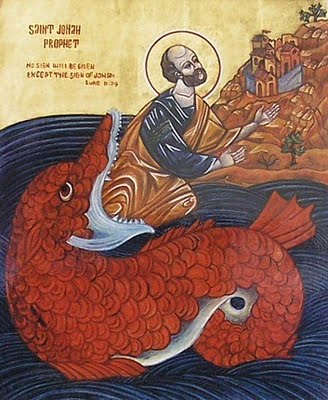
 “The Sanctity of Life” conjures up all sorts of images in the average person’s mind. Thoughts of national campaigns, special church services, or protests come to mind. Religious Right initiatives and focused “Pro-Life” rallies may cross your mind. But none of that is found in the book of Jonah. The phrase has a much broader application within the book. All life is sacred and garners preservation in this book. The most interesting feature of this theme in the book, however, is that of all the characters the only one who does not seem to get this is Jonah himself.
The theme first appears in the context of the pagan sailors. Here God has sent a massive storm to torment the ship and to threaten those on board. When Jonah finally confesses that the storm has come on because of him, he offers a solution: throw me into the sea. If it seems a strange solution to us it has roots in ancient religious practices. The idea was to appease God’s wrath with a sacrifice, i.e. Jonah. The prophet was on the run from God and it was because of his rebellion that God had sent the storm in the first place. But to the reader’s surprise the pagan sailors do not like this solution. They do not want to throw the prophet overboard. Jonah’s suggestion is largely ignored as they try to row back to shore. But their effort is to no avail and they finally concede to tossing the rebel overboard. But they offer up a prayer of sorrow before they act:
Therefore they called out to the LORD, “O LORD, let us not perish for this man’s life, and lay not on us innocent blood, for you, O LORD, have done as it pleased you.” 15 So they picked up Jonah and hurled him into the sea, and the sea ceased from its raging. (Jonah 1:14-15)
The sailors understand that life is sacred, that life cannot be snuffed-out without serious consequences.
God had set up an ethical system that validated their fear. In the Ten Commandments God had established, “You shall not murder” (Exodus 20:13). Murder was forbidden in Israel. But the principle predates the Exodus. After the flood God says to Noah, “”Whoever sheds the blood of man, by man shall his blood be shed, for God made man in his own image” (Genesis 9:6). Because man is made in the image of God he is regarded as a sacred object, and his life is sacred. The sailors, the pagan sailors mind you, get this. It is only with fear, regret, and prayers for mercy that they finally submit to throwing Jonah into the sea.
As the story continues to unfold we see the theme again developed. This time it is particularly developed from the perspective of God’s great mercy and compassion on Nineveh. God loves these people and desires to spare them from the destruction they have earned. God says to Jonah quite plainly: why shouldn’t I pity a people I created. In the context, Jonah is ticked about the demise of a silly plant, and God responds by saying:
10 And the LORD said, “You pity the plant, for which you did not labor, nor did you make it grow, which came into being in a night and perished in a night. 11 And should not I pity Nineveh, that great city, in which there are more than 120,000 persons who do not know their right hand from their left, and also much cattle?” (Jonah 4:10-11)
Jonah grieves for a plant that he had nothing to do with and is frustrated that God should care for a whole nation full of people that he made. Why shouldn’t he pity them? Jonah has no regard for their lives, but God does.
In the midst of all this concern for the preservation of life we find Jonah weeping for a plant and hating a nation. The contrast is so stark that the application of the text seems obvious: what do we value? In this age of save-the-forest-destory-the-fetus we have to ask, what our view of life is? In this age of digital connections we have to ask, what is our view of the person? In this age of idolatrous individualism we have to ask, do we care about our neighbor? It’s easy to be an advocate for some forms of life preservation and yet a blind participant in the dehumanizing culture we live in. Jonah calls us to consider the sanctity of life. My hope is that in our current 21st century context we will carefully consider the value of life in all the spheres we find ourselves in and not simply the obvious ones.
I am all for advocating for the unborn, but I want to advocate for the isolated and dehumanized among us too. To value life means more than just avoiding murder. In Jonah’s case it meant caring enough about Nineveh that he was willing to give up his prejudices for their sake. Of course, as the story reveals, Jonah only begrudgingly did that. Will you and I be different?
 Sparrow & Heart Soul Care