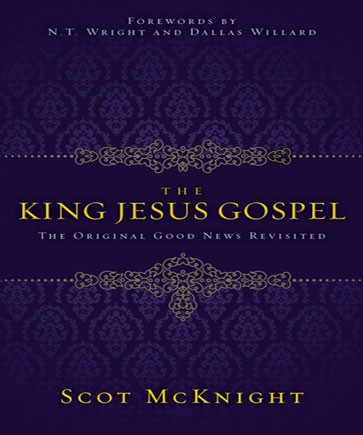
 I was lost. It was now the third time that I had left DC and was driving out towards Arlington. I had missed my exit again! I knew where I wanted to be but it seemed like I just kept circling around and around. I am not the best with directions, I readily admit that. But this was infuriating. I knew where I wanted to end up, but I just never got there. Often this is how I feel as I talk with theologians, pastors, and Christians about the gospel. I believe if you ask the average person they can do nothing more than talk to you about the implications of the gospel; actually giving a definition is hard for many in the church today. Scot McKnight says there is a “fog” in the church regarding the gospel. His latest book The King Jesus Gospel: The Original Good News Revisited is an attempt to clear away that fog and articulate a thoroughly Biblical good news. With some disagreements I believe McKnight does indeed take us, not simply to the heart of the fog, but to the true gospel as presented in Scripture.
For some it will seem strange to write a book clarifying what the gospel is, and McKnight is aware of that. But he wastes no time arguing it, he merely illustrates it throughout the course of the book by pointing to the various definitions of a host of authors, pastors, and Christians who articulate this gospel differently from each other and differently from the Scriptures themselves. His contention, and one I’ve found elsewhere, is that much of the Evangelical church has reduced the gospel. We have taken the whole picture presented in Scripture and emphasized only one part of it to the point of excluding the others. This, he says, is specifically true of important doctrines like “justification by faith alone” (25). He believes that the larger Evangelical culture has actually become “soterian,” that is we have turned the gospel message merely into a message about the plan of salvation or a method of persuasion. For McKnight the gospel is bigger and more encompassing than just the Plan of Salvation. He writes:
I am denying neither salvation – or justification by faith – nor the importance of salvation in the Bible, and I believe much more could be said than what has been listed above. Still, apart from salvation we stand unreconciled before God. But what I hope to show is that the “gospel” of the New Testament cannot be reduced to the Plan of Salvation. (39)
For McKnight the gospel is best defined, according to Scripture itself, as the saving story of Jesus as the fulfillment of the story of Israel. And McKnight deeply roots this definition within exegesis.
McKnight is and has been a well-respected New Testament scholar, so it is no surprise that he wants to focus his content on exegetical work. He takes us to a wide array of passages to conclude that Paul, Jesus, and the Apostles all understood the gospel as the saving story of Jesus fulfilling the story of Israel. He begins by examining, carefully 1 Corinthians 15:20-28, one of the clearest definitions of the gospel in the whole New Testament. I was especially interested, in this chapter, in the pressure McKnight puts on Evangelicals to stop settling for a “Good Friday” gospel and keep moving forward to a full-blown Easter gospel. Quoting Brenda Colijn he writes: The story of Jesus Christ is a complete story and not just a Good Friday story (53). He continues:
Because we are prone to ignore anything other than the death, with perhaps a glance at the resurrection, let me give a word about each of the other elements [of 1 Corinthians 15]. In the burial Christ entered fully into our death, and in that burial the church has taught that Christ visited/ransomed the prisoners of hell (cf. 1 Peter 3:18-22). The resurrection evokes a theology of justification (Rom. 4:25) and even more of God’s eschatological irruption into space and time – the new creation (2 Cor. 5:17) and the arrival of the final general resurrection. The appearances evoke a real bodily resurrection (see John 21) and a profound apologetic for that belief, and the exaltation, second coming, and final consummation reveal a theology of Jesus as Lord and Judge and God as having a Plan for History that arrives at its destiny after this long journey, when all things are in their proper place as God rules. What this means is that the gospel is a whole-life-of-Jesus story, not just a reduction of the life to Good Friday. In my judgment, soterians have a Good-Friday-only gospel. (54-55)
This lengthy quote reminds us that the gospel, even here in 1 Corinthians 15 is bigger than we have often made it.
He unpacks too how Jesus preached the gospel. The fact that some contend that Jesus did not preach the gospel ought to have raised flags for us sooner, but we continued on with a reductionist good news. After-all, McKnight points out, if the gospel is simply about the plan of salvation it is fair to ask if Jesus preached this. Rather, he states, we need to ask “Did Jesus preach that he was the completion of Israel’s story? If he did, Jesus preached the apostolic gospel, whether he preached the Plan of Salvation or not” (92). This chapter was particularly helpful for me to see the connection between Jesus’ and the apostle’s preaching of the “Good News of the Kingdom” and the “Good News of Salvation.” I have, for sometime now, struggled with this tension wondering how the two (the kingdom and salvation) were not two distinct messages. McKnight does a great job here of showing us how the gospel is broader than both and yet includes, necessarily, both.
Overall this book is an impressive reminder to sharpen our theology by grinding it against the pages of Scripture. Far too often we have allowed our theology to merely take the shape of previous theologians and not the shape of the authoritative Word of God (Dr. Peter Gentry recently highlighted this problem in a faculty address at Southern Seminary). I want my understanding of the gospel to indeed include all that Paul, Jesus and the other Apostles included. I do not want to limit and reduce the gospel, for, as McKnight stresses, it is this reduction which has led to such a deficient discipleship within the church. He writes:
But evangelicals have the same struggle of moving The Decided to become The Discipled because they have created a (sometimes smug) salvation culture in which the obsession is making the right decision so we can cross the threshold from the unsaved to the saved (The Decided). A gospel culture, though, encompasses it all and leads The Members into The Discipled because it equates the former with the latter. (31)
To address our church-wide discipleship problem in America, then, we do not necessarily need new programs, workbooks, and courses. What we need is to clearly articulate the Biblical gospel which necessarily calls people to “confess Jesus as Messiah and Lord” (133), terms which require our submission to His Kingship.
I still have some concerns with the work. While we do not want to equate the gospel and the plan of salvation, there are times where McKnight puts, in my opinion, too strong of a division between them, almost to the point of diminishing the centrality of the cross (see 134, see also his discussion of “The Problem,” p. 136-142). But he attempts often to add qualifiers, caveats, etc. to these statements. I am also not certain of some of his claims (specifically that “neither Peter nor Paul focuses on God’s wrath when they evangelize in Acts,” p. 135). And I have significant issue with his suggestion that we can’t adequately discuss the gospel unless we take something like an hour to expound the entire scope of Scripture (148). It seems that the apostles he quotes do condense the gospel for their various conversations. Some such claims require further personal investigation, which I assume McKnight gladly welcomes. Having said, all that, however, I am content to promote this book as both Evangelical and thoroughly necessary for our Evangelical/Soterian culture.
Readers will find parallels of this content in only a few works produced in recent years. Fred Sanders, John Piper, and N.T. Wright have all articulated variations of this same point about a reduced gospel (with some obvious and key differences). Some Emergent theologians too have stated similar things about a reduced gospel. What McKnight does here is not to encourage us to redefine the gospel, as some Missional and Emergent theologians have done, but rather to re-learn the true definition of the gospel. I commend this book to thoughtful Christians and I know I will personally be returning to it again and again. McKnight, I believe, has helped us arrive at our destination, while so many others have abandoned the trip altogether or are still circling DC.
 Sparrow & Heart Soul Care
2 Comments