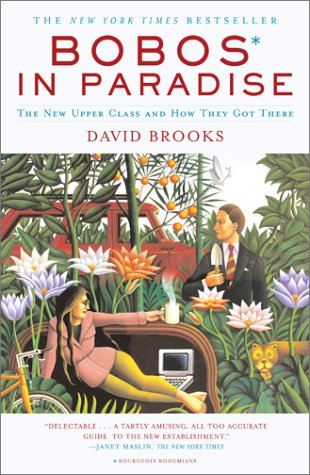
 A few years ago if you wanted to have a bestselling book all you had to do was use one simple phrase: the culture shift. It seemed like everyone was talking about the culture shift, and apparently everything in the culture shifted. Some were too broad and to alarmist in their discussions, some were too dismissive and too simple. But regardless everyone was talking shift! Slowly that conversation has been abating. There are still some people describing the shift as if it were a new anomaly, but they are usually ignored. David Brooks, however, is still talking about shifts and he should not be ignored. His 2010 release Bobos in Paradise describes an interesting cultural shift. This shift has brought two seemingly incompatible worlds together and changed the way most of us think about everything. This shift is something I think Christians in particular need to observe as we continue to live in this shifted culture.
Many folks have been writing about and discussing the way that a new class of cultural elites has come forth to not simply change the way we think about culture but in fact to shape that culture. Everyone has a different name for them: hipsters, adultalescents, twixters, rejuveniles, and probably some variations on the vulgar side. David Brooks identifies them as Bobos, by which he means bohemian bourgeoisie. Here’s how Brooks describes it:
It was now impossible to tell an espresso-sipping artist from a cappuccino-gulping banker. And this wasn’t just a matter of fashion accessories. I found that if you investigated people’s attitudes toward sex, morality, leisure time, and work, it was getting harder and harder to separate the antiestablishment renegade from the pro-establishment company man. Most people, at least among the college-educated set, seemed to have rebel attitudes and social-climbing attitudes all scrambled together. Defying expectations and maybe logic, people seemed to have combined the countercultural sixties and the achieving eighties into one social ethos. (10)
A Bobo, then, is someone, largely from the educated class, who has combined both the spirit of the bohemian rebel and the bourgeois capitalist. The book spends the next 200+ pages describing the “ideology, manners, and morals of this elite” group. It turns out that not only does Brooks reveal his keen sociological skills, but he paints an important picture of the present culture that Christians need to take note of.
The Bobo is “cultural consequence of the information age,” Brooks tells us. It was just in recent history that Americans would have seen a serious social divide between the elite cultural influencers and the thinkers of the day. In the fifties, for example, we see the culture dominated by-in-large the bourgeois WASP (White Anglo-Saxon, Protestant). Brooks spends time quoting them and quoting the voices of the Sixties to help us get a full picture of the WASP culture of the 1950s. It’s their view of knowledge, however, which is most important to observe.
The WASP elite were also genially anti-intellectual. Its members often spoke of “eggheads” and “highbrows” with polite disdain. Instead, their status, as F. Scott Fitzgerald had pointed out a few decades before, derived from “animal magnetism and money.” (22)
The shift happened when colleges started admitting those who earned the right to go to college and not simply those who were born into the right families. “Without much fuss or public discussion, the admissions officers wrecked the WASP establishment” (24). To replace this American aristocracy there was a rising meritocracy, an elite class brought to position by means of merit. It was largely owing to this rising influx of intellectuals into the upper crusts of society (places like Harvard and Yale, which had previously been exclusive to the bourgeoisie heirs) that the Sixties countercultural revolutions were bound to happen. “Dumb good-looking people with great parents have been displaced by smart, ambitious, educated, and antiestablishment people with scuffed shoes” (39).
This change, however, as Brooks continues to note, has created a new problem. The Bohemians were becoming the elites and were rising to the top places in cultural influence and were confronted with the temptation to abandon their roots and become the new WASPS. The tension exists today; a tension between success and sellout, between money and simplicity, between conformity and rebellion, between bohemian and bourgeois.
Brooks spends the rest of the book unpacking the ways in which this tension is being reconciled by the Bobos. With Bobo wit and sarcasm he writes about their consumption habits, their tensions over money, and their views on sexual ethics. In all the cases he analyzes how Bobos have shaped the way we think about these and related subjects in our culture today. This is the era of ideas and of knowledge. And it’s exteremely important that Christians see and understand the picture that Brooks has painted in this brilliant and often hilarious book.
There has long been a sense of anti-intellectualism within the ranks of Christian subculture. There has been a confession of ignorance quickly covered by an assertion of “faith,” by which most Christians mean simply a blind belief that they don’t need to know anything. Particularly during the Fundamentalist era of Christendom there was an abandonment of science, philosophy, and art. There was a disconnect from the very things that this present culture seems to applaud. Now, lest I be accused of being a crowd-pleaser (and perhaps I still will be), I do not mean to suggest that Christians should just adopt whatever the culture believes is important. But rather I want to turn our attention to the reality that the culture is once again celebrating the things that Christians have long historically celebrated too.
Christians throughout history have been on the cutting edges of science, philosophy, and art. We have been the thinkers, the movers, the shapers of culture. But the more comfortable we got the more lazy we got, and when the culture began to push back against Evangelicalism we were defensive and often stupid in our responses. We were not thinking. In many ways the Bohemian revolutions were a response to ignorant, joyless, arrogant, and presumptuous Christianity. As we look at the emergence of this new elite, however, Christians must once again renew their commitment to a God-given rationality and to the importance of knowledge. We must join the Bobos in their pursuits of knowledge and a better world than that of the vain and meaningless WASP indulgences.
Christians can, I believe, learn a lot from the Bobos of our culture. In recent years Christians scholars have made an appeal to renewed Christian thinking (see John Piper, Mark Noll, and Os Guinness). Christians are people who have faith, yes, but it is not an irrational, illogical faith. We are not people blindly groping in the dark, we are people who believe God is the cause of reason and he has given us brains to use and to create a better world for His glory.
Read Brooks’ analysis not simply because he has studies this culture well, but also because he is a Bobo and he is living this culture now. Christians have for far too long been evaluated as backward thinking idiots. It’s time we shifted from the realm of dodo to that of Bobo.
 Sparrow & Heart Soul Care