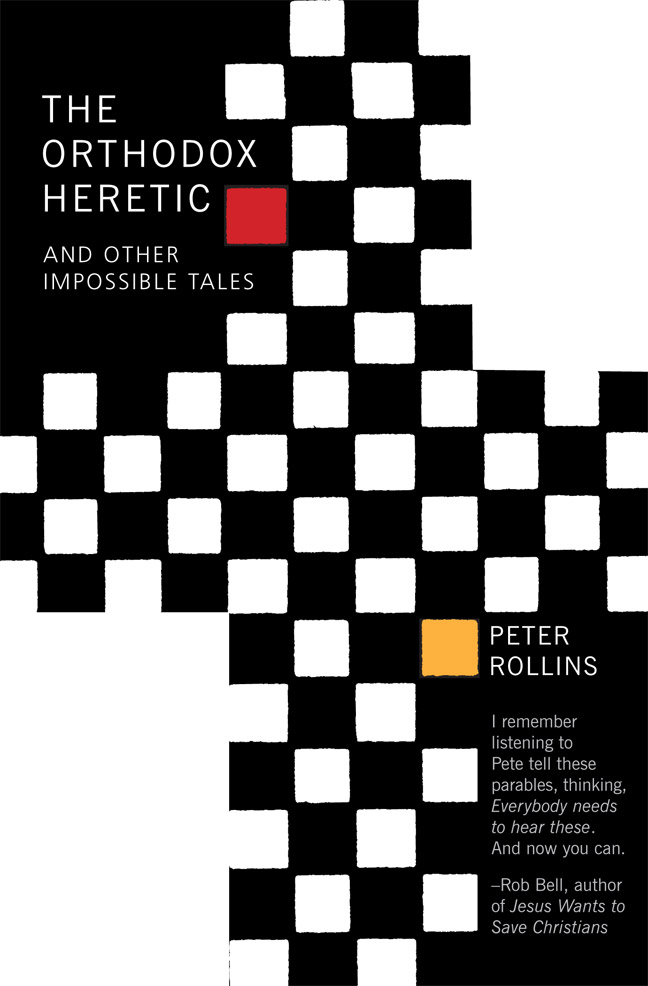
 “Half-way decent.” That’s the phrase that I think most aptly describes The Orthodox Heretic. It’s a book all about halves. The set up of the work is broken down into two halves: the parable section, immediately followed by a corresponding commentary. It’s presentation of Christianity is divided too, half heresy and half orthodoxy. It’s a work full of half-truths. Rollins says things that are technically accurate, but which are painted in such a way that they actually become false. And that might just be all part of the author’s design. For his ultimate goal, it appears, is to help undermine Christianity’s theological roots in order to “save Christianity.” While this isn’t a phrase that Rollins uses it’s a notion that seems to permeate his writing. The book is really insightful and provocative in a lot of ways, and yet I find it to be far more heretical than orthodox…and that too seems to be by the author’s design.
Rollins begins the work with a rather pretensions discourse about “(mis)communication” and the power of parables. Parables, he tells us, are unlike any other means of communication. For they do not seek to impart information but rather to change hearers and readers. Rollins says:
A parable does not primarily provide information about our world. Rather, if we allow it to do its work within us, it will change our world – breaking it open to ever-new possibilities by refusing to be held by the categories that currently exist within that world. In this way the parable transforms the way we hold reality, and thus changes reality itself.
It’s an awful lot to expect out of this form of (mis)communication. “Parables,” he writes, “represent a mode of communicating that cannot be heard without being heeded.” One can’t help but wonder where he learned about parables! Ultimately, Rollins hopes that this work contains just such enigmas. He hopes that his book is full of real living parables that can change the world (is that redundant). The sad truth is, however, that they are actually just plain old normal, everyday parables.
That is not to say, however, that they are poorly written. Far from it. Rollins has an impeccable mind and a sense of creativity that makes the parables come to life and he communicates powerful truths through them. He is constantly causing us to question our presuppositions and expectations, to challenge us to dig deeper into our understanding of truth. Chapter one “No Conviction” asks us to question whether our spiritual lives are sufficient simply because we read our Bibles and attend a church service. Chapter six, “The Pearl of Great Price” propels us to wonder if our love of Jesus is contingent upon what we can get from him, instead of simply content with Him. Chapter twenty-five, “Overthrowing The Emperor” calls us to wonder if we haven’t made God a subject of our worldly power and missed all that he says and did to demonstrate His power through weakness within the Scriptures. The stories are well crafted and compelling, but the commentaries leave much to be desired.
Here is really where the half-truths come out most clearly. Rollins is king of false dichotomies throughout the book. Routinely he paints a picture of Christianity that is so obsessed with studying the Word of God that it never actually gets to living out that Word. So he paints a contrast between those who know God’s Word and those who live it. It’s fair, of course, to suggest that there is a separation for some, but it is not accurate to contrast the two (as if you must be one or the other). So Rollins writes:
Here we are invited to reflect upon the true meaning of the phrase Word of God. While this term is often used in order to describe a set of Scriptures, the above tale asks the reader whether the words in a book, no matter how beautifully constructed, could ever be worthy of such a title. (15)
Instead, Rollins suggests, the Word of God is “loving your neighbor…The Word is formed only when it is performed” (17). He paints it in a slightly different way when addressing the subject of suffering. Here he suggests that we must either impart information or show compassion. It is one or the other in Rollins’ mind.
For the language of faith is not primarily interested in communicating information (Jesus did not come as a scientist or a theologian), but in forming healthy, healing, transformative relationships….The truth of faith is not articulated in offering reasons for suffering, but rather in drawing alongside those who suffer, standing with them, and standing up for them. (41)I
I agree with the sentiments. There is a marked difference between loving someone in their suffering and offering them insensitive answers that speak for God’s purposes in their pain. But the suggestion that faith is not about information, but, rather, about relationships is a false distinction.
Rollins parades half-truths throughout the book, continually challenging the authority and sufficiency of the Scriptures. The parables are not simply provocative, they are often very insightful and helpful. It is in the commentary after each parable, however, that I find myself not simply disagreeing but rather annoyed with the pretentiousness and with the condescending tone. The tone which limits itself far more often to the heresy than the orthodoxy. The book is engaging in many ways, but finally I have to consign it to the “do not recommend” pile. For it is only half-way decent. And, in the words of J.I. Packer, a half-truth masquerading as a whole truth becomes a complete untruth.
 Sparrow & Heart Soul Care