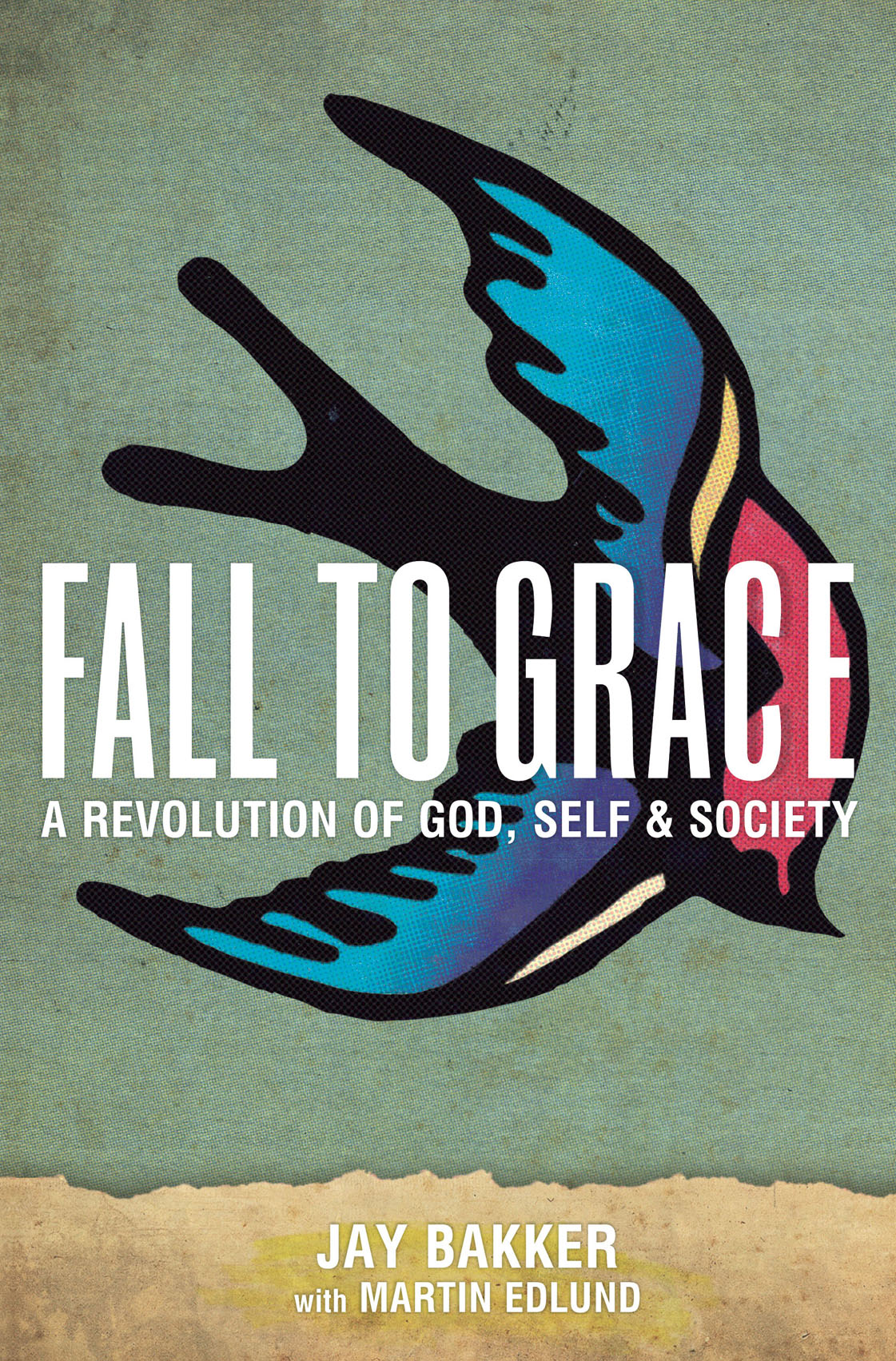
 Passion is a powerful thing. It can make us do and say crazy things. Some men are so passionate about money that they will neglect every other responsibility to attain more of it, which leaves them with little time to actually enjoy spending it. Others are so passionate about food that they will literally kill themselves by consuming large quantities of it. Some young men are so passionate about video games that they will waste their lives sitting in the dark playing “Call of Duty,” and occasionally wondering why no girls will date them. My friend Pastor Matt is so passionate about 80s metal that he makes ridiculous statements about how it is the greatest music ever made! Crazy, I know! But that’s what passion can do to us. Jay Bakker is passionate about grace, which is actually a really good thing. And if you know anything about his story you can appreciate why the son of the dis-graced televangelists Jim and Tammy Faye loves grace so much. But Jay’s passion for the concept in general has actually led him to misunderstand it and misapply the Biblical doctrine of grace. In fact, although Jay quotes the apostle Paul often in his new book Fall To Grace, the “grace” he is passionate about is not exactly the same as the one that Paul loves.
To some degree everyone’s theology is shaped by their own experiences. We can’t escape that, and it would be silly (and deceptive) to pretend like our theology is purely objective. John Frame deals with this quite well in his Doctrine of the Knowledge of God where he talks about the existential aspect of doing theology. But it seems more evident in Jay’s case that his life experiences have not simply affected, but in fact determined, his theology. For those not familiar with Jay’s story he gives us the recap in chapters one and two. He tells us that in hearing his story we can get a visible picture of grace (2). He’s right of course. Throughout history theology is often communicated through stories and personal experiences. Yet, as we learn, Jay’s theology is so shaped by his own experiences that it actually loses its connection to the theology of Scripture. With genius wit he writes:
My family set the standard for televised crack-ups. Before O.J. on the interstate, before Michael Jackson dangled babies over balconies, before Britney went all bald and strange, there was Jim and Tammy Faye “mascara meltdown.” But prior to being pariahs my parents were pop-culture pioneers. They were the first people o bring down-home, family-friendly Christian worship into America’s living rooms through television. (2)
Jim and Tammy Faye Bakker were pop-culture icons in the mid 1980s thanks to their show Praise the Lord (PTL), which “at its height…was carried on twelve hundred cable systems around the globe, broadcasting into more than thirteen million homes” (2-3). They founded a Christian-themed amusement park (Heritage USA), and were essentially celebrities across the nation. But it all fell apart. In 87 Tammy Faye was checked into Betty Ford Center because she was addicted to pain killers. Later that year it came out that Jim had in years past had an affair, and someone in the PTL organization had paid hush money to the young secretary. Finally by the end of 1988 Jim found himself on trial for fraud and conspiracy, eventually leading to his conviction and imprisonment. The whole ordeal is a hard to read about through Jay’s eyes. He writes:
From the perspective of an eleven-year-old-boy, the free fall was dizzying. One minute I was the scion of a famous family. The next I was a social leper with the most notorious last name in Christendom (besides Iscariot). I was so radioactive that my friends were literally forbidden to play with me. (6)
It wasn’t just his social life that suffered, however, his faith did as well. He states that the theology he grew up on was devoid of grace. If you obeyed the rules God rewarded you, and if you didn’t God punished you. “It was turn or burn, baby” (6). He tried, throughout his teenage years to get “right with God” but “it didn’t stick.” He states, rightly, that he couldn’t keep the rules. Finally he gave up: If a lousy Bartles & Jaymes wine cooler was all it took to separate me from God, then I was gonna accept my one-way ticket to hell…Reserve me a seat in the bar car (8). By the age of thirteen Bakker says he was a full-blown alcoholic. Drugs and sex followed. Bakker’s own story is a heightened and dramatic version of the same basic one that I hear often from Fundamentalist kids. But his has a twist: he read the Bible and discovered grace!
In what has to be one of the most beautiful parts of the book Jay describes how he was brought into a right relationship with God and His church through reading the epistles of Paul and discovering grace. He quotes Romans and Ephesians and highlights the beauty of God’s accepting us as we are. He does not call us to get right and then he will give us grace, there is no way to earn this gift of God.
Paul’s message wasn’t about guilt and punishment. It was about acceptance; it was about forgiveness; and it applied to me! What I felt instinctively about God – that he must be loving and understanding of human frailty- was right after all. Where had Paul been all my life? (16)
This grace saved Bakker’s life, and in Fall to Grace he says “it can revolutionize” your life too. It would be this grace that became the foundational for his whole theology. “A deep, confident understanding of grace creates a sturdy foundation on which to build our faith, our lives, and our world” (22). But as the book continues to unfold and we get further away from Jay’s story we see how it has influenced, and even redefined, the concept of grace in his theology.
The book is broken down into three parts, each discussing how the concept of grace revolutionizes our various relationships. First it revolutionizes our relationship to God, then to self, then to society. This is largely where the book takes a turn and its theology aligns itself more with neo-orthodoxy than with Paul. Take for example the way his view of grace revolutionizes God. In Jay’s theology the grace of God and the judgment of God are completely incompatible. This view, while not exactly revolutionary, is different from what we read in Paul. And Bakker notes this in passing, but the way he reads Scripture allows him to discount the one set of verses in favor of his “grace” verses. He writes:
There are Christians who make God out to be a bruising punisher: a wrathful God who enforces His demands with the kind of shock-and-awe arsenal available only to the divine. Certainly, if that’s the God you’re looking for, you’ll find ample evidence of Him in the Bible. Fear and trembling were common themes in the Old Testament…(and, yes, in places in the New Testament). (70, 72)
So how does Jay get around these representations of God in the Bible? By denying that it is all inspired. He starts out this part of the book by emphasizing that we are to get our picture of God and of grace from the Scriptures. “Read your Bible,” he tells the folks at his church (29), “Otherwise, we’re at the mercy of whoever shouts the loudest or who puts on the best show” (30). But his own practice doesn’t follow this model. In fact his whole approach to reading Scripture comes out more clearly in the final chapter as he explains the validity of homosexuality. Here he attempts some exegetical and cultural gymnastics to make obviously anti-homosexual texts say something different. But then finally he plays his “trump card”: Paul presents a picture of grace and acceptance that surpasses his statements about judgment. Bakker writes:
The point is that we must weigh all the evidence. Obviously, Paul had things to say that a lot of people find hard today. At times, his anger and judgment got the better of him. But his message of grace forces us to a different conclusion: The clobber Scriptures (the passages that speak against homosexuality, and which Jay says are used to clobber homosexuals) don’t hold a candle to the raging inferno of grace and love that burns through Paul’s writing and Christ’s teaching. And it’s this love that should be our guiding light. (176)
His reading of Scripture is all very selective and this allows him to compose a theology quite out of line with orthodoxy. It’s not that I can’t sympathize with Jay. Indeed I can. I fear much of the church is rooted in legalism of a new or old kind. I fear that many churches have not simply wronged and harmed homosexuals but have sometimes burned bridges to reaching them with the gospel. But the solution is not to redefine grace. Which is what Jay has done.
Jay speaks of Jesus as dying for our sins, but he denies, out right, that Jesus in anyway satisfied the just wrath of God against our sinfulness when he died. He writes:
Some red-meat Christians even want to interpret God’s gift of grace through Jesus as being all about atonement – about God demanding and getting His pound of flesh. But remember, God became human in the form of Jesus. It’s God up there on the cross. God is the One making the sacrifice for us. What could be more generous (and further from anger) than that? (72)
Certainly the way he paints it is a caricature, and not a genuine description of penal substitutionary atonement, but nonetheless that is exactly what Paul taught (Romans 3:24-26). So the grace given us is not found in Jesus’ payment of our debt, which raises a host of questions about what it means to speak of Jesus’ death as a “sacrifice.” Sacrifices in the Old Testament were performed as an atonement for sin, a propitiation of sorts. Jesus’ “sacrifice” in the New Testament is a fulfillment of this Old Testament practice. Grace devoid of this is merely a toleration of sinners; it does not deal with their sin and consequences for sin. And that is exactly how Jay thinks of grace, as toleration.
The truth is that I still have a soft spot in my heart for Jay Bakker. He was a personal role model for me early on in my preparation for ministry. I think many of the things that he says and does are very important for the church to hear and follow in. But ultimately this book is deeply flawed. It is self-contradicting, theologically weak, and it buys into many of the most poorly articulated liberal convictions (especially those about Scripture, which Evangelical scholars have long since refuted and responded to in great detail…I wonder if Jay has read the works of conservative New Testament scholars?). Jay is passionate about some kind of grace, but it saddens me to no-end to conclude that it is not the grace Paul was passionate about.
 Sparrow & Heart Soul Care