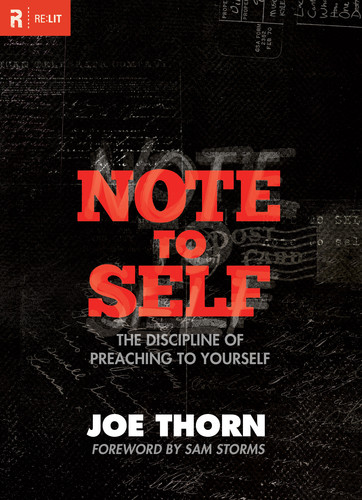
 I am not crazy! I may act like it sometimes, but I am really quite normal. Okay, maybe not “normal,” but my mind does function properly. Nonetheless, I find that I talk to myself. You probably do to. We talk to ourselves about schedules, about stress, and sometimes we even have those ethical discussions in our mind about whether or not we should or shouldn’t do something. We all talk to ourselves; the question is what are you saying. Joe Thorn talks to himself too, but he has written a book that is aimed at helping all of us talk rightly to ourselves. Note To Self is a fantastic, if brief, look at how to rightly talk to yourself. In fact the book is an example of more properly preaching the gospel and the law to yourself. It is a book all of us talkers need to read!
It seems that Thorn is seeing the same thing a lot of pastors see these days: people who sit weekly under the preaching of the word and yet do not live transformed lives. The issue, as he sees it, is that we are not preaching the gospel and the law to ourselves. We may talk about preaching to ourselves, but we don’t really know how to do this (23). Thorn defines the discipline as follows:
Preaching to ourselves is the personal act of applying the law and the gospel to our own lives with the aim of experiencing the transforming grace of God leading to ongoing faith, repentance, and greater godliness. (23)
There is an important addition to this practice, and perhaps somewhat unique to Thorn, that we must make note of here. For Thorn we are not simply to preach the gospel to ourselves but also the law. “The gospel will remain cloudy, if not irrelevant, to us if we do not understand the law of God” (24). So he takes some time in the introduction to unpack this addition. He states that the law does three things for us: (1) It shows us what’s right; (2) what’s wrong; and (3) what’s needed.
God’s commands give us specifics to follow. “We need his law more than we need a vague admonition to ‘love’ and ‘worship’” (24). The law also shows us our own imperfection and indeed inability to keep that law. Even though we know what’s right we fail to do it. And so, like a perfect progression, the law leads us to the gospel.
In preaching the law to ourselves we see and admire God’s will and way, while exposing and confessing our sinfulness. This leads us toward the gospel where we find our only hope of redemption and restoration. (27)
So there is a cycle in this preaching process, according to Thorn. We preach the law, see our failure, turn to the gospel for hope, and back to the law as “joyful and free obedience” (32).
The book is not, however, so much of an articulation of an exact method; it, rather, exemplifies what it might look like to preach rightly to yourself. Chapter after chapter Thorn demonstrates how one might preach the gospel and the law to himself as they relate to the various subjects of the Christian life. What’s interesting is that he is largely dealing with the most mundane and indeed frustrating parts of the Christian life: humility, unity, thankfulness, contentment, honoring parents, repentance, etc. What Thorn realizes and communicates well is that it is in these daily battles that we most need to communicate that gospel. He writes:
The impact of preaching to ourselves is not found in dramatic moments of crisis, or in our ability to use words creatively, but in the ongoing, regular, and virtually plain preaching of the law and the gospel. Preaching to ourselves is, in a practical sense, like reading notes you have written to yourself. They will often amount to important reminders about who we really are in ourselves and in Christ. (32)
The chapters are short (two to three pages), and written as simple sticky notes (“Dear Self, you need help”) and yet for their brevity they don’t lack punch. Each chapter is a sharp stinging expose on the soul’s trend towards self-worship and idle self-talk.
Thorn goes straight for the kill with himself and with us. Speaking of rejoicing he writes:
let’s be honest, the reason you do not experience the joy you read about in Scripture is because your heart is divided, and your interests are spread thin (37).
On our tendency to wallow in the guilt of our past sins instead of running to Christ he writes:
It’s as if amassing feelings of guilt becomes a perverted kind of penance in which you pay for your transgression by making yourself feel bad – as if your guilt is a means of getting clean. (45)
On waiting for Jesus he offers this stinging indictment:
The reason you are not eagerly waiting for Jesus is because you either misunderstand his second coming and/or love the world more than your King and his kingdom. (60)
It is not as if Thorn is just a mean old preacher, though. He writes as one who knows what its like to battle sin in the flesh. He writes with a pastor’s heart and with sensitivity. He writes not simply to condemn us all for these failures, but he writes to demonstrate how to apply the gospel to them and give us hope of transformation. He wants to help. So speaking of our tendency to pretend with others he says:
When you pretend, you lose gospel influence in two ways – inwardly and outwardly. You lose the inward influence of the gospel in that you are not honest with others and deny them the opportunity to speak into your life…You lose outward influence of the gospel in the lives of others because you can’t off them anything that is real. (67)
Routinely Thorn’s heart for others comes out and his burden not only to remind himself of the gospel but us is evident in these pages.
This is a practice that I know I need help with. Thorn’s book has given me much to chew on, but it works best not as methodology book (do it like this). Rather it works best as a demonstration of what it means to take seriously the gospel implications for all of our lives. Maybe writing actual letters to yourself is necessary for you or maybe not. But whatever you do follow Thorn’s desire to live this gospel out in every area of your emotional, mental, and tangible life. As he writes:
You need to find ways to remind yourself about the things that matter, because when you aren’t intentionally setting the truth before yourself you forget. (135)
Whatever you do, friends, don’t forget! Be honest with yourself and apply the gospel to yourself! After all, if you’re not preaching this gospel to yourself, then what are you saying?
 Sparrow & Heart Soul Care