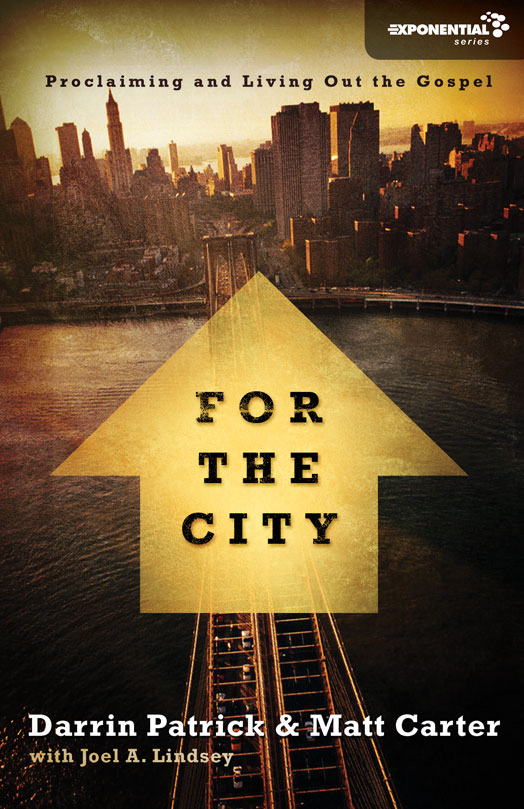
Darrin Patrick may be a name that you don’t yet know, but you will. He is quickly rising to become one of the more popular pastors of young evangelicalism. He is currently the director of Acts 29 Church Planting Network, the author of several books, and the pastor of The Journey in St. Louis. He is a captivating guy, with a unique story. In his latest book For the City, Patrick and co-author Matt Carter tell their stories. Each is the pastor of a large church in a major urban center and each is committed to the gospel and transforming their city. By means of their stories and their confessions Patrick and Carter make urban ministry come to life.
I confess, I thought the book would be much more methodological than narrative, but it is this narrative that brings the methodology to life. Neither Patrick nor Carter believe they have it all figured out (chapter 9). Both men planted churches that grew rapidly and yet admit that they would have done it differently could they do it over again. Each made major mistakes. Darrin’s speaks of his lack of leadership and his lack of openness to his people. Matt speaks of overworking himself and his staff, and generally being a poor leader. Their candor is refreshing. The young evangelical culture is quick to make an icon, a celebrity, a fourth member of the trinity (which makes a quartet) out of any popular theologian. I think nothing would frighten these men more than that, they seem very down to earth. They seem very aware of their flaws, and indeed aware of much of the larger church’s flaws.
It is neither Patrick’s nor Carter’s interest to attack the evangelical church, perhaps that is why the stick largely to relating their stories. The stories of how they planted Austin Stone Community Church and The Journey, respectively. They were keenly aware, over the course of their planting, that they each wanted to be part of a church that did more than exist for themselves. Matt spends sometime in the first chapter unpacking the different ways churches have, historically, interacted with their city of location. Some are simply in the city. “Churches like this are geographically in the city, but they aren’t effectively engaged with the people and culture of the city” (24). Others are against their city, and they settle into an “us vs. them” mentality (25). Some are of the city, that is to say they are so much like their city that they have lost their witness for the gospel. The Biblical church, in Patrick’s and Carter’s eyes, is a church that is committed to both Gospel proclamation and seeking the “shalom, ” (think human flourishing) of the city (26).
There is some overlap in the book with Darrin Patrick’s previous publication Church Planter. His chapter on contextualization is drawn almost right from that work. But overall this is a great book. It avoids the silver bullet mentality of some methodology books, and incorporates the personal narratives of each planter to help us flesh out the concepts of “seeking the peace” of your city. The examples of how both Austin Stone and the Journey have intentionally ministered to their city are worth the price of the book. As each church found unique problems located in their cities they sought to address them as a church with both the gospel and service. The results are astounding. They are honest about their mistakes; like Darrin’s admission that early on their ministry teams were scattered in too many different directions and found themselves frustrated and ineffective. But where they are successful they provide readers with a picture of what it looks like tangibly to love your city, to be “for” your city. Far too many books and speakers talk about “missional” intentionality, but Patrick and Carter live it and communicate it to us nicely.
The book will make a great companion to Patrick’s volume on the pastor, even where it overlaps. And whether you’re in a big city or a small town, like me, the book has something to offer you. After all the size of your location doesn’t matter, for we may have different cities but we have the same King who desires to love them through His people.
 Sparrow & Heart Soul Care
How about “‘with’ the city?”
http://www.subversiveREFORMATION.com
yeah, I think “with” is a completely legitimate preposition here. Both Austin Stone and The Journey have partnered with existing entities and groups in their city to make a difference. There is no way in which a community can be changed solely by a church. There are some Christians who give the impression that they are the great saviors of their cities and that without them no good would be accomplished. Such thinking is naive at best, unbiblically arrogant at worst. Good addition, Travis.