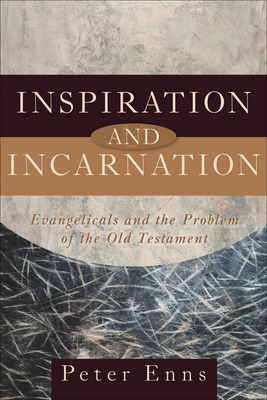
Every once in a while a book comes along that changes the shape of a discipline, that impacts the Christian community in an unparalleled way…then there is a book like Peter Enns’ Inspiration and Incarnation, which doesn’t. I read this book expecting heresy to explode from nearly every page. I had followed the Enns controversy at Westminster, where he was eventually removed for the contents of this book. I had given passing glance to blogs and books which attacked and characterized Enns. The truth, however, is that after reading the book I didn’t find it all that controversial. I don’t necessarily agree with Enns conclusions, but for the most part he wasn’t say anything new…even though he thinks he is.
The book is broken down into three sections. Each section deals with a particular problem, as Enns sees it, for Evangelicals concerning how the read and understand the Old Testament. Section one deals with the similarities between the Old Testament and the writings of other ancient cultures. “Is the Old Testament really that unique,” he asks. “Does it no just reflect the ancient world in which it was produced? If the Bible is the word of God, why does it fit so nicely in the ancient world?” (15). Section two raises issue about the theological diversity in the Old Testament. “Why do different parts of the Old Testament say different things” (15), even seemingly contradictory things? The third division tackles the way in which the New Testament authors use the Old Testament. Each division has its own chapter in the book and gets a more developed treatment.
Enns makes a number of great observations, raises important questions and reminds us often of the importance of the social, cultural, and even theological contexts from which the Scriptures were composed. This is important and healthy for readers of the Bible. Yet Enns seems to think that these various issues raise all sorts of questions in the minds of Bible readers that cause us to doubt Scripture. Perhaps Enns is right, but I can’t help but wonder if these questions are more his own and those of a few of his students than they are real problems of Evangelicalism. What I wondered more about was why the actual doctrine of inspiration play so little into his actual discussion of these issues.
Take, for example, his first chapter about the similarities between the Old Testament and the writings of the ancient Near East. He points to the Babylonian creation story and the Gilgamesh epics as examples that parallel, in very similar wording even, the creation and flood accounts of Genesis. The problem this raises, for Enns is as follows: how can we say logically that the Biblical stories are true and the Akkadian stories are false when they both look so very much alike (39)? I guess that’s a fair question, but it’s not as though this is all new information. Christian scholars have known about and interacted with these very documents for ages and seen no reason why we should question the authority and inspiration of Scripture. In fact, as John Frame has pointed out, if these events were real we should, at the very least, expect other cultures to have documented them and interpreted them. Enns even points out that these subjects have been addressed previously by other scholars (13), but not to his satisfaction. He believes that many have not dealt honestly with the implications of this data. I am no Old Testament scholar, but both my theological education and my various readings have interacted with this information and even conceded the points which Enns reminds us of here: (1) this data is older than the Genesis accounts, and (2) it seems very likely that Moses borrowed from it in this composition of Genesis. I don’t fault Enns for bringing the subject up again, it’s hardly a closed study, but I find no compelling reason, as he does, to revert to calling Gensis 1-11 myth. Nor do I see any indication from Enns that the doctrine of inspiration has bearing on how we interact with this data.
This is one of the more peculiar points for me in the work. The book’s title seems a misnomer, for he rarely interacts with the doctrine of inspiration, except to call it into question by the appearance of controversial data. There is no indication that the standard Evangelical doctrine influences how we view the data, only that the data influences how we view the doctrine. Surely the influencing works both ways, doesn’t it? All this applies equally to his discussion of similarities between Old Testament law and ancient Near Eastern law. The conclusions that Enns comes to here don’t seem at odds with the common understanding of Evangelical academia. He, however, seems to think it does.
In the second division he wrestles with the diversity found in the Old Testament. He looks particularly at an example in Proverbs where we are told not to answer a fool in his folly (Proverbs 26:4), and to answer a fool in his folly (26:5). How can both be true? Enns points out that it is all about understanding the details of the circumstance and making an informed decision. One is true in some cases, the other is true in other cases. This is the common understanding, but Enns points us to differences between Proverbs celebration of wisdom and Ecclesiastes discussion of the insufficiency of wisdom alone (1:18; 7:16). This difference in focus creates a tension, Enns says. And “to invest energy in smoothing out the diversity of Proverbs and Ecclesiastes amounts to not reading these books but actually reading past them” (77). Once again, however, I am curious as to whom Enns is addressing. Scholars have long held that difference in perspective and focus are part of the Old Testament canon. The diversity that Enns finds so troubling is commonly accepted, and without calling into question inspiration.
The same holds true of his discussions of Job, Chronicles, and the law. In each case it seems that Enns is raising questions that no one seems to have a problem with. He points out that various in the law are “situational…just as we saw with wisdom literature” (87). And again this is the common understanding I have heard about the Scriptures. The only question that does seem to warrant closer inspection is the variance on whether the Passover meal was to be roasted or boiled (91 f.). It’s an issue that warrants further investigation, no doubt, but one that hardly warrants a full-scale reevaluation of inspiration. The examples overall don’t seem to warrant an “Evangelical problem with the Old Testament,” at least not to the degree then Enns informs us it does.
In the final division Enns tackles the odd hermenutical method of the apostles as they quote the Old Testament. This is a matter that has long plagued New Testament scholars and exegetes. Enns offers little help here. I am grateful to him for his discussion of Second Temple hermeneutics and their relationship to the apostle’s style, but again he isolates these issues from the doctrine of inspiration and suggests that the apostles are merely creatures of their context. Their strange-to-us hermeneutics are simply rooted in their cultural practices. How should we relate to this method? That is to say, should we adopt the same practice of interpreting Scripture that the apostles do? Yes and no, he says.
We ought to adopt the goal of the apostles, Enns says, which was to reinterpret the Old Testament in light of the fulfillment of Christ, but not their eisegesis (i.e. their imposing on the text foreign meanings) (158). What method, then, should we use to accomplish this hermeneutical goal? Well Enns does favor the historical-grammatical method, but ultimately he leaves the issue of method open (161). “In other words, the Old Testament is open to multiple layers of meaning” (161). The problem I have here is that it leaves the issue of interpretation very broad. It makes defending right interpretations from wrong ones, something Enns concedes we must do (170), rather impossible. Ultimately, again, he leaves us wondering if the doctrine of inspiration has any real relationship to how we understand what the apostles are doing in their hermeneutics, even if they do resonate with the culture in which they were composed.
Enns wraps things up with a great word about interpretive humility, one I can greatly affirm. But overall the book raises many questions in my mind about the author’s intent. To whom is he writing? He says he is writing for “those who desire to maintain a vibrant and reverent doctrine of Scripture, but who find it difficult to do so because they find familiar and conventional approaches to newer problems to be unhelpful” (13). Well, I don’t know what these “newer” problems are, the ones he lists are old and well-known, and frequently interacted with. I don’t doubt, of course, that there are people for whom the issues he raises are still troublesome and cause to question the doctrine of revelation…they must exist if nowhere else at least in Enns own circle of acquaintances and students, etc. But by routinely ignoring what inspiration itself says about how we understand these issues he offers us little help. Enns doesn’t want to tackle those questions, he is not interested in interacting with “God behind the scenes,” that is with what he thinks is abstract theology. Rather he wants to look at “the God of the Bible, how he is portrayed there” (106). This is a noble sentiment, but one that seems to miss that the God of the Bible refers to His Word in the typical orthodox formulations of “inerrancy.” There is a reason that Christians today cling to this standard definition of an inerrant Scripture that does not contradict itself in its purpose or nature, even while it is diverse and similar to other ancient works. We cling to that definition because we believe it comes right from the Bible itself. Enns’ failure to interact with this doctrine leaves me scratching my head and wondering why he called this book INSPIRATION and Incarnation in the first place.
 Sparrow & Heart Soul Care
1 Comment