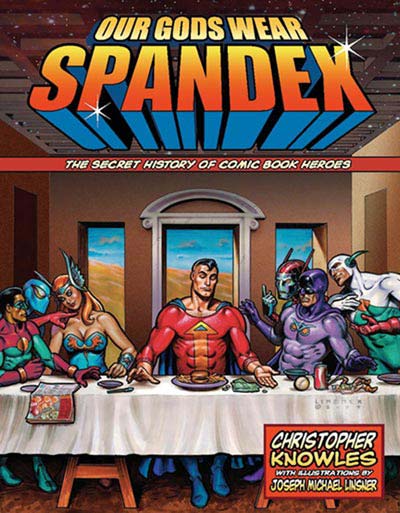
Hyperbole and book reviews seem to go together like mullets and NASCAR. How many endorsements have you read which state plainly “this is the best book on the subject I have ever read.” And how many “best books” can one endorser have? I try to avoid exaggeration, but the truth is that I am probably quite prone to it. That being said, I think I am still safe to say that Christopher Knowles’ Our Gods Wear Spandex: The Secret History of Comic Book Heroes is one of the most poorly researched works I have ever read!
The premise of the book is quite fascinating: comic book heroes are contemporary culture’s representations of the divine. Knowles suggests that the heroes of Marvel and DC are in fact rooted in pagan mythology and occultism. The subject and the thesis are compelling and I believe probably accurate (in fact I have a few other books on my shelf which suggest the same thing), the problem is that Knowles does a terrible job of supporting his premise. Throughout the book he not only makes wild leaps in logic, but assumes facts based upon unfounded assumptions.
He asserts in the introduction that “This book will explain how superheroes have come to fill the role in our modern society that the gods and demigods provided to the ancients” (xv). He actually spends far less time discussing the significant influence of comic book heroes on popular culture than tracing their lineage across a whole host of esoteric (a beloved word of Knowles, he uses it nearly every page) occults and religions. But this tracing consists of far fewer facts than one would hope. The evolution is, rather, based on wild assertions and assumptions, and circumstantial evidence at best.
When speaking of the great influences of what would eventually become comic heroes he points to several literary geniuses. He cites Jules Verne and states, as if it is astounding proof of comicdom’s religious roots, “Significantly, Verne is believed to have been a Freemason and to have had contacts with both the Rosicrucians and the Golden Dawn” (70). This is his pattern throughout much of the work. So he says of H.G. Wells, “He had various contacts with spiritualists like the Theosophists and political radicals like the Fabian Socialists” (71). He says of pulp fiction writer H.P. Lovecraft that, “Many researchers have speculated that Lovecraft had extensive contacts with esoteric and occult organizations” (93). Of the creators of Captain Marvel he writes, “Bill Parker (who studied classical literature in college) and artist C.C. Beck (the son of a Lutheran pastor)” (124). This is not good research and it is most definitely not proof that comic book heroes stem from religious roots.
Now, again, I believe that this premise actually does hold weight. But Knowles’ attempts to persuade us are ridiculous. The fact that someone knew people involved in the occult, loved the study of ancient Egypt, or was the son of a pastor adds little to nothing to our foundation. Again, I say, this may be one of the most poorly researched books I have ever read.
While I think Knowles is onto something, and even found the introduction and the first few chapters well written and thoughtful, ultimately I am afraid that Our Gods Wear Spandex is stretching “facts” too far.
 Sparrow & Heart Soul Care