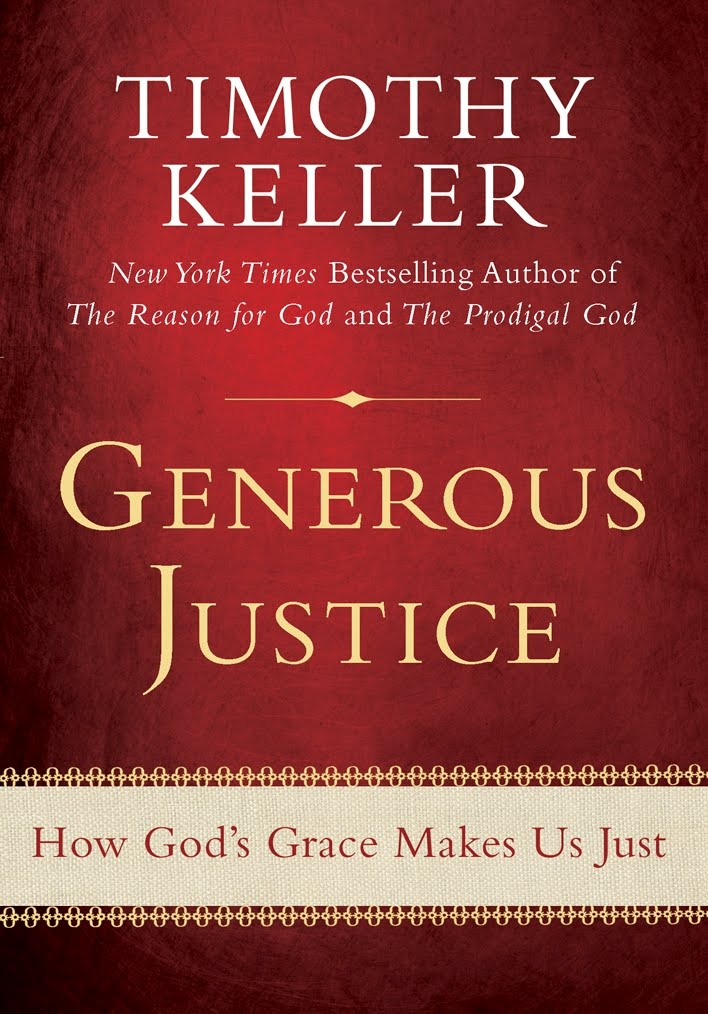
God’s grace makes us just. That’s what Tim Keller, founding pastor of Redeemer Presbyterian Church in Manhattan, argues in his book Generous Justice. It’s a bold claim, and it so for two reasons: (1) Many in our current age, both within and without the church, believe that you can take or leave the grace of God but you must have justice; (2) Others believe the opposite of this, that you must have the grace of God but social justice is not mandated. Ultimately both groups see no obvious connection between the gospel and this thing called justice. Keller is in danger, right out the gate, of writing a book that many will find irrelevant to the way they do church. But, thankfully, Keller believes in the thesis and he has reasons why you should too. The book is not simply interested, however, in giving us justifications it is also concerned with giving us some suggestions for application, and both those reasons are why you should read this book.
Many people talk about social justice these days, but very few have any clue what that looks like and what the phrase means. Many more are lost concerning what it means for the local church to be involved in social justice, in fact some believe that the church, as the church, shouldn’t be involved at all. To such people, it seems, Keller is expressly writing. He opens his introduction by identifying specifically to whom he wants to communicate. There are four types of people to whom Keller is writing: (1) The young evangelicals excited to talk about this subject; (2) The Christians who are suspicious of social justice; (3) The Christians who have rejected Orthodox theology in the name of “broadening their mission” to include social justice; and (4) The skeptics who believe Christianity is a poison to society that accomplish no earthly good. Though to some degree the author will interact with each of these people in different ways, he begins his book with the same message to them all: There is a direct relationship between a person’s grasp and experience of God’s grace, and his or her heart for justice and the poor (xix).
Keller’s apologetic nature comes out almost immediately in the layout of the book, which is broken down into eight chapters each essentially answering some of the basic questions about the church’s relationship to social justice. So chapter one asks: What Is Doing Justice? To answer this he takes us to the Old Testament and specifically to two repeated Hebrew words which communicate the various aspects of justice in the Old Testament Scriptures. First, Keller gives us the word mishpat which has as its “most basic meaning…to treat people equitably” (3). It is giving “people their rights.” The word is used, he tells us, more than 200 times in the Old Testament and often in relation to the “quartet of the vulnerable”: the widow, orphan, immigrant, and the poor (4). To the degree, then, that we take up their causes we are living out Micah 6:8, we are being just. To the degree that we do not, Keller says, we are violating justice. All this is rooted in the very character of God, he tells us. Most frequently in Scripture God expresses his concern for this quartet, and not for the rich and powerful. The author writes as one who has surely studied this concept at great length, as a man who knows his Scriptures well. In fact I love that Keller makes almost no qualifiers when he says something like this; it is a very matter-of-fact statement. “The Bible says that God is the defender of the poor; it never says he is the defender of the rich. And while some texts call for justice for members of the well-off classes as well, the calls to render justice to the poor outnumber such passages by a hundred to one” (7).
The second term to consider, then, is tzadeqah which “refers to day-to-day living in which a person conducts all relationships in a family and society with fairness, generosity, and equity” (10). This is the kind of living out justice that really makes the ideas in the former unnecessary (specifically punishing wrong-doers and caring for victims). A look at the life of Job gives us a picture of this kind of justice, as the man considers how his right relationship with God has profoundly social implications. So, Keller writes, “Ezekiel and Job make radical generosity one of the marks of living justly” (17). According to the Old Testament, then, justice towards others is part of what it means to be in right relationship with God.
In chapter two Keller recognizes the first major objection: Are the laws in the Old Testament binding on Christians today (19)? The answer, for Keller, is yet again a simple yes. He clarifies that Christ’s coming merely changes the “way” in which we abide by the Old Testament principles, they do not deny the principles themselves. “The coming of Christ changes the way in which Christians exhibit their holiness and offer their sacrifices, yet the basic principles remain valid” (21). Keller than gives us examples to help us see this concept in practice. He distinguishes between Israel’s civil and moral law. We usually recognize our obligation to obey the moral law, but how should Christians think about the civil law. For it is in the civil law that we find these commands about social justice. The problem we run into is that Israel is a theocratic state, and the church is not. But since “the Mosaic laws of social justice are grounded in God’s character, and that never changes” (22) we must, like Israel, still exist as a “community of justice.” Keller considers both the concept of forgiving debts and gleaning laws in the Old Testament to give us an idea of how this principle might play out for the church (in contrast to the theocratic state of Israel). Take for example the gleaning laws, he says, it’s not that we should enact laws that require farmers to leave grain for the poor, but rather there is a principle at stake here. The law enabled the poor to pick the grain themselves and not rely on charity and handouts. “The gleaning laws enabled the poor to be self-sufficient, not through getting a handout, but through their own work in the field” (30). So Keller sees a potential application when he states, “How could a government follow the gleaning principle? It would do so by always favoring programs that encourage work and self-sufficiency rather than dependency” (30). At this point Keller does not go where I wish he had, which is determining how the church specifically can apply this principle. Rather he turns to consider why it is so hard for us to apply these Old Testament principles.
As Keller explains it the issues is that the Bible’s picture of the causes of poverty are more complex than the reductionist beliefs of left and right wing politics. For example the liberal theorists believe poverty is caused by social factors (economic deprivation, racism, joblessness), while conservatives believe that it is rooted in the breakdown of the family and individual responsibility. Therefore each group has a different and conflicting approach to solving poverty. But the Bible puts forth several factors as causes for poverty, including oppression, natural disaster, and personal moral failure. Therefore, we must, Keller argues, take politics out of the equation and see the solution to poverty as more complex than any one program. It’s clear from all of this discussion that care for the poor is a passion of the author, but, he argues, that’s because ultimately it is God’s passion. And so he brings us full circle back to the start of the chapter to highlight how even in these Old Testament ritual, ceremonial and civil laws, God is evidencing his care for the poor. He leads us, then, into the next chapter with wise preparatory words: It is the generosity of God, the freeness of his salvation, that lays the foundation for the society of justice for all” (40).
In a lot of ways the book is like a bottle of Tums. At the start of each new chapter it knows that you’re going to have trouble with what you’ve just digested, and so it offers you something to help settle things. Chapter three begins with yet another such apologetic approach. Keller knows that many are going to simply say, “But that’s the Old Testament! What did Jesus say about Justice?” In fact that is precisely the response Keller heard at his first church when he tried to promote the ideas in this book. But “while clearly Jesus was preaching the good news to all, he showed through his ministry the particular interest in the poor and the downtrodden that God has always had” (44). Keller goes on to list example after example of Jesus’ own concern for the poor. He spoke with women in public; he made a Samaritan the hero of his story; he claimed that God loved a Gentile widow; he welcomed children; he touched lepers. Jesus called his disciples “to give to the poor in the strongest and most startling ways” (45) and to commit “economic and social suicide” (47) to show them favor. Out of all of this, then, Keller draws the inference that “one’s heart attitude toward the poor reveals one’s heart attitude towards Christ” (53).
All throughout the book the author has been highlighting for us just how different Jesus is. He is not what his contemporaries expected, and in many ways he is not what we in the modern church expect and assume either. It is very common for many in the church today to make countless distinctions, divisions, and functional separations. So we draw seemingly arbitrary distinctions between the mission of the church (collectively) and the individual Christian. Or, for Keller’s point, we draw distinctions between private morality and social justice. But once again Jesus once again, like the Kool-Aid man, does the unexpected and busts through our walls of separation to give us “the whole cloth” (54). “Jesus, like the Old Testament prophets, does not see two categories of morality” (55). Keller gives us a glimpse then of how the New Testament church understood this and followed Jesus’ model of the whole cloth. He highlights for us that this is the model we have been given and it is the model we are to utilize today. Quoting Galatians 6:10 he points out: Helping “all people” is not optional, it is a command (61).
As we move on to chapter four Keller preps us with this question: Are we under obligation to help those outside of the family of faith? It’s not an inane question, for many criticize concern for social justice in the church on the grounds that all the supposed biblical support deals mainly with care for those in the church. Keller, like a good apologist and pastor, then, takes us to the parable of the Good Samaritan and asks us to explain this in light of such a narrow view.
The story of the Good Samaritan is one of, if not the, most frequently cited parables in all of the Scriptures. It’s often referenced without fully understanding its implications, however, and so Keller goes through a careful exposition of the storyline. He explains not just what is said but how Jesus’ responses would have been so countercultural. But the story is more than just countercultural for ancient Israel, it has meaning for us too. So Keller states that the parable most “informs Christians’ relationships with their neighbors” (63). If there is debate over whether or not other proof texts for social justice apply to those beyond the Christian community this one must. Keller writes: Not everyone is your brother or sister in the faith, but everyone is your neighbor, and you must love your neighbor” (68). He now prepares for the objections.
Over the course of his ministry, Keller tells us, he has heard numerous objections and so the apologist comes out to play. But Keller takes us, once again, in a direction I did not expect. This time he leaves, momentarily, the text of Scripture and moves into the pages of history. Keller finds help, surprisingly, in the pages of sermons and essays by Jonathan Edwards. Edwards was a congregation minister in Massachussettes from 1729-1751. But don’t let his powdered wig fool you, the man had much to say about Christianity’s service to the poor, much that is still relevant. I was utterly fascinated by just how much Edwards speak to today. But ultimately Keller knows we can’t be convinced by this American Puritan, even if he was America’s greatest theologian. Rather he wants us to be continually reminded that our motivation stems from the gospel itself. The story of the Good Samaritan is really about us. It’s about how we were dying in the ditch when Jesus came along and rescued us. And it is this realization which fuels us to care for the poor. “Before you can give this neighbor-love, you need to receive it. Only if you see that you have been saved graciously by someone who owes you the opposite will you go out into the world looking to help absolutely anyone in need” (77).
Motivations continue in chapter five. With each new chapter readers can feel the weight mounting up against all the objections and, perhaps more honestly, the excuses. In this chapter Keller cites two theological motivations that Scripture gives us: (1) the Imago Dei, and (2) God’s ownership of all things. By pointing us to the Imago Dei Keller reminds us that all men are created in God’s image and are therefore owed the same level of dignity and respect. “The image of God carries with it the right to not be mistreated or harmed” (84). In fact he points out that for Martin Luther King Jr. it was this doctrine which motivated him to fight for Civil Rights. Secondly, he reminds us that God owns all that is and therefore we have no claim to keep it to ourselves. We are merely managers of God’s things, not owners ourselves. So Keller writes: Therefore, just men and women see their money as belonging in some ways to the entire human community around them, while the unjust or unrighteous see their money as strictly theirs and no one else’s (90). Ultimately, for Keller, the main motivation is the grace of God given to us in the gospel. “The logic is clear. If a person has grasped the meaning of God’s grace in his heart, he will do justice” (93). Keller takes us on a quick survey of some key Biblical passages in both the Old and New Testament to see that this motivation is spread across the pages of the Bible. For him all the motivation to do social justice is really rooted in the gospel, and he will repeatedly drive that point home. In chapter five this point is expressed as our justification drives us to justice.
The Bible’s high view of God’s law and moral character reveals that there is no amount of hard work or good work that we can do to earn his favor. We are all doomed and deserving of punishment. But God in mercy and grace saves us despite our inability to help ourselves. We are morally and spiritually bankrupt, but God saves us. This justification then is our motivation to do justice. “To the degree that the gospel shapes your self-image, you will identify with those in need” (102). After all we, at least spiritually speaking, are those in need. “In other words, when Christians who understand the gospel see a poor person, they realize they are looking into a mirror” (103). This concept is truly the only thing that will drive us to action. He spends just a moment in concluding the chapter discussing the weakness of guilt-driven social justice. Guilt doesn’t work, he says, because we have “built-in defense mechanisms against such appeals”. Instead, he says, “I believe…when justice for the poor is connected not to guilt but to grace and to the gospel, this ‘pushes the button’ down deep in believer’s souls, and they begin to wake up” (107). Again and again and again Keller would have us see the gospel is our motivation.
As we move into the latter part of the book we make a shift from theology to practice. Chapter six asks “How should we do justice?” We’ve moved, now, from motivation to methodology. Here the author reveals as much awareness and skill as he does when he interacts with the Scriptural text. Keller has spent decades working in Manhattan and seeking to do what he calls us to do: live out justice. This has meant a lot of different things for him and for his church, and he shares from his own examples as well as the examples of his friends in other metropolitan cities. The practical pictures of what working this out looks like is invaluable for me as a pastor and all of us as Christians. Keller does not want to talk simply in abstract forms, he wants to look at specific application, but he also doesn’t ever present a magic bullet model. He doesn’t tell us to copy him and his friends, and that is much appreciated. After all many who read this won’t live and work in NYC, and we need to contextualize models for our context, not his.
Chapter six begins with some theory on methodology. Keller wants us first to see that justice is not an attachment to our church ministries. It’s not a programmed event in the life of our churches. Rather it is a way of life for the Christian. He makes bold declarations often throughout the book, this is only one:
Doing justice, then, requires constant sustained reflection and circumspection. If you are a Christian, and you refrain from committing adultery or using profanity or missing church, but you don’t do the hard work of thinking through how to do justice in every area of life – you are failing to live justly and righteously. (112)
The truth is that doing justice is hard work and its not the simple one-weekend a month kind of programmable activity. In fact, Keller, outlines the reality that “vulnerable people need multiple levels of help,” including relief, development, and social reform (113). The rest of the chapter explains each phase. Relief is “direct aid to meet immediate physical, material, and economic needs.” Development moves people or communities beyond dependency on relief and into self-sufficiency. It requires giving them the tools necessary to do it on their own. This is a hugely important step in Keller’s book. At this point he takes us on a detour to see what it looks like, and no one gives us a better picture than does John Perkins. Perkins has done the developmental work that most of us only talk about, and he has given us a great example. The material that Keller covers here, even it quickly, is compelling and attractive. Finally, social reform “moves beyond the relief of immediate needs and dependency and seeks to change the conditions and social structures that aggravate or cause that dependency” (126).
The chapter wraps up by asking the very important question of how the church’s responsibility to do justice relates to its other responsibilities. He recognizes, of course, that the church can get bogged down with the major long-term and highly involved tasks of development and social reform. He draws a distinction that I am not quite sure I agree with when he states that the institutional church should do relief, and the “organic” church should do development and reform. That is to say the church as the institution should meet physical, material, and financial needs, but Christians individually working together beyond the institution must do the rest. On this one point Keller seems strangely in-line with some of the more major critics of the church’s involvement with social justice. Of course he wants to remind us that evangelism and social justice go together, but then he seems to suggest that the “institutional” church can only do this up to a certain degree. I appreciate the sensitivity he has to not over-committing the institutional church and its leaders, yet making a hard line between “institutional” and “organic” church doesn’t quite seem necessary in my mind. It’s only slightly better than those who say the church, as the church, shouldn’t be involved in justice even while individual Christians should. This is, in my book, and even more arbitrary and ridiculous distinction. It’s really my only complaint with what is an otherwise stellar book, and even this is so minor in the grand scheme of the book it hardly seems worth mentioning.
Chapter seven deals with “Justice in the Public Square” and with amazing sociological insight Keller points out how the competing views on justice in our culture are rooted in a lack of definition. The problem, as he sees it, is that because of “the rules secular discourse” we cannot make moral judgments in public, but all justice is judgmental (157-8). If we can’t talk about the roots of the concept of justice, if we can’t define the words we use then how can we ever hope to make real headway in applying the concept of justice to our world? It’s an empty term for most of our culture. “We can’t agree on what justice is because we can’t talk about our underlying beliefs” (158). The result of this secular rule is that Conservatives and Liberals respectively have half the picture of what it means to do justice, but ultimately because they cannot dialogue end with this reductionist definition. “This means that no current political framework can fully convey the comprehensive Biblical vision of justice, and Christians should never identify too closely with a particular political party or philosophy” (163). Practically, then, when it comes time for Christians to engage in justice in the public square we must not “be strident or condemning in [our] language or attitude, but neither should [we] be silent about the Biblical roots of [our] passion for justice” (169). Unlike the various political ideologies we do not have to abide by the secular rule, and we must truly define justice in all its complexity in Scripture. Keller spends a few pages outlining the complexity of justice in the Bible and contrasting it with the Conservative and Liberal political views of the subject. This was really insightful to me and I am certain will be invaluable in years to come.
Finally, then, we come to chapter eight. For such a small book it is packed with content and rich with Scripture, theology, and practical application. Keller writes beautifully, engagingly, and apologetically. He is always anticipating our objections and answering them. In chapter eight he deals the final and ultimate blow to our excuses and our objections: the gospel. Keller wraps things up nicely by reminding us that ultimately the gospel is about righting wrongs, repairing what is broken, and restoring all things in the universe to order under His glory and authority. He begins the chapter by reminding us of the concept of “shalom,” peace. He states that shalom means “complete reconciliation, a state of the fullest flourishing in every dimension” (174). To do justice, then, he says “means to go to places where the fabric of shalom has broken down, where the weaker members of societies are falling through the fabric, and to repair it” (177). This means giving of ourselves, it means all the things that Keller has spelled out in the pervious pages. It means hard work, and for some the motivation is still lacking. So he points us then to consider this final observation: beauty motivates us to be just. “It takes an experience of beauty to knock us out of our self-centeredness and induce us to become just” (183). For Keller that beauty is ultimately found at the cross. “In the incarnation and death of Jesus we see God indentifying with the poor and marginal literally” (185). His death, in particular, was the “ultimate instance of God’s identification with the poor. He not only became one of the actually poor and marginalized, he stood in the place of all those of us in spiritual poverty and bankruptcy and paid our debt…Now that is a thing of beauty. To take that into the center of your life and heart will make you one of the just” (188).
This has been a long review. In fact if you just skipped to the summary of my thoughts at this point I can’t hardly blame you. It goes to show, however, just how important I think this book is. Keller probes nearly every objection and every motivation he can in so few pages to help us build a theology of justice. It is a theology rooted in the gospel and active in our daily living. This is a book that I will use practically for years to come; I will use it both to reignite my theology regularly and to give me help practically on how to be just as a man, the leader of a family, and the leader of a church.
 Sparrow & Heart Soul Care
1 Comment