Mary Had A Lamb
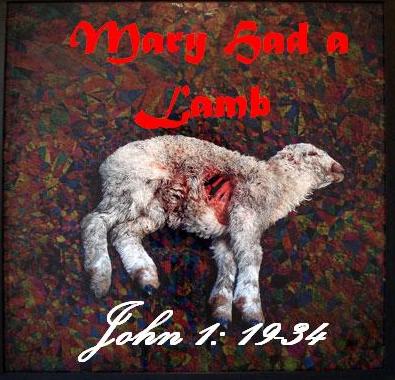 In his book Death By Love: Letters from the Cross pastor Mark Driscoll recounts one of the stories of a member at his church. Mary, was a fourteen year old girl who, for her first boyfriend, began dating a young and violent man. He wasn’t violent at first but he revealed his nature as their relationship progressed. Eventually he became violent with Mary, locking her in his car so he could yell at her, throwing her into walls, and eventually raping her. It was a horrific experience, no doubt, for Mary, but she eventually broke things off with him became a Christian and married a godly man. But she could never shake the feelings of guilt that had come associated with her rape. It was not, to be sure, her fault, yet nonetheless she felt guilty. She told her pastor that she felt dirty and like “damaged goods.” She needed cleansing, cleansing from the dirt, stain, and guilt that comes from the sin that others commit against us. Thankfully Mary had a Lamb who takes a way the sin of the world. That Lamb is described in John 1:19-34.
The text opens with John the Baptist, that eccentric revolutionary preacher, proclaiming in the hill side that all men are to repent and be baptized. Now John’s work is garnering some attention not only because of the authority and uniqueness of his proclamation, but also precisely because he is baptizing. Now Baptism was not uncommon to the Jewish culture, but it was done as a symbol of cleansing and was normally self-administered, but here is John calling all Jews everywhere to be baptized and then he himself is doing the baptism. It’s a break in protocol and so the Pharisees send a delegation to inquire more about who this man is, for they believed that he might be some figure who would come in the “end times.” The prophets of old had foretold of a number of figures who would come in the last days and so they ask John: are you the Messiah, but he’s not; are you Elijah, but he’s not; are you the prophet greater than Moses, but he says no to that also. When probed a little further John states that they shouldn’t be concerned with who he is, for he is just the messenger of the one who will really change things, and that’s precisely what Jesus does.
This whole passage revolves around the issue of Baptisms. John was performing baptisms in a different manner and for a different reason, and the Jewish religious leaders take note. But John is just the transitioning stage for the one who will really give us a paradigm shift. Jesus will baptize differently too, but his baptisms will be with the Spirit of God. There are all sorts of ways that men and women try to cleanse themselves from the stain of sin and guilt. The rape victim showers, and others self-medicate, still others perform great religious tasks. Baptisms can become just such a religious task that men and women think, if performed rightly can cleanse me of guilt. But the reality is that only being baptized by Jesus with the Holy Spirit is truly cleansing. Why? Verse 29 explains: Jesus is the Lamb of God who takes away the sin of the world! Only Jesus can take away our guilt, the guilt associated both with our own sin and with the sins that others have committed against us. The question that may come to our modern minds, at this point, is what does it mean for John to call Jesus the “Lamb of God?” The answer is rooted in the Jewish Old Testament sacrificial system.
Because the sin and guilt have always been a problem for humanity God provided a temporary way for men to have communion with Him without bearing the guilt and punishment that was theirs. So the system he set up was one where the Jews would take a sacrificial animal and identify themselves with that animal, putting their sins on that animal and then killing it as a testimony that this is what they deserved for disobeying and rebelling against God. It was an act of mercy by God to say I will take a substitute for your punishment. In calling Jesus the “Lamb” of God John is indicating that Jesus is our sacrificial substitute who will take away our sin through his own sacrifice. In Jesus’ death on the cross for sinners men and women can be free from the stain of sin and the guilt and shame that sin carries with it.
For each of us, with our own sin or those of us still bearing the shame of sins committed against us, there is hope and freedom in Jesus. Sisters, those of you who like Mary have been violated, know that Jesus offers you freedom from the guilt you feel (the guilt that is not yours to begin with). Jesus can relate too. Jesus, himself, can relate to your shame, disgrace, humiliation. Jesus’ body was stripped naked, he was beaten, he was mocked and suffered torment. His beard was pulled out, a shameful and disgraceful thing in that culture. And Jesus was held against his will and tortured and defiled, and finally killed. Hebrews 12:1-3, however, offers us hope in lieu of this event. We read: Let us run with endurance the race that is set before us, looking to Jesus the founder and perfecter of our faith, who for the joy that was set before Him endured the cross, despising the shame, and is seated at the right hand of the throne of God. Consider Him who for sinners endured such hostility against himself, so that you may not grow weary or fainthearted. Why did Jesus endure the cross? So that we may approach the throne of God’s grace with confidence, so that we may not grow weary in the trials of this world! We may persevere, friends, overcoming guilt and shame because Jesus endured the cross and there took all the shame associated both with our sins and the sins committed against us.
Friends, be free in Christ, the Lamb who takes away the sins of the world! May has a lamb, do you?

