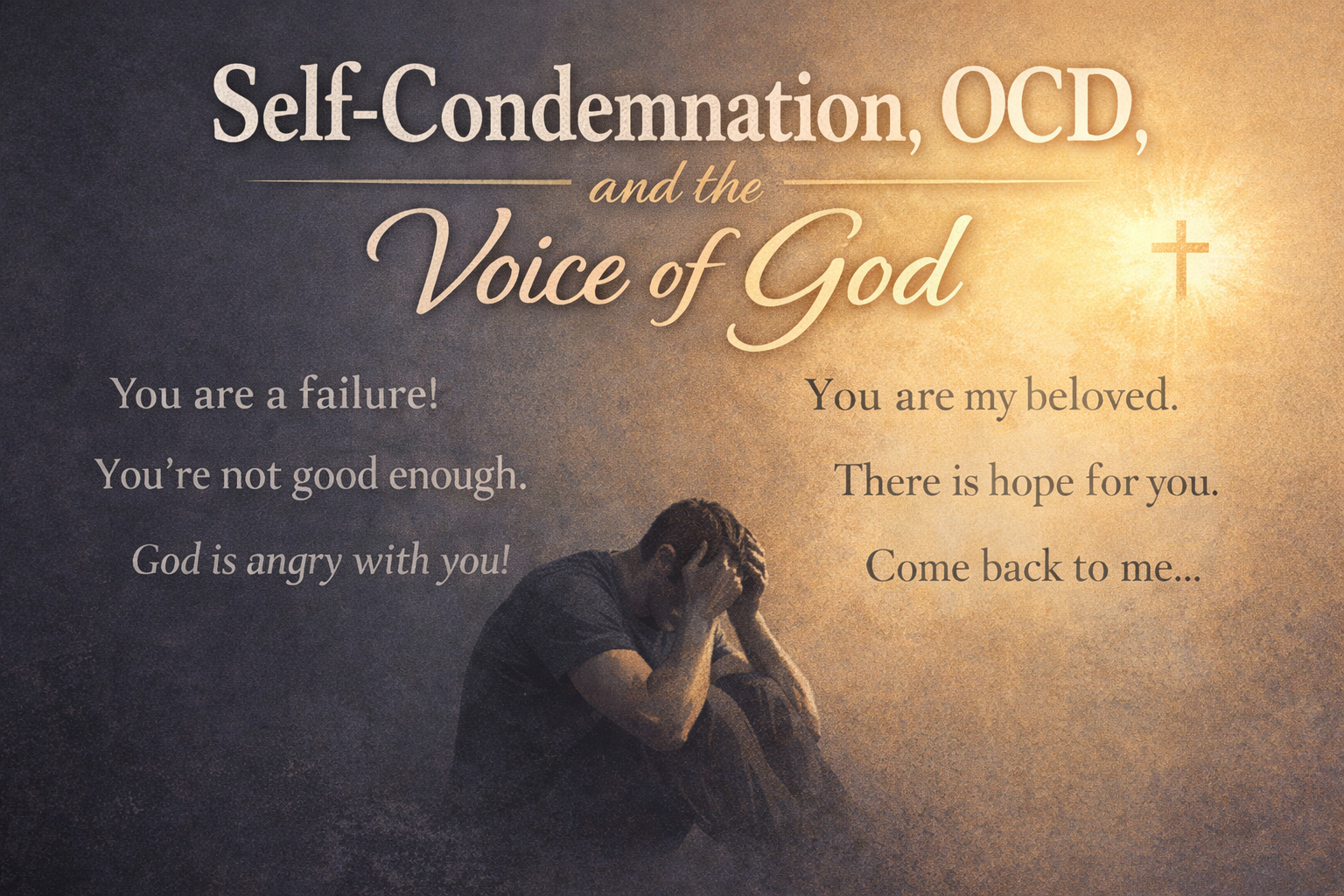
Persistent intrusive thoughts have to be one of the most exhausting experiences to live with. Those who suffer from Obsessive Compulsive Disorder know that reality well. Unwanted and unrelenting thoughts wear us down, create anxiety, and often leave us feeling condemned. For the religious it can be particularly difficult not to confuse intrusive thoughts with God’s conviction. One way we can learn to distinguish intrusive thoughts and God’s conviction is by observing their tone. While OCD condemns, the Lord never condemns His own.
OCD thoughts are often full of condemnation. “You aren’t doing enough?” “You are responsible for any harm that comes to others.” “You could have done more.” “You don’t really love others.” On and on the list of thoughts goes, each adding burden to our shoulders and making us feel more and more like failures. OCD makes us feel like failures in relationships, failures at work, failures at home, failures with God, and generally just failures in life. Sufferers often hear the voice of condemnation in their intrusive thoughts.
In such moments it can be easy to confuse this with God. Scripture repeatedly calls believers to put sin to death and to pursue holiness (Rom. 8:13; Col. 3:5; Rom. 6:12–13). Because of this, we can easily assume that any sense of inner accusation must be God calling us to change. After all, God does work in our conscience to call us to change and growth. But, while God’s conviction can be painful and sobering, it is never cruel, shaming, or hopeless. The key to healthy discernment is found in the tone.
Scripture tells us that “there is no condemnation for those who are in Christ Jesus” (Rom. 8:1). In other words, if you have put your faith in Jesus Christ for salvation then you never have to fear condemnation from God. Your sins, every last one, have been punished in Jesus on your behalf (1 John 2:2). For the believer, conviction comes in the form of desire for a godly life, the hatred of sin, the love of God. It does not come as hatred of self, or berating and beating oneself. God does not condemn His children; but OCD does. OCD can sound like hatred and disgust, but the voice of God sounds like compassion, love, encouragement, and the call to something better.
If, then, you feel a conviction over specific failures or sins, pay attention to the tone. What does that “conviction” say? How does it sound? Does it say:
- You are the worst!
- How can you call yourself a Christian and act like that?
- You don’t really love others; you’re so selfish!
- You are nothing but a failure and nobody likes you.
Those are not the words of our God who calls us “beloved” and claims us as His own. His words are never words of condemnation for His children. Instead, His conviction sounds like this:
- There is a better way to live than this.
- This behavior/desire will not honor the Lord whom you love.
- This path isn’t leading you toward life and godliness.
- The Lord is inviting you back into faithfulness.
- You are forgiven, and growth is possible.
The difference is noticeable. One has such a positive and encouraging bent towards it. It is a longing to see sin put to death for sure, but it comes from a place of hope and calling. The other is exceedingly negative. It sounds less like a call to change and more like an intent to crush your spirit. God never crushes His children (Isa. 42:3).
If you want to grow in this discernment here is a simple exercise. Write down some of the most common critical thoughts that rattle around in your brain throughout the day. Identify which thoughts feel most pronounced and then attempt to characterize their tone. Do they sound constructive, encouraging, inviting? Or do they sound harsh, condemning, and cruel? Don’t concern yourself first with their truthfulness or accuracy, but their tone. There will always be ways in which we need to grow and change, but God’s commands to us are sourced in His love for us and in the gospel of Jesus Christ which makes change possible. So evaluate the tone and ask the Lord to help you discern what is true. Many intrusive thoughts are not spiritual signals or morally meaningful at all; rather they are neurological noise produced by a disordered anxiety system.
One quick word of caution on this exercise: This is not an exercise in perfect discernment, but in gentle awareness. You are not solving all your thoughts nor are you trying to perfectly perform an exercise. This is simply about giving you an opportunity to grow. Growth in awareness, not mastery, is the goal.
It’s never easy to discern intrusive thoughts from the truth. The thoughts feel so compelling and so true. But if you listen to the tone you can help yourself, in time, to grow in discernment. God does not condemn those who are in Christ. OCD offers us criticism without hope, but that is not God’s voice. The gospel does not merely tell us that condemnation is gone—it gives us a new voice to listen to: the voice of the Father who delights in His children because of Christ.
 Sparrow & Heart Soul Care