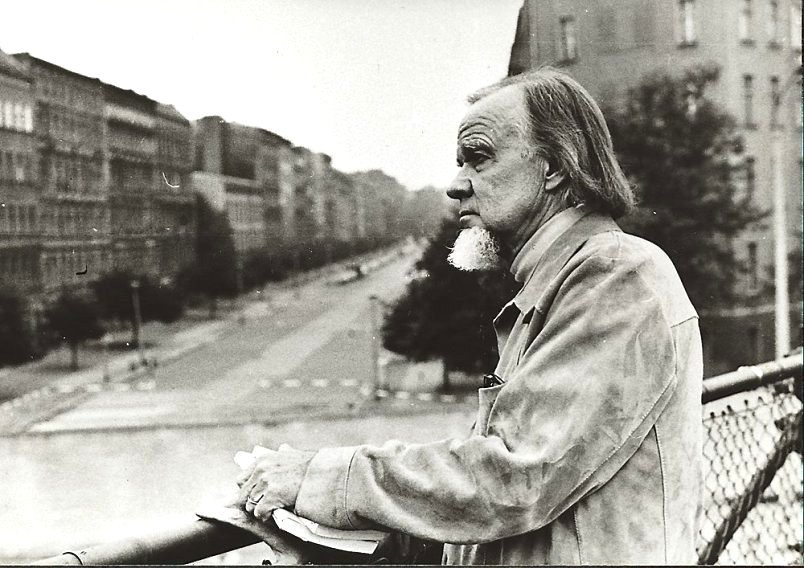
In some regards, Francis Schaeffer should not have made the kind of impact he did on the Christian world. He began as something of a separatist Christian, and was often a catalyst for divisions in the church. The height of his career was spent in the Swiss Alps – hardly the epicenter of theological development. He was not himself an academic, and there are times where in reading his material you can see evidence of his lack of education. Yet, people continue to read his books and speak his name. Many a great Christian academic names him among their significant influences. Schaeffer made a massive impression on the church. In particular, his ability to apply an Orthodox faith to cultural engagement has dramatically changed the Evangelical landscape.
When Schaeffer came on to the Evangelical scene people did not know what to do with him. His long hair and goatee were not welcomed by the church at the time. His insistence on wearing knickers, long socks, and hiking shoes wherever he went made the church suspicious of him. Why did he dress this way? Who was this man? But his teachings were more shocking than even his appearance. His teachings were unsettling to some, and his cultural awareness was shocking to Christians of the time. Greg Jesson has noted:
When Schaeffer lectured at Wheaton College and frequently referred to the existentialist films of Ingmar Bergman and Federico Fellini, the students were in the midst of fighting with the administration for the right to show films like Bambi and Herbie the Love Bug on campus.
“Francis Schaeffer’s Enduring Relevance” in The Southern Baptist Journal of Theology. 24:2. 2020.
Christianity in the 1960s had prided itself on being separate from the world. There was almost no thoughtful engagement with cultural ideas. But here was Schaeffer, talking openly and intelligently about abstract art, the music of the Beatles, and the writings of Nietzsche, B.F. Skinner, and Albert Camus. He was doing something that Christians didn’t do. And while it’s true that Schaeffer came to enjoy these cultural artifacts, his engagement with them had a bigger goal. Schaeffer engaged culture so that he could give honest answers to honest questions.
This was a particular common phrase for Schaeffer. Adam Rasmussen called it the Schaeffer’s “educational motto” (“Honest Answers to Honest Questions: The Francis and Edith Schaeffer Approach to Education of Adults”). In order to answer questions honestly, Schaeffer needed to know about the dominant cultural ideas. He researched widely, engaged in broad conversations, and thought deeply about various ideas, concepts, and cultural artifacts. He wanted to understand in order to help people see the holes in their worldview and the ways in which Christianity provided better answers. He engaged culture in order to point cultural people to Christ.
It was L’Abri in particular, more so than his books and movies, that modeled this cultural evangelism best. At L’Abri hundreds upon hundreds of travelers from all over the world would come and ask their questions and engage in conversation with Francis. They would be treated as real people with honest questions and they would be given time and attention. No question was off limits, and Schaeffer proved himself to be ready to engage in any dialogue. Ultimately he engaged culture because he cared about people. People were the mission and cultural engagement was the means of connecting with them – and hopefully, connecting them with Christ.
It can be difficult for us, in this day and age, to appreciate how profound and ground breaking Schaeffer’s ministry was. Cultural engagement has been a hot topic in the church for many years now. Progressive Christianity in particular has long since called the church to interact with the world more thoroughly or else become irrelevant. In fact, they want cultural engagement to replace Biblical orthodoxy. Liberal theologians argue that if the church doesn’t embrace and abandon respectively, then it will die. But Schaeffer believed quite the opposite. To abandon the fundamentals of the faith was to have nothing meaningful to say to the world. His ability to apply the Orthodox faith to such a wide array of cultural concerns, and cultural people, is what made his impact. A pastor who could talk about the musical philosophy of John Cage might be interesting, a novelty act of sorts, but he would eventually fade into insignificance. Schaeffer’s enduring legacy is grounded in his ability to engage culture through Orthodox faith.
There’s much here for the modern church to continue to appreciate, and much that we can learn. People today still need honest answers to honest questions. They need Christians who know how to think about the dominant ideas of our day and intelligently interact with them. The world needs Christians who treat seekers liker real people, real people deserving of time and attention. The world also needs strong believers who are committed to the Fundamentals of the faith. We can engage the world and have nothing meaningful to say, or we can engage the world with Orthodoxy and have make a difference in the lives of real people.
 Sparrow & Heart Soul Care